 Jenny Gathright
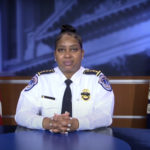
Acting U.S. Capitol Police Chief Yogananda Pittman testified before Congress on Thursday, facing questions from lawmakers who argued the U.S. Capitol Police were unprepared and poorly organized for a deadly U.S. Capitol insurrection that far-right groups and white supremacists planned in the open.
Pittman acknowledged that the department’s intelligence division prepared reports ahead of Jan. 6 based on information from the FBI and other sources. She testified that her department was aware, through these reports, that militia members, white supremacists, and other extremist groups planned to come to D.C. on Jan. 6, planned to be armed, and intended to target Congress.
But in response to questions about why the police force was not prepared, Pittman said her department did not foresee how big the crowd would be. (Pittman became acting chief on Jan. 17 after Steven Sund, who led the police force during the insurrection, resigned.)
“Since [Jan. 6], it has been suggested that the department was either ignorant of or ignored critical intelligence that an attack … would occur,” said Pittman. But, Pittman added, in her view, the intelligence did not suggest that a crowd of the size seen on Jan. 6 would form and violently storm the Capitol.
Pittman said there was intelligence to suggest that organized groups were planning to storm the Capitol, but she claimed that there was no intelligence to suggest how many additional people would participate and take on a “mob mentality” in the violent insurrection. When that mob formed, Pittman said the police force could not have stopped it, despite extra security measures they took in anticipation of the day’s events.
“To stop a mob of tens of thousands requires more than a police force,” said Pittman. “It requires physical infrastructure or a regiment of soldiers.”
Two U.S. Capitol Police officers died in the aftermath of the insurrection. One officer, Brian Sicknick, died from injuries he sustained during the rampage. Capitol Police Officer Howard Liebengood also died by suicide after mobs stormed the building, according to his family. Jeffrey Smith, a Metropolitan Police Department officer who responded to the scene, also died by suicide in the days following the incident.
In her testimony, Pittman also said she does not consider Jan. 6 or the inauguration of President Joe Biden to be the end of imminent threats to the U.S. Capitol — adding that some militia groups have discussed an effort to “blow up the Capitol” in connection with the upcoming State of the Union address, which has not yet been scheduled.
In the aftermath of the attack on the capitol, Pittman said her department was focused on shoring up the flow of communication about intelligence and improving its emergency alert system. Internally, Pittman said she was also focused on supporting officers in the department. The union representing capitol police officers recently issued a no-confidence vote in the agency’s top leadership.
Acting Sergeant-at-Arms Timothy Blodgett also testified Thursday, calling the intelligence reports that law enforcement officials received prior to Jan. 6 “muddled” and “contradictory,” and said they did not clearly represent the threat to the U.S. Capitol.
“The intelligence missteps cascaded into inadequate preparation,” said Blodgett.
Blodgett testified that there were serious breakdowns in communication to capitol police officerson the ground during the insurrection. Communication between U.S. Capitol Police officers was so poor, he said, that when members of Congress or their staff were trapped in their offices that day, the system of safely extracting them was “dependent on [his] staff being notified.”
Six officers were suspended with pay and 35 were investigated for their behavior during the Jan. 6 attack, which in some cases included taking selfies with the insurrectionists. Pittman testified Thursday that those investigations are still ongoing.
In response to questions about whether a culture of racism persisted in the U.S. Capitol Police department and contributed to the failures of Jan. 6, Pittman pointed to her historic appointment as the first Black woman to lead the department.
“I take any allegation of inequitable policing seriously,” said Pittman. “I can assure you that under my command, USCP will continue to police equitably. I have no evidence whatsoever to suggest that there was any discrepancy [in] our security posture … based upon race.”
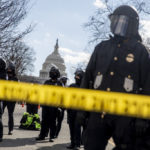
The U.S. Capitol’s continued security posture — including the fencing around the U.S. Capitol — also presented a line of questioning.
Rep. Jaime Herrera Beutler (R-WA) expressed concerns about the persistence of a security perimeter with fencing around the U.S. Capitol — which she said was costing the government $2 million per week to maintain. Beutler joins a chorus of both Republican and Democratic lawmakers calling for the fence to come down.
Local D.C. officials and residents have been pushing U.S. Capitol Police to take the fence down — and D.C. Del. Eleanor Holmes Norton has introduced legislation to ban permanent fencing around the U.S. Capitol.
“Sacrificing the openness of this institution is not the only way to keep the Capitol Secure,” said Beutler. “I don’t like that there’s a fence around the Capitol complex.”
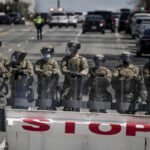
But one reason Pittman gave for the persistence of the security posture around the Capitol is continued threats from the far-right militias that participated in the insurrection.
“We know that members of the militia groups that were present on Jan. 6 have stated their desires that they want to blow up the Capitol and kill as many members as possible, with a direct nexus to the State of the Union,” said Pittman. “So based on that information, we think that it’s prudent that Capitol Police maintain its enhanced and robust security posture until we address those vulnerabilities going forward.”
“It won’t be as fast as some people want, and it won’t be as long as other people want,” said Sergeant-at-Arms Blodgett on the timing of the fence’s removal.