Colleen Grablick
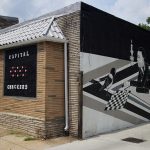
After nearly 40 years at its Shaw outpost, the Capital Pool Checkers Association is searching for a new clubhouse. The landlord that owns the building where the group gathers is selling the building, and the membership-financed club can’t afford to stay.
“The future of checkers in D.C. … I see it as a doctor with a stethoscope looking at a patient with a puzzled look,” says Talmadge Roberts, club president and a 90-year-old Washingtonian who’s been playing checkers in D.C. since he moved to the city as a Howard University student in the 1950s.
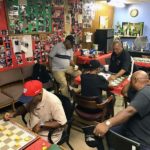
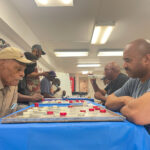
The group moved into its S Street spot, one block away from the Howard University Metro stop, in the 1980s, when rent cost around $75 a month, Roberts says. Members play pool checkers — a game much like the popular straight checkers, except players can move pieces both forward and backward. The game is popular in the southern United States, where it’s believed to have been passed down for hundreds of years.
Current landlord Jackie Foster confirmed to DCist that the building’s sale is pending as of a few weeks ago, but has not been finalized. She says she decided to sell for personal reasons and difficulties related to the pandemic. She adds that she has offered to help the club find a new home, acknowledging the high rent prices in D.C
The club is scouting out potential leasing options, but most of them are far beyond the budget of Capital Checkers, according to Roberts and Jonah Gold, a five-year club member. After hearing that Capital Checkers would need to move by late March, Gold started a GoFundMe to cover moving costs, and hopefully some of the rent at their new home.
“In D.C., as it’s just gotten so expensive, it’s really hard to identify a space that they’re going to be able to continue to call their own,” Gold says.
The organization funds itself solely on membership fees and occasional fundraisers, but the group’s numbers have dwindled over the decades. Before moving into its clubhouse, the players — then in their 30s or 40s — matched up in barber shops. At its peak, the club had nearly 60 members, according Roberts, who is more commonly known in the clubhouse as “Razor,” for his precise game-play that’s similar to the “dexterity of a surgeon using a scalpel,” he says.
Losing the club’s gathering place would be devastating for the roughly 20 core members left — many who have been matching off against each other for years — and for the game of checkers in D.C., Roberts says.
Throughout the years in Shaw, club members would volunteer at elementary schools for after-hours checkers clubs and encourage children in the community to stop by and learn the game — efforts to keep checkers alive that could be diminished without a physical gathering place.
“Ultimately, if we don’t keep driving this thing and recruiting new members, at some point in time there will not be any members,” Roberts says, adding that the popularity of video games has decreased youth interest in board games.
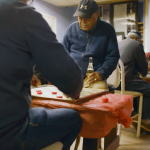
During the pandemic, Roberts and Gold say they’ve been meeting in small groups (fewer than 10 players) at the clubhouse, masked and bundled. With a broken furnace, the members rely on space heaters and layers of long johns to stay warm during marathon games.
For Gold, one of the club’s youngest players, finding a physical place to play is imperative to maintain the sense of community the club provides for its members.
“I think the priority for them is they don’t want to go too long without a space because these players are old, and this is their main social outlet, amidst COVID,” Gold says. “And I think they’re worried that if they don’t have a place to play, that the club will kind of dissipate and they won’t be able to kind of keep momentum to get a place later.”
But as the Shaw area has gotten increasingly popular (and expensive), neither Gold nor Roberts are sure how Capital Checkers could afford to stay in its current neighborhood. One of the leasing options they checked out came with rents upwards of $8,000 a month, according to Roberts.
“Everything I guess must change, but the downside of this kind of change is that change should benefit almost everybody,” Roberts says. “The way gentrification is working in D.C. and in our case … change for the benefit of everybody is not happening.”
Since its launch, Gold’s GoFundMe raised more than $2,400, a tally he says reflects the importance of the club in its surrounding community, and a sign of support that’s lifted the members’ spirits.
“I think without the community’s support, it would be really difficult to imagine what the club would do next,” Gold says. “So I’m very thankful to the people who have donated.”