Ally Schweitzer
The Washington metro area has a long way to go before it meets a widely touted regional goal to build 375,000 affordably priced homes by 2030.
That’s according to an analysis released Tuesday by the D.C.-based Housing Association of Nonprofit Developers. The organization’s new Housing Indicator Tool shows that while multiple local governments have lauded — and in some cases officially adopted — regional housing goals established by the Metropolitan Washington Council of Governments in 2019, most local jurisdictions are not on track to actually meet those targets.
“In a region with over 10 million people, access to affordable housing is unequal, out of reach for those in need, and not meeting pace with demand,” HAND Executive Director Heather Raspberry said in a statement.
Economists, housing advocates and supporters of “smart growth” policies in the region have stressed the importance of building thousands more homes to reduce overall housing prices, which rise when there aren’t enough homes to meet demand. Building housing that’s affordable to moderate- and low-income households and close to mass transit is essential to maintaining a strong workforce, reducing traffic congestion, preventing homelessness, and fostering equity and racial diversity, advocates say.
Yet the D.C. region has built just 12% of the new homes the Urban Institute says are needed by 2030 to meet demand and cool skyrocketing housing costs, according to HAND. Funding and preserving affordable housing is costly and often controversial, Raspberry says, and many local leaders haven’t shown a willingness to do the work — and spend the money — that is necessary.
“Do you have a plan in place? Does it prioritize affordable housing? Does it prioritize the prevention of displacement?” Raspberry says. “Are you creating an environment that is inviting developers to come in and do this work? Because it’s expensive work.”
All of these steps are “critical” to toppling the region’s housing shortage, reducing gentrification and lowering prices, Raspberry says.
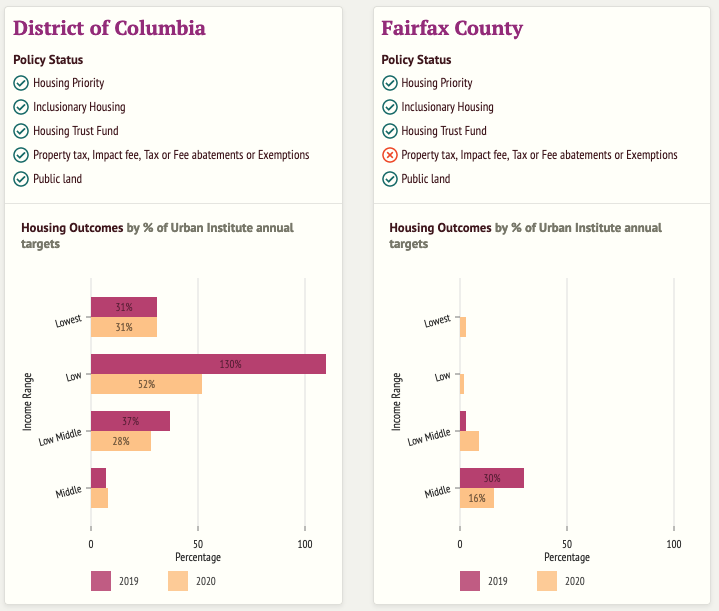
Some jurisdictions are building more homes than others. Of 10 localities analyzed by HAND’s Housing Indicator Tool, D.C. and Arlington County are closest to meeting some affordable housing targets recommended by the Urban Institute.
The District has created the most housing for low-income residents, but is still falling short of homes for very low-income people. Some activists and advocates for low-income residents in D.C. have criticized Mayor Muriel Bowser for allowing market-rate housing to flourish, while not dedicating more funds and crafting policy to encourage homes for the neediest residents.
For its part, Arlington County has excelled at adding more homes for low-middle-income households, but has built virtually none for the most vulnerable households in the last two years.
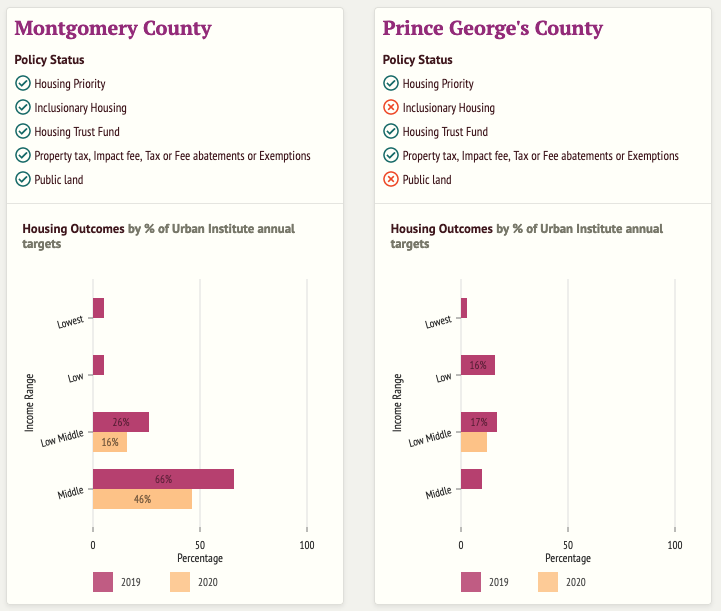
In Maryland, Montgomery County built a fair amount of housing for middle-income residents in 2019 and 2020, but not enough for lower-income groups, despite having policies in place to encourage new affordable housing construction, according to HAND. The tool shows that Frederick County has made only slight progress, and Prince George’s County has built little new housing across the board.
Fairfax County built some homes for middle-income households in 2019, but progress slowed in 2020. Charles County in Maryland has added scarcely any new housing for middle- to low-income households.
The tool uses price bands to define affordability. Homes where housing costs don’t exceed $799 a month are considered within reach to the lowest-income households. Low-income housing is $800 to $1,299; low-middle is $1,300 to $1,799; and middle is $1,800 to $2,499.
Of the 375,000 new homes the region needs, according to the Urban Institute, nearly 80% of them must be affordable to middle-income and low-income households to meet projected demand.
Raspberry says governments must quickly adopt pro-housing policies and forge relationships with the private sector and philanthropic organizations to get more housing built. Leaders must also summon the will to challenge homeowners who fight new housing in their communities, Raspberry says.
“There’s a lot of NIMBYs [Not In My Backyard] that obstruct and derail the affordable housing attempts that are being made, but we have to boldly say that’s unacceptable,” Raspberry says.
The director says now is an especially opportune time to do that, as many local residents have been harmed financially by the pandemic, and driven to activism in the wake of last summer’s uprisings for racial justice.
“There’s more recognition than we’ve ever seen over the last year since the death of George Floyd and the many demonstrations and tragic incidents that have followed,” Raspberry says. “It has forced this extraordinary discussion about racism in America.”
“We know the very fabric of our society is woven tight with policies and programs that are intended to maintain the status quo,” Raspberry adds. “And if we want to change that trajectory, we’ve got to be intentional.”