 Jordan Pascale
The District Department of Transportation is ending one of its pandemic initiatives that had mixed reviews.
The “slow streets” program attempted to create safer neighborhood streets for families to walk and bike, helping to accommodate six feet of social distancing. While the idea had community support, the implementation and enforcement never materialized quite as many had hoped.
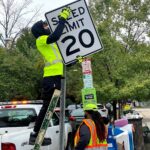
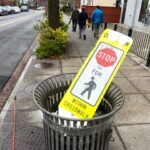
The District installed 22 miles of “slow streets” in seven wards (Ward 8 opted out) last summer. The pilot project lowered the speed limit to 15 miles per hour and put out barricades that instructed “local traffic only.” The signs were often moved, hit, or ignored by drivers.
Now, the restrictions on those spaces will disappear at the end of May.
DDOT says it will re-evaluate the program, and the agency is asking residents to weigh in on their experiences.
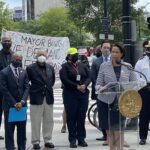
“We are committed to reviewing the lessons learned from this experiment,” interim DDOT director Everett Lott said during a D.C. Council Transportation Committee hearing on the future of transportation after the pandemic. “It was conceived and implemented on a very quick turnaround during the emergency and we seek a permanent and more effective strategy to safely create spaces for people.”
Several residents testified that there was a lack of enforcement and that the slow streets should have been a contiguous or connected network, instead of one-off stretches. They also argued that signage needed to be more clear for drivers.
Ward 6 Councilmember Charles Allen said much of the DDOT efforts during the pandemic, like streateries and bus lanes, were good, but the slow streets didn’t go far enough.
“I don’t think we’d have been as aggressive with our public space as we could be,” he said. “We’ve given up so much space for the convenience of a car in a neighborhood.”
He recalled one day early in the pandemic when a tree fell into his street. With the street blocked off, it became a de-facto playground.
“Kids were out on their bikes and their scooters, neighbors were out talking to each other from across the street,” he said. “And that moment stuck out for me because it really was a moment when everyone desperately needed more safe outdoor space.”
And his experience with the slow street on G Street NE was a bad one — his family lasted 30 seconds on the road before drivers sped through the area.
Lott said he’s also heard these criticisms and responses from residents who have advocated to close the streets off completely to vehicular traffic. ” I don’t know if that’s truly an option that we can consider,” Lott said. “But that is one of the things that we’ve heard.”
He said he would want more input from residents and advisory neighborhood commissions.
D.C. resident and Greater Greater Washington board member Nick Sementelli argued during his testimony that DDOT should to stop playing on the margins.
“(Slow streets) really didn’t make the kind of big changes that would allow someone to say, ‘OK, I don’t need to drive to work today,'” he said. “That’s the kind of question that we need to open up what’s really going to change people’s motives.”
The pandemic brought a host of other changes to the way we use city streets. The D.C. Council hearing also touched on streateries, bus-only lanes, and closing the upper portion of Beach Drive to traffic. The latter is a National Parks Service decision, but D.C. will provide input. Last October, NPS said the street would re-open to cars after the pandemic.
Many of the testifiers lauded streateries and the closure of Beach Drive and called for more bus lanes, as well as a better slow streets program.
Ward 3 Councilmember Mary Cheh, who chairs the transportation committee, said the District should seize the opportunity after the pandemic to reshape the transportation system.
“The pandemic has been hard on all of us, but there have been some benefits,” Cheh said. “We’ve seen a different future or the possibility of a different future. So we should jump on that.”
This story was updated with Councilmember Allen’s correct ward.