Debbie Truong
After the coronavirus reached the country with full force last March, Amy Zhai worried about leaving her house for daily walks. The high school student feared not only the deadly virus but also her physical safety as a young Chinese American woman.
Former President Donald Trump called it the “Chinese virus.” Reports of anti-Asian violence and discrimination started rising across the country as people sought to find scapegoats for the pandemic. The attacks alarmed Zhai, a 12th grade student at Richard Montgomery High School in Rockville, Md.
“I just felt so unnerved when we would walk by someone,” she said. “I just ended up not leaving the house for three months.”
More than a year later, as campuses gradually reopen, Zhai said some Asian American students in Montgomery County Public Schools are worried they will face bullying from other students about the virus if they return to classrooms. One student said she is forgoing in-person learning because of it.
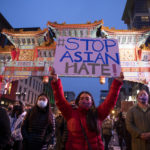
Discrimination and racist violence against Asian people have risen across the country in the last year. Fears were heightened last week after eight people, including six Asian women, were fatally shot at spas in Atlanta.
The Montgomery County school system issued a statement in February condemning the harassment and bullying Asian American students have faced during the pandemic. And after the shootings, Superintendent Jack R. Smith and Board of Education President Brenda Wolff urged parents and students to report any hateful behavior.
Still, some Asian students in Montgomery County, a racially diverse and progressive D.C. suburb, lamented the school system did not do or say more in the days after the shootings.
At the same time, some Asian American students say the rise in anti-Asian hate and the conversations spurred by the Black Lives Matter protests last year, has prompted them to reflect on their own racial identity. Some are delving into their personal histories and researching issues affecting Asian communities, topics they say get short shrift in American public education.
Zhai, who is co-president of the newly formed Asian American Progressive Student Union, said the school system offers many clubs where Asian students can celebrate their culture and heritage. But she said conversations about violence and discrimination have been overlooked.
“This type of ethnic scapegoating hasn’t happened to us in all of our lifetimes as students,” the 18-year-old said. “It’s strange to be going through this for the first time, and I don’t think it’s going to be the last time.”
Worries about safety
Zhai has started taking walks along the canal near her house again, but she is more vigilant about her surroundings and braces herself for the possibility of verbal harassment.
“I always mentally prepare myself that if someone says something to me, I can have a quick rejoinder,” she said. “I worry about … physical assaults, especially if I’m walking alone or with my mother, especially since these attacks are gendered.”
Stop AAPI Hate, a coalition of groups representing Asian Americans and Pacific Islanders, received nearly 3,800 reports of harassment and violence toward Asian Americans in the last year. Nearly 70 percent of people who submitted a report were women.
The group logged 140 incidents across D.C., Maryland, and Virginia — including at least one report of a professor echoing Trump’s racist rhetoric. Local Asian American business owners have reported months of racist violence and verbal harassment.
In the weeks before schools closed last year, Alanna Li said a few classmates at Thomas S. Wootton High School in Rockville called her “corona.” On social media, she has come across posts from other students making jokes about Chinese people, as well as perpetuating stereotypes that fetishize Asian women. She started noticing neighbors glaring at her during runs.
More than 14 percent of students in Montgomery County Public Schools are Asian, according to school system data. At Wootton, which sits in a part of the county with a large Chinese population, more than 37 percent of students are Asian.
Large numbers of Asian students also attend schools in Northern Virginia. In Fairfax County Public Schools, the state’s largest school system, nearly 20 percent of students are Asian. In Loudoun County, 24 percent of public schoolchildren are Asian.
“When people go to a largely Asian school, it makes them almost less vigilant about issues that affect the Asian American community,” Li said. “They can say, ‘oh, I have Asian friends and so therefore I’m not racist.’”
She plans on sticking with virtual school for as long as possible.
“I’m not a fan of online learning,” Li said. “But I think it’s almost better because I’m removed from a community that could potentially harm me.”
Claire Gelillo, a senior at Richard Montgomery who is Filipina and white, said she has always wondered how others perceive her. Some people assume she is Latina and others view her as fully white.
“That’s sort of always been an identity thing for me — wondering the way the world sees me, just out of my own curiosity,” the 18-year-old said.
But now Gelillo fears the way other people see her could lead to violence.
“That internal questioning has become part of my personal safety in a way that’s never been before,” she said. “I’m fearful that if I go out in public and a certain person perceives me as an Asian person, that they would want to commit an act of violence against me.”
Looking ahead
As more students prepare to return to in-person instruction in the fall, schools should start planning to address the racial trauma young people have endured, said Akil Vohra, the executive director of Asian American LEAD, which supports underserved Asian American students in the Washington region.
The organization has focused on bolstering mental health support to students during the pandemic, according to Ari Pak, the programs director of Asian American LEAD. Staff members are checking on students more frequently, meeting with them individually or in small groups at least twice a month.
Pak said students are dealing with layers of trauma from the cumulative stress of distance learning, the pandemic, financial uncertainty and worries about violence against Asian people.
“These pieces are all individual traumas that our youth are internalizing and processing,” Pak said.
A recent study from the University of Maryland, Baltimore County found Chinese American families are experiencing extremely high rates of racism and discrimination related to COVID-19.
Researchers surveyed or interviewed more than 500 Chinese American parents and their children. They found nearly everyone had experienced or witnessed racial discrimination against Asian American people at least once throughout the pandemic. One in four people reported witnessing racial discrimination every day.
This has led to higher rates of anxiety and depressive symptoms among Chinese American youth, according to Charissa Cheah, a psychology professor at UMBC who led the research.
“My hope for highlighting this part of the study is for parents to know that they need to be more proactive in talking to their children about what’s happening,” she said.
Many young Asian American activists have aligned themselves with the Black Lives Matter movement and organized with Latino peers to advocate for immigrants, Cheah said. Now more Asian American students are speaking up and educating classmates and teachers about anti-Asian discrimination.
“What we’re seeing now is this sense that there is a need to have initiatives that are focused specifically on Asian American experiences because our voices have been invisible for so long,” she said.
Aryani Ong, founder and co-director of the advocacy group Montgomery County Progressive Asian American Network, said she is helping plan a series of virtual listening sessions where students can express concerns and make suggestions about addressing anti-Asian sentiment in the community.
Ong, a former civil rights attorney, said educators should check on students and ask what they need to feel safe.
“That’s a precondition before they can learn,” she said.
‘No one talked about it’
Kelly Ji has participated in class discussions about the sexualization of women. She has called on the county to remove police officers in schools, a common demand among Black Lives Matter activists who argue Black and Brown children are over-policed in schools.
But even as she advocated for others, the 16-year-old said it was not until recently that she began thinking critically about her place in the world as an Asian American.
“Even though I was racially woke or actively looking for justice, I was kind of denying the people around me,” Ji said of living in a heavily Asian community. “But as anti-Asian hate crimes pick up and as I feel more a part of that just because of how people perceive me, I have to figure that out.”
Growing up, the 11th grade student at Wootton said she avoided interests she thought would make others perceive her as a “stereotypical” Asian person. She “wanted to be white.”
That started to change in high school. After her family experienced a racist encounter on vacation more than a year ago, and amid the country’s racial reckoning, Ji said she is learning to be proud of her community and advocate for it.
The teenager started noticing her classes never offered opportunities to talk about the spike in anti-Asian violence. After the shooting last week, she said her teachers did not check to see how students were feeling, as some did in the aftermath of other national tragedies, including the insurrection at the U.S. Capitol.
“No one talked about it,” she said.
Derek Turner, a spokesperson for Montgomery County Public Schools, said in an emailed statement that discussions about bias and violence in schools is critical. The school system sent a newsletter earlier this week that included resources for staff members to talk with students about anti-Asian racism.
“We as a school system have a responsibility to find new ways to address it with our students,” Turner said.
But conversations about the shootings were also absent from Paris Ye’s virtual classes at Richard Montgomery. The 10th grade student said she is accustomed to having people overlook anti-Asian racism.
“It still feels a little bit weird for me to talk about these things or be asked about these things because I never am,” Ye said. “That’s probably something we need to change, and we probably need to be having these conversations in classes.”
It was not until recently, after joining the Asian American Progressive Student Union, that Ye began learning about Asian American activism and solidarity between Asian and Black communities — topics she has never encountered in school curricula. The student group has also led discussions on colorism and beauty standards.
After the shootings in Georgia, Ye said it was strange to see violence against Asian people gain national attention. She questioned why it took so long for many people to start paying attention when the coronavirus pandemic has exacerbated anti-Asian sentiment over the last year.
“Having it in the spotlight now really shows how it never really was before,” she said. “It makes me sad that it has to get this bad for it to really be in the general conversation … it feels like it’s so late.”