 Jenny Gathright
On his way to The Fields at RFK Campus on Saturday, Evan Ross Solomon was thinking about a single musical note: an A. Ross Solomon, the artistic director and a principal conductor of the D.C. Youth Orchestra, was getting ready to lead his first in-person rehearsal in more than a year.
“I think just to hear the first A when the orchestra tunes is gonna be like panacea,” he said, as students were setting up their sheet music and warming up. “Usually, it’s the most mundane thing. It’s the start of rehearsal. But now I think it’s going to represent the start of our return to playing together, playing outdoors here in a beautiful space.”
The D.C. Youth Orchestra Program, which offers music programs for students from age 4 to 18, never stopped practicing or performing during the pandemic, but students kept themselves muted during Zoom rehearsals, and concerts were essentially videos of students performing their parts from home.
Saturday was a momentous step forward: The group held an in-person, outdoor rehearsal with a group of about 20 students, mostly high schoolers. And for the young people who met at RFK, the return to rehearsing face-to-face was a sign that perhaps, one day soon, their lives could return to some semblance of normal.
“This is something that’s a big part of my life, and because it’s been off for so long, now that we’re back, it feels like a part that has been restored,” said John Joire, a 17 year old French horn player who has been in the DC Youth Orchestra Program since he was four years old.
Some students were so eager to see each other and play together, they showed up early for the practice.
“They weren’t supposed to be here until maybe like 11:45 and of course—typical— our kids get there an hour before, just ready to play,” said Assistant Program Director Rashida Coleman, who was in the orchestra herself as a young person.
After their warmups and distanced greetings (the students were instructed not to hug each other), the musicians sat down and sounded the A. Some let out a brief cheer, but then the rehearsal proceeded with little fanfare as the ensemble launched into rehearsing their first piece, a composition by Samuel Coleridge-Taylor.
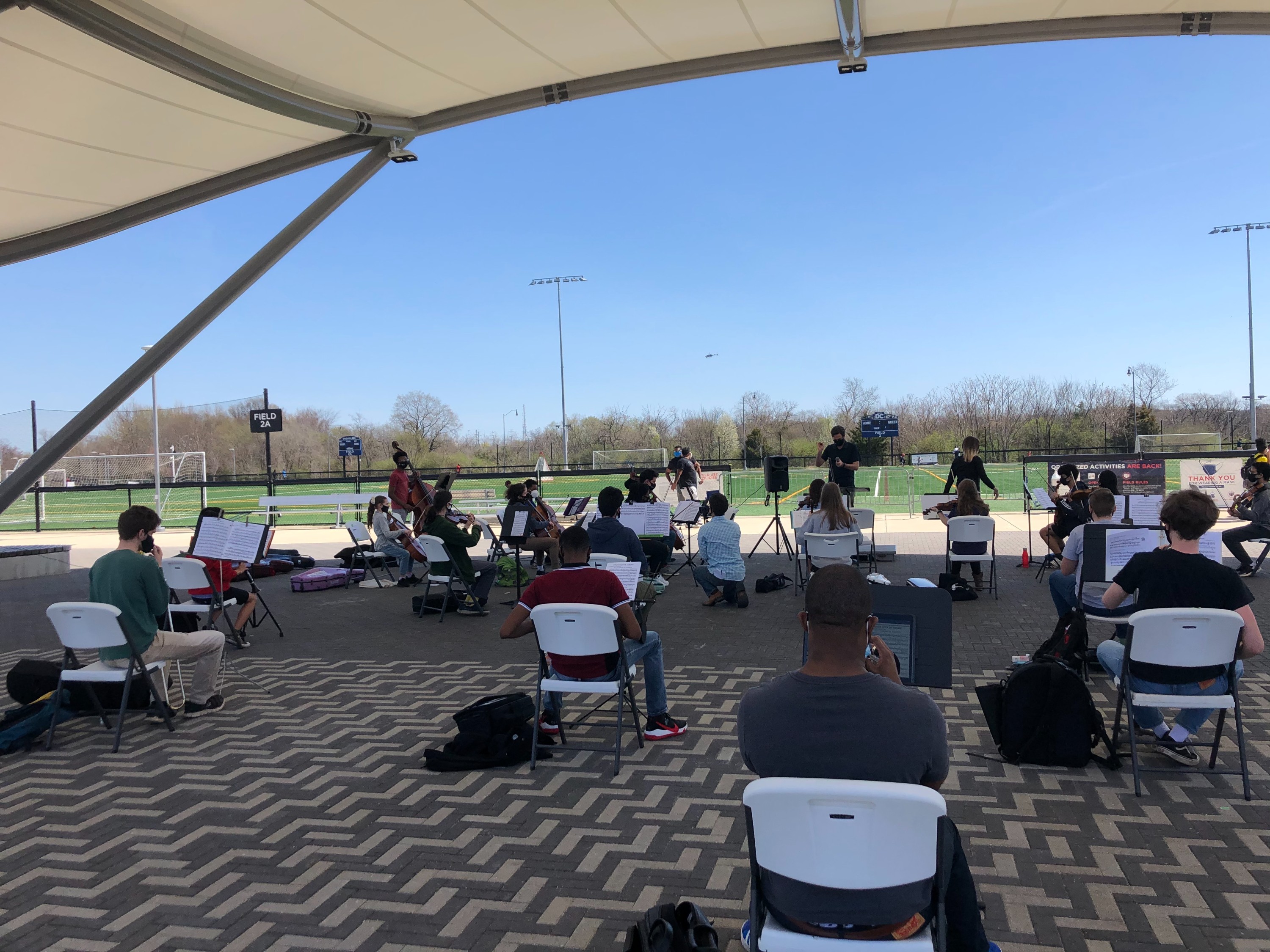
It felt like a fairly routine rehearsal—apart from the health precautions the orchestra put into place. The event was outside and capped at 30 people. Everyone wore masks. And the wind and horn sections were especially careful, since they’re blowing air—and thus, potentially, viral droplets. Their chairs were spaced farther apart than everyone else’s, they had special masks with slits in them to access their mouthpieces, and they put covers over their horns to stop droplets. It was a little inconvenient, but the students didn’t seem to mind.
“If it’s safer for all of us and if it lets this happen, then I don’t mind doing it at all,” said Matthew Haymes, a 16-year-old French horn player.
The special masks and precautions were a reminder of the current state of the pandemic. The daily rate of coronavirus cases in D.C. is currently well below the January peak, and thousands of residents are getting vaccinated each week, but public health experts say D.C. is not out of the woods yet. The case rate throughout the region—and across the country—has been ticking up in recent weeks and is still above where it was this time last year.
Still, as the weather gets warmer, it feels like space for safer gatherings outdoors has opened up.
“Honestly, it’s emotional,” said Kenneth Whitley, one of the orchestra’s principal conductors, as he watched the group of young people play. “We could not hear anything for the last year. When I’m … conducting on Zoom, they can see me, I can see them, but it’s in silence.”
And Whitley says even after a year of Zoom rehearsal, the students sounded good— perhaps a sign that the self-reliance they gained when rehearsing independently was paying off.
“This is already showing me how much they’ve grown. How much independence they’ve developed,” Whitley said. “To have rehearsal one with just 20 to 23 students, sounding like this, that tells me that everybody has really been working hard.”
The transition to live rehearsal wasn’t without some adjustment, but the ensemble’s confidence grew with time.
“When the kids first started, they were shy and a little bit inside themselves, which is not surprising given the year that we’ve all had,” said Liz Schurgin, the DC Youth Orchestra Program’s Executive Director. “As the music went on, they began to open up—and I could feel it. I could feel what they were experiencing.”
Onlookers, who were gathered around RFK to play sports, enjoy the weather, and hold cookouts in the parking lot, smiled as they passed the orchestra.
Whitley said that throughout its 60-year history, the youth orchestra has been a particular point of pride for the city. The group is affordable to join, with sliding-scale tuition. It draws young people from all eight wards of D.C., along with the Maryland and Virginia suburbs, and it’s reflective of the region’s demographics: 59% of the students in the program identify as African-American.
“For years, and certainly when I was a student, every time the youth orchestra would go on an international tour, Washington D.C. just felt good about that,” Whitley said. “Because there are always many students of color in the program and in the orchestra … it became a highlight. The community could say that’s ours, and we feel really good about that.”
The organization hopes to expand the outdoor rehearsals to the rest of its students in April, while still keeping a virtual option for students who would prefer to rehearse from home. And its leaders plan to put together an outdoor concert in the area sometime in the coming months—though they’re prepared to do another virtual concert if conditions require it.
“As with everything COVID-related, there are five options on the table at any given moment,” Whitley said.
After 90 minutes of playing, the orchestra packed up and left.
“I’m really, really excited,” said 18-year-old Nailah Harris as she put away her cello. Harris said even though the group had been rehearsing the music on their own for months, putting it together in person felt different. “I’m hoping this step can help people come together and play music again. It’s kind of pushing people towards going out and being creative.”
The ensemble that played on Saturday was mostly composed of teenagers who had been doing schooling virtually for much of the past year, and hadn’t been able to see friends as often or at all.
“You know like movies and shows that show a high school experience? [Going] to parties, [hanging] out with friends … you feel like you’re missing out on something that could have been if not for COVID,” Joire said.
But on Saturday, he got at least one small piece of his former life back.
“For my kids, getting together and playing music with an ensemble is like oxygen,” said his mother, Lisa Joire.
After all of the students left, one straggling sweater remained. Coleman grabbed it for Lost and Found—perhaps the most poignant sign that some things don’t change, even during a world-shifting pandemic.