Martin Austermuhle
Optimus Prime may have survived a crash landing on pre-historic earth and the many battles with the Decepticons that followed, but he’s likely not going to escape the Old Georgetown Board alive.
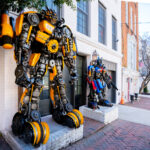
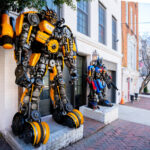
Members of the federal board charged with reviewing any changes to the exterior of Georgetown’s historic homes hinted Thursday that two large Transformers sculptures placed outside a house on Prospect Street NW — one of Optimus Prime, the other of Bumblebee — will likely have to come down because they don’t comport with the neighborhood’s historic character.
“This really puts us in a position of having to look like the old curmudgeon bad guys and girls. But it’s certainly not appropriate for a historic district,” said H. Alan Brangman, chairman of the three-person Old Georgetown Board, speaking late Thursday afternoon.
The massive metal sculptures are made of real car parts and each weighs about two tons. They belong to Dr. Newton Howard, a brain scientist at Georgetown University with an affinity for “sentient living autonomous robots who can transform into other forms,” as his architect and zoning expert, Stephen duPont, told the board in trying to explain what Transformers are. (“The Wikipedia entry is 15 pages long. Toys sell for hundreds of dollars. I was not that familiar with these,” duPont said.)
Howard installed the Autobots on planters outside of his front door in January. And thus began the brutal battle of robots versus, well, Georgetown.
The planters are technically in public space, and some of Howard’s neighbors argued he needed a public space permit from the Old Georgetown Board to display the robotic duo. Howard responded that he never needed a permit just to have traditional plants outside his home, so the Transformers shouldn’t be treated any differently. Some neighbors disagreed, adding that Optimus Prime and Bumblebee don’t much match the neighborhood’s 230-year-old history. (The debate started last month in the Advisory Neighborhood Commission representing the area, but they said the Old Georgetown Board had to weigh in first.)
Arguing Howard’s case to the board, duPont said the sculptures are art — and should thus be allowed to remain standing sentry outside the Prospect Street house.
“What has caught my attention is the artistry of this particular endeavor. The fabricator really went to town using automotive components and putting together structures that are really good representations of the original characters. The characters have good gesture. They’re really quite remarkable,” he said.
But in a letter to the board, the Citizens Association of Georgetown argued that good art or not, the sculptures don’t fit in the neighborhood’s historic character.
“Prospect Street like many residential streets is characterized by attached houses built to the property line abutting public space. While planters are normally found in this zone, monumentally scaled sculptures are not. There is also no historic precedent for displaying sculptures on public space abutting the primary facade,” wrote the group.
Mary Catherine Bogard, a historic preservation specialist with the board, seemed to agree, noting that the Transformers weren’t just any type of sculpture. “They depict a commercial character, and skirt the edge of proprietary product promotion, perhaps, and this is an important recommendation for the board for the precedent it could set,” she said.
The issue of precedent was on the minds of the directors of the Prospect Street Citizens Association, who submitted a resolution opposing the presence of Optimus Prime and Bumblebee in their neighborhood. “The approval would create a precedent that homeowners in Georgetown would be able to use public space to display structures of whatever size, content or design,” they wrote. (Last month, one Prospect Street neighbor said they could inspire someone to erect a statue of Joseph Stalin outside their home.)
But for some, possible precedent mattered less than what they said the sculptures brought to the neighborhood.
“I like the Transformers. My leg is in a cast, but seeing the Transformers makes me happy. I hope you let them stay, it would be sad if they were taken away,” wrote Maddie, an 8-year-old who lives nearby, in a letter to the board. Her 5-year-old brother similarly chimed in: “I like the Transformers. I like walking to see them. Can you please let them say?”
Those pleas did little to sway the board members, who said they were duty bound to respect the rules — and process — of the historic district. Board member Amy Weinstein did say she’d be willing to support a temporary compromise.
“I’m very familiar with Transformers. I’ve walked on them in the dark across my living room floor when my son was into them and they hurt like hell,” she said. “I personally love these. My problem is that they’re in public space, and public space is public and we have ways to deal with approval of what can happen there. I think they’re clearly not compatible with the Georgetown historic district, and the fact that they’re in public space makes me come to the conclusion that I could support a temporary installation of them for maybe six to eights months more. They are fun and it is COVID pandemic times and people are out walking constantly. But as a permanent installation it’s inappropriate in the Georgetown historic district.”
Brangman also said he’d be willing to grant the Transformers a temporary reprieve. “If it’s not a temporary installation, then it’s not something the board would approve,” he told duPont.
Howard now has until Tuesday to decide whether to withdraw his public space permit request and instead pursue a permit for a temporary installation. But in an email to DCist/WAMU, he again raised the possibility of continuing the fight.
“Taking it all the way to the highest level of our court system if needs to be!” he said.
This post has been updated with a comment from Newton Howard.