 Jordan Pascale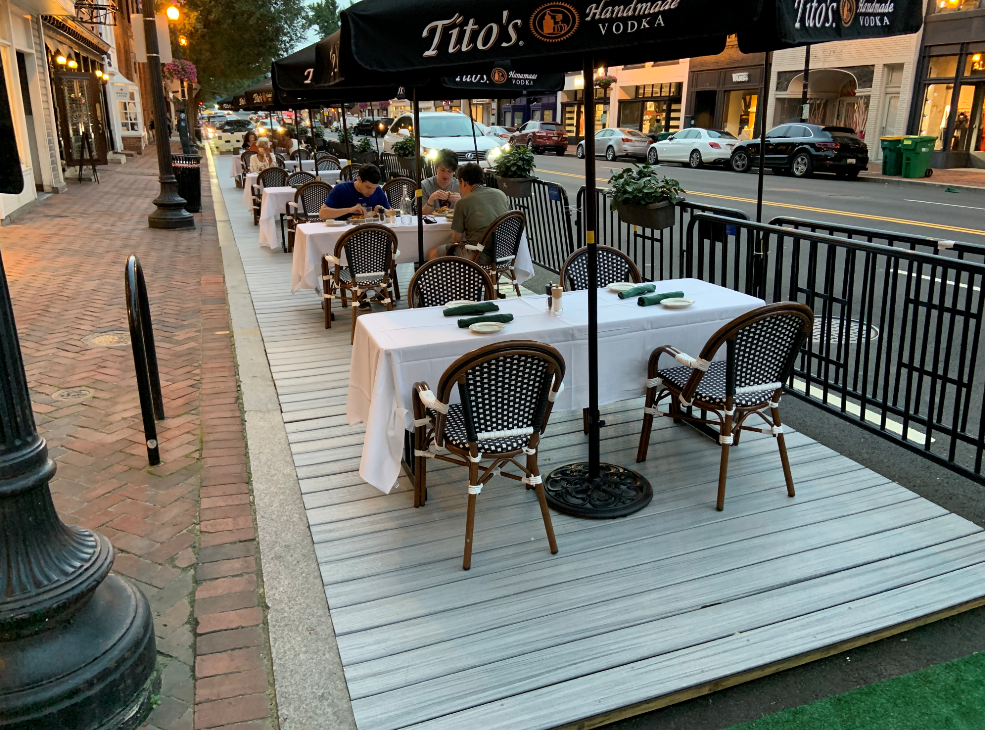
Georgetown is expanding its notoriously narrow sidewalks in the historic shopping district. The Business Improvement District is using a temporary deck-like material for more room for dining and walking.
The additional decking will add about five feet of space for pedestrians and restaurants to use as outdoor dining.
Nearly a mile of panels will be installed on parts of M St. NW from 29th St. to 34th St. and on Wisconsin Ave. between Q St. and the C&O Canal. Concrete and metal barriers will provide some protection from traffic.
“The deck extensions are designed to be accessible to those using a wheelchair or pushing a stroller, to allow stormwater to flow under the deck to the curb, and to keep storm drains and fire hydrants clear,” the BID said in a press release.
The new addition should be fully installed by mid-May and be in place through the end of the year. Then, the community will evaluate and decide what to do next with the project and apply for new permits if businesses and the community want to keep it.
Three prototypes are already installed at Clyde’s at 3236 M St. NW, Laduree at 3060 M St. NW, Thunder Burger at 3056 M St. NW, and L’Annexe at 2917 M St. NW.
“The goal of the Georgetown Decks is to help Georgetown recover from the pandemic by making it an even better place than it was before COVID,” the BID says.
Many cities have repurposed city streets during the pandemic to allow more room for outdoor dining and social distancing.
Restaurants can choose to have tables closer to the building and leave the decks open for walking, or they can put tables on the decks. That’s when concrete barriers will be installed around that entire section, in accordance with DDOT safety standards.
The BID says retailers may be able to use the decks as well for a sales area if the District allows such a permit.
The project is slated to cost about $1.3 million, with $500,000 coming from a District grant.