Matt Blitz
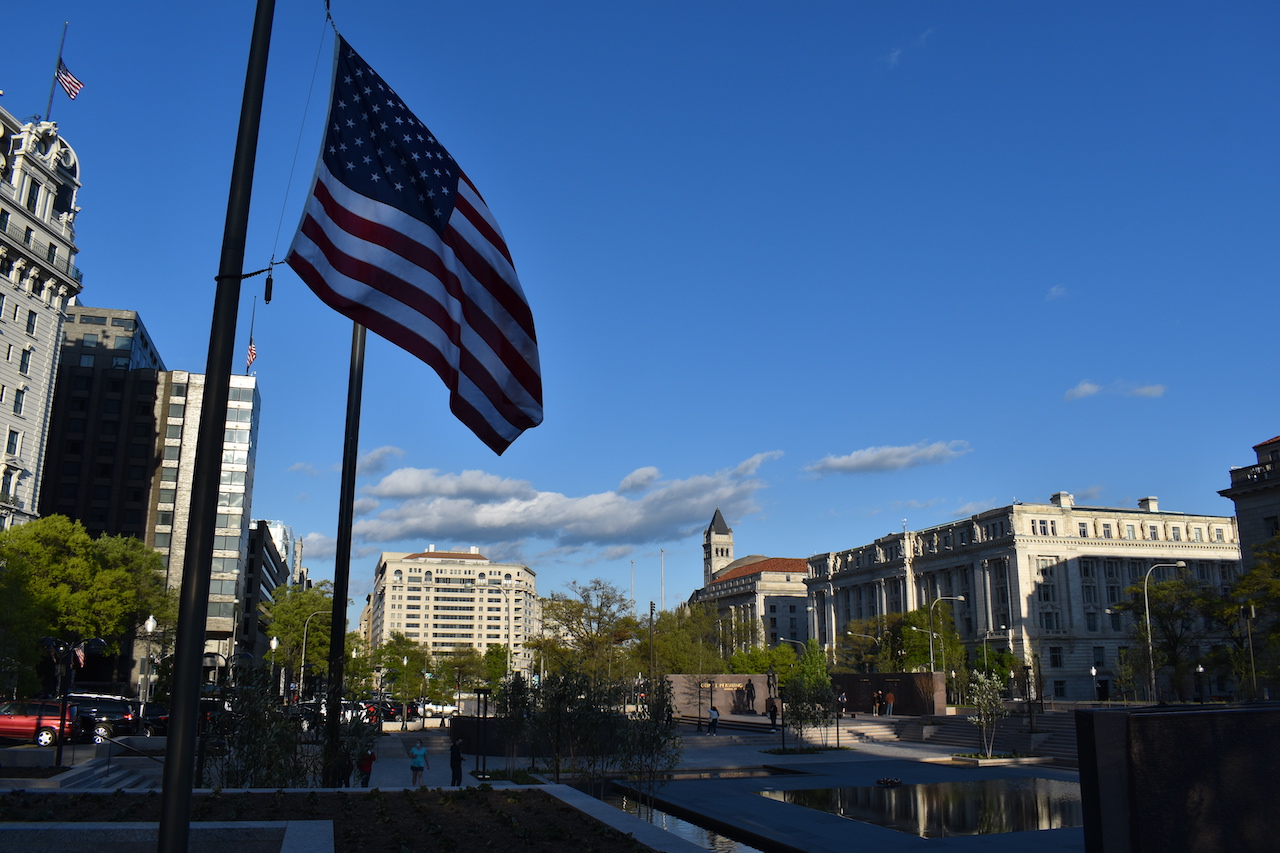
The sun is setting on Friday night at D.C.’s newest national memorial along Pennsylvania Avenue.
Earlier in the day, as part of a ceremony, a U.S. flag was raised for the first time signifying that the World War I Memorial in Pershing Park was now open to the public. There was also a fighter jet flyover that created a big boom.
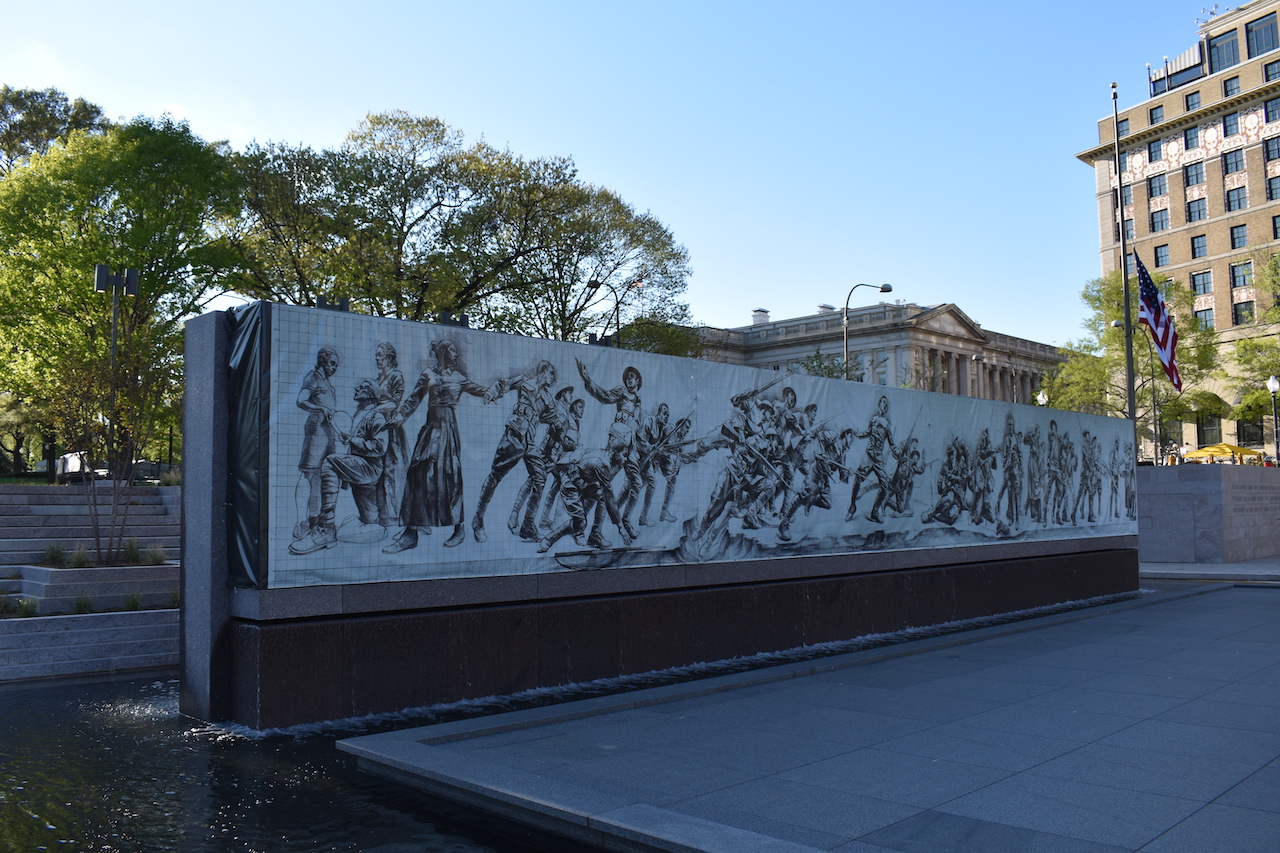
This despite it still missing its defining feature:“A Soldier’s Journey,” a sculpture that will be the largest free-standing bronze relief in the Western Hemisphere. While there’s a canvas stand-in, the real thing will not be installed for another three years.
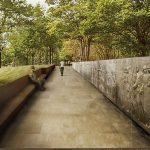
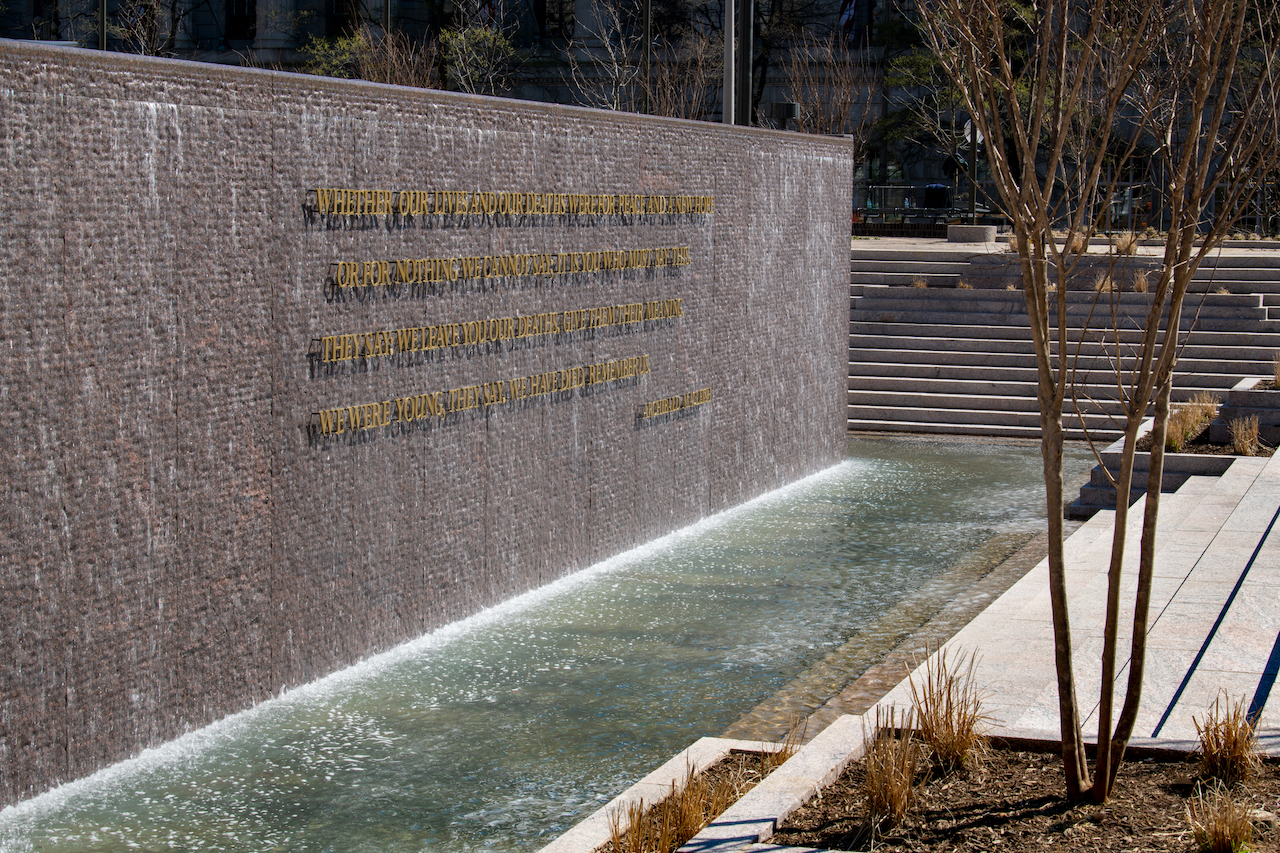
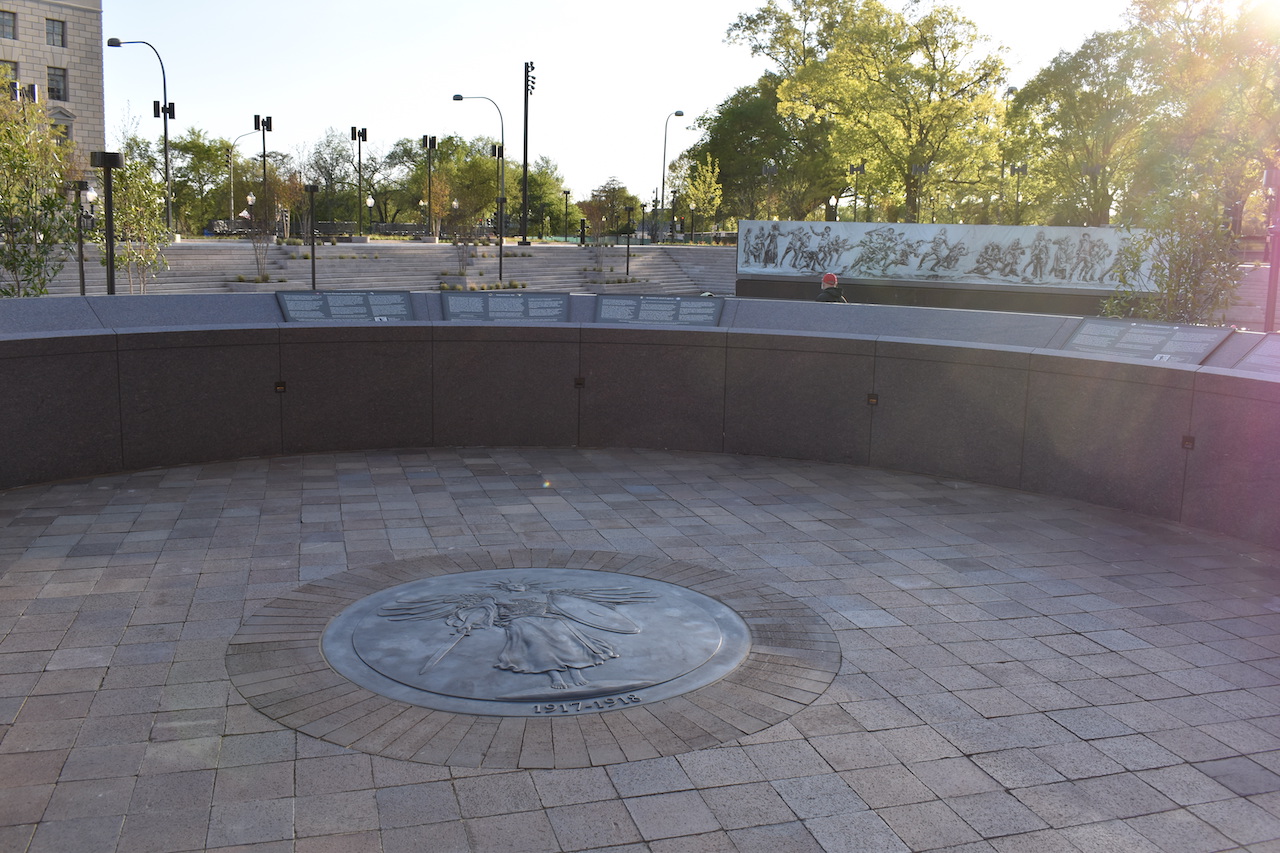
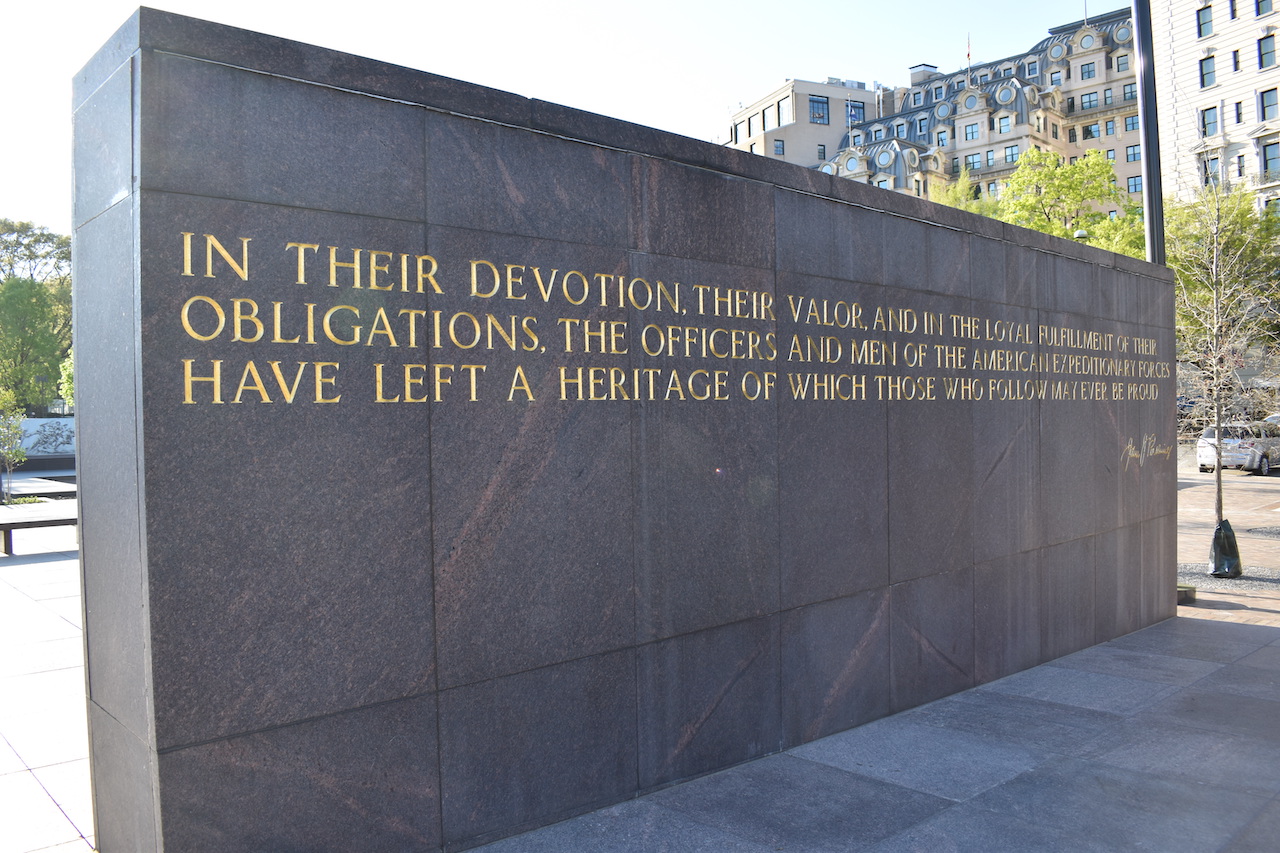
Here in the plaza, though, there’s still plenty to see. There are a number of water features, both still and animated. Engraved quotes, maps, and a brief history of the war line marbled walls.
There’s an enlarged victory medallion embedded in the ground. If a visitor stands in the middle, sound reverbs back to them creating an echo effect.
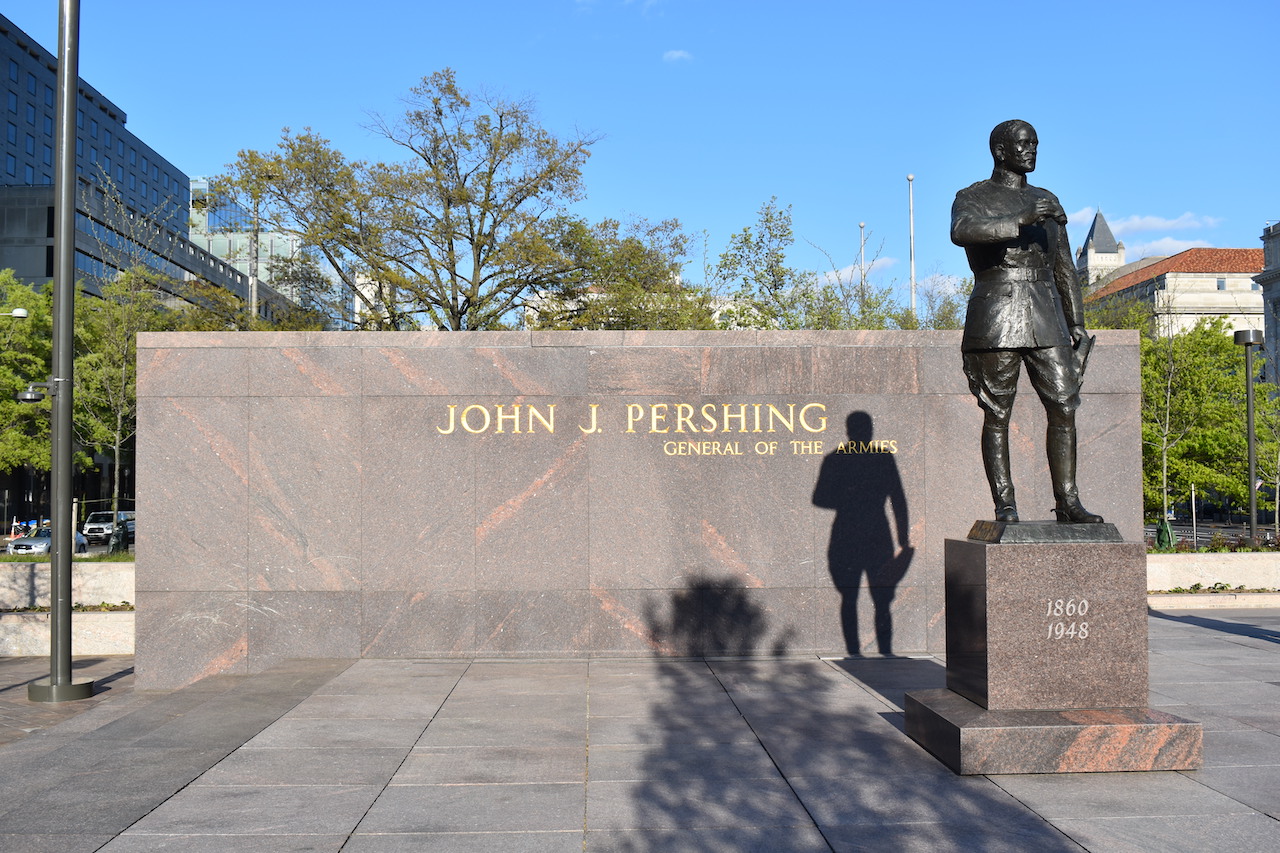
And there’s the statue of General John Pershing, a leftover remnant of the previous iteration of the park that stood in this space.
The memorial isn’t without its detractors. Like the Eisenhower Memorial, the project continues to be a source of conflict, competing ideas, and tense conversations about what it means today to build a memorial in D.C. Its proponents say that a national World War I memorial in the District was a must, considering that every other major conflict from the 20th century has one. This lack of memorial solidified World War I’s reputation as America’s forgotten war.
With the construction fences now down and a seasonably spring weekend approaching, a few people mill around reading the engraved text, listening to the murmur of water, and watching the shadows move across the privately-funded $42 million memorial.
For the first time, its 30-year-old architect Joe Weishaar is watching the public engage with his work. He admits that this is almost too much for him to comprehend.
“I’ve avoided thinking about it,” he says. “This is my first big project…so far, my business has been bathroom renovations, kitchen renovations, and a national memorial.”
Before the new World War I Memorial, there was Pershing Park. Opened in 1981, the nearly two-acre park was built intentionally as a livable, modernist, landscaped space. It was constructed by the now-defunct Pennsylvania Avenue Development Corporation, an organization chartered to improve the appearance of “America’s Main Street.”
Renowned landscape architect M. Paul Friedberg was hired to transform this former traffic island into an urban park. While still being a site of remembrance (in this case, honoring General Pershing), it had trees, flowers, a pool basin, a domed glass concession stand, and a waterfall made from granite. In the winter, ice skaters glided on the pool basin-turned-ice rink.
“This was a neighborhood park,” says Greater Greater Washington contributor Neil Flanagan, who’s written a lot about Pershing Park. “It was a hybrid of this kind of memorial space as well as a very active space … it was supposed to be a park for office workers and the people who lived down there.”
During the 1980s and 90s, this portion of Pennsylvania Ave. went through a revitalization, including a huge renovation of the National Theater and the opening of luxury hotels. In the late 1990s, the nearby National Sculpture Garden debuted its ice rink, drawing away skaters from the park.
In 1996, Congress disbanded PADC and Pershing Park became a ward of the National Park Service. The skating rink, concession stand, and fountain all stopped working, people stopped visiting, flowers died, and the park fell into disrepair.
“It was no longer the most important space [in that section of the city],” says Flanagan. “And the Park Service neglected it.”

Around the same time, the World War I Centennial Commission and Doughboy Foundation planned to convert D.C.’s War Memorial near the Reflecting Pool into a national one, but D.C. Delegate Eleanor Holmes Norton and then-Mayor Vincent Gray stopped those efforts in 2012.
In 2015 and at the urging of NPS, Congress authorized the use of Pershing Park to be the location of a national World War I Memorial. Flanagan says this authorization allowed the memorial to skip a potentially lengthy site selection process.
“Memorials are supposed to go through a planning process that’s supposed to balance federal and local needs,” says Flanagan. “And they specifically went out of their way not to do that by getting Congress to authorize the site.”
This obviously rankled some Washingtonians, critics, and urban planners, leading to calls to reinvest in the park as opposed to a complete redo.
Charles Birnbaum, president of the D.C.-based Cultural Landscape Foundation and one early critic of the memorial project, tells DCist/WAMU via email that the park simply needed attention, money, and a renovation — not to be demolished.
“Pershing Park’s derelict condition was one reason cited for erasing it altogether and replacing it with a new memorial. The park’s stewards bear responsibility for caring for the park, not the park itself,” he writes. “Imagine denying a patient adequate care and then blaming the patient for getting sicker. That’s what happened with Pershing Park.”
But the World War I Centennial Commission moved forward and, in 2015, set up an open competition for designs. More than 300 designers entered, one of whom was then-25-year-old Weishaar. The Arkansas-born architect was working at a Chicago firm that specialized in residential projects when he submitted a design to the competition and “kinda forgot about it.” But then he got the call that his design for the new national World War I Memorial had made the finals.
“I had never been to D.C. before and had never seen the site before,” he says. “I came up with everything just from photographs and Google Earth.”
Weishaar, though, believes what impressed the committee was his ability to adapt, the way his design told a story, and the connection he formed with the soldiers he was memorializing.
“These are all 20 to 25 year old guys. At the time, I was 25, so I felt this real connection with them,” he says. “I didn’t have any relatives who served [in World War I], but I still felt a kinship with them.”
In January 2016, the commission officially selected Weishaar’s design, “The Weight of Sacrifice.”
It has taken more than five years for that vision to become a stone reality and the memorial still remains a work in progress. Namely, it’s missing “A Soldier’s Journey,” the 58-foot long brass relief that sculptor Sabin Howard is currently working on in his New Jersey studio. He’s creating a series of scenes featuring 38 realistic figures — each one, he says, taking 600 hours to create.
To capture the realism, he used live models and took 12,000 photos. The relief shows men, women, and children of several different races and ethnicities.
The relief also interweaves a number of different stories. There’s the recognizable tale of a hero leaving for war, being wounded, and returning to his family. There’s the more subtle story of how a soldier changes after experiencing the brutal violence of war.
“I had to really look at what I was doing and go, ‘How is an eighth grader going to react to this?’” Howard says. “I ended up making something that’s almost like a bronze movie.”
As Pershing Park gradually became the World War I Memorial, many had their own visceral responses and lamented what was being destroyed.
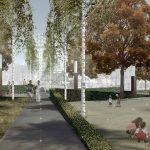
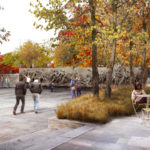
But Weishaar says as he learned about the park’s past, he began to integrate elements and features from that past into the future. About 90% of the stone is from the hardscape of the park, he says, all restored, cleaned, and refitted. There are seating areas meant to welcome those who want to sit, reflect, and eat lunch.
The static water feature is intentionally placed to separate the sacred space of the memorial from folks moving through their everyday routine, be it hustling to work or chatting with a friend. The memorial is even sunk into the ground to block traffic noise, attempting to provide a similar quietness that was an important component of Pershing Park in its earlier years.
“It has to function both as an urban park and as a memorial, which is a unique challenge,” says Weishaar. “We had to create spaces where people feel comfortable coming and eating their lunch and they don’t feel like they’re going to interrupt [a] ceremony.”
He believes when people are reacting to the memorial’s takeover of Pershing Park, it has more to do with the failure of keeping the space maintained. Weishaar says he provided NPS a “maintenance plan” outlining what will be needed to keep the World War I Memorial looking like it does today.
“It’s basically an incredibly thick manual of, you know, ‘Every day, come fish leaves out of the pool. And you need to sweep this many times a week,’” he says. “It very clearly states and lays out appropriate funding for here’s how you upkeep this memorial forever.”
For Weishaar, he simply wants people to enjoy, reflect, and use the memorial.
“If people are here, that’s so much better than the alternative,” he says referring to Pershing Park’s lack of use in its later years.
Besides the reused stone, the location, and the attempt at creating a visited urban park, there’s another common thread between the past and present here — the sense that something has been forgotten.
“This is, unfortunately, true of history,” says Weishaar, “If you don’t see it, it eventually fades away.”