Colleen Grablick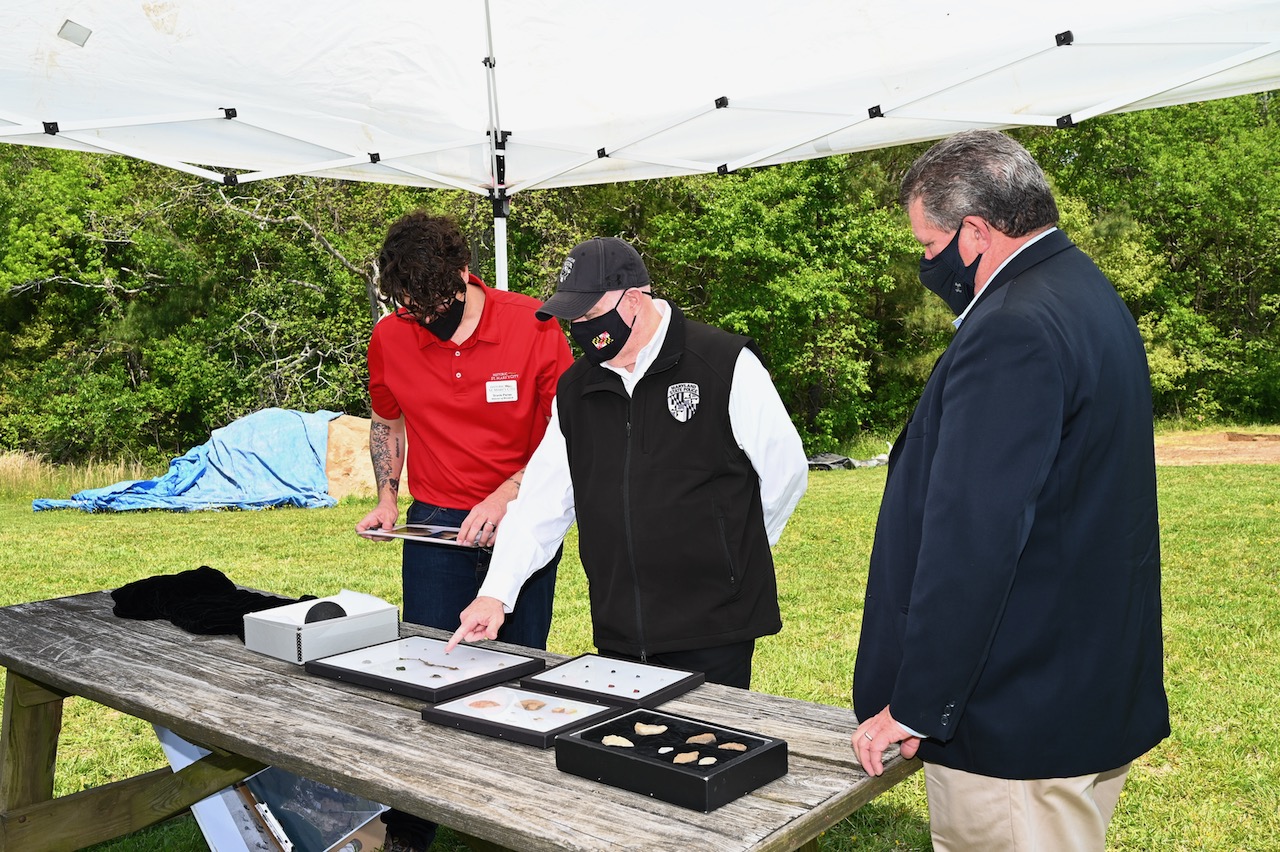
Maryland’s colonial history is continuing to unfold for researchers, with the newly announced discovery of three artifacts dating to the early 1600s.
The artifacts were found at the site of St. Mary’s Fort — the first colonial settlement in Maryland and one of the earliest in the United States. Archaeologist Dr. Travis Parno and a team of excavators first found the site in 2019 and had been hoping to find evidence — or in archaeologist speak, “diagnostic artifacts” — that would add pieces to the historical puzzle.
“I joked with my team when we started excavating, ‘if you could find me a coin that has 1634 on the front, that would be great,’” says Parno, the director of research and collection with Historic St. Mary’s City (HSMC), referring to the year the first 150 English settlers arrived in Maryland.
Parno and his team officially discovered the location of St. Mary’s Fort, a site about the length of a football field, in 2019, but announced the find earlier this year. They hoped to return shortly after the discovery, but, as was the case with most plans in 2020, the pandemic threw a wrench into their timeline. Their work resumed last summer.
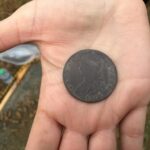
By November, Parno says the team turned up something remarkable: a silver shilling with a “maker’s mark” on both sides, indicating it was printed in London between 1633 and 1634.
“For us that was sort of Christmas,” Parno says. “When that was found, that was as good of a day as we could have.”
On Wednesday, Parno, alongside Governor Larry Hogan, unveiled the coin, as well as two more artifacts from the settlement — objects Parno says not only add to the story of the settlers, but provide a lens for examining the colonists relationship with the Indigenous people who lived on the land thousands of years prior.
“We want to really use archaeology to amplify these stories of what those relationships [between the Indigenous people and colonizers] were like,” Parno says. “What the positive moments of diplomacy and trade were, but also what the negative moments were of encroachment and violence and duplicitousness.”
The second object presented Wednesday was a tinkling cone, a small piece of flattened and rolled copper that would have been traditionally strung on a leather cord and worn by Indigenous people. According to Parno, tinkling cones were likely produced by the colonists and traded with the Indigenous people.
“It’s just really neat to again have this object that represents the interactions between these two groups of people in the earliest period of the Maryland colony,” Parno says.
The third object, a five saints medallion, points to the Maryland settlers’ Jesuit missionary efforts. The medallion represents five saints — two of them Jesuit — canonized by Pope Gregory XV in 1622. The St. Mary’s settlers are largely credited with laying the foundations for Catholicism in America.
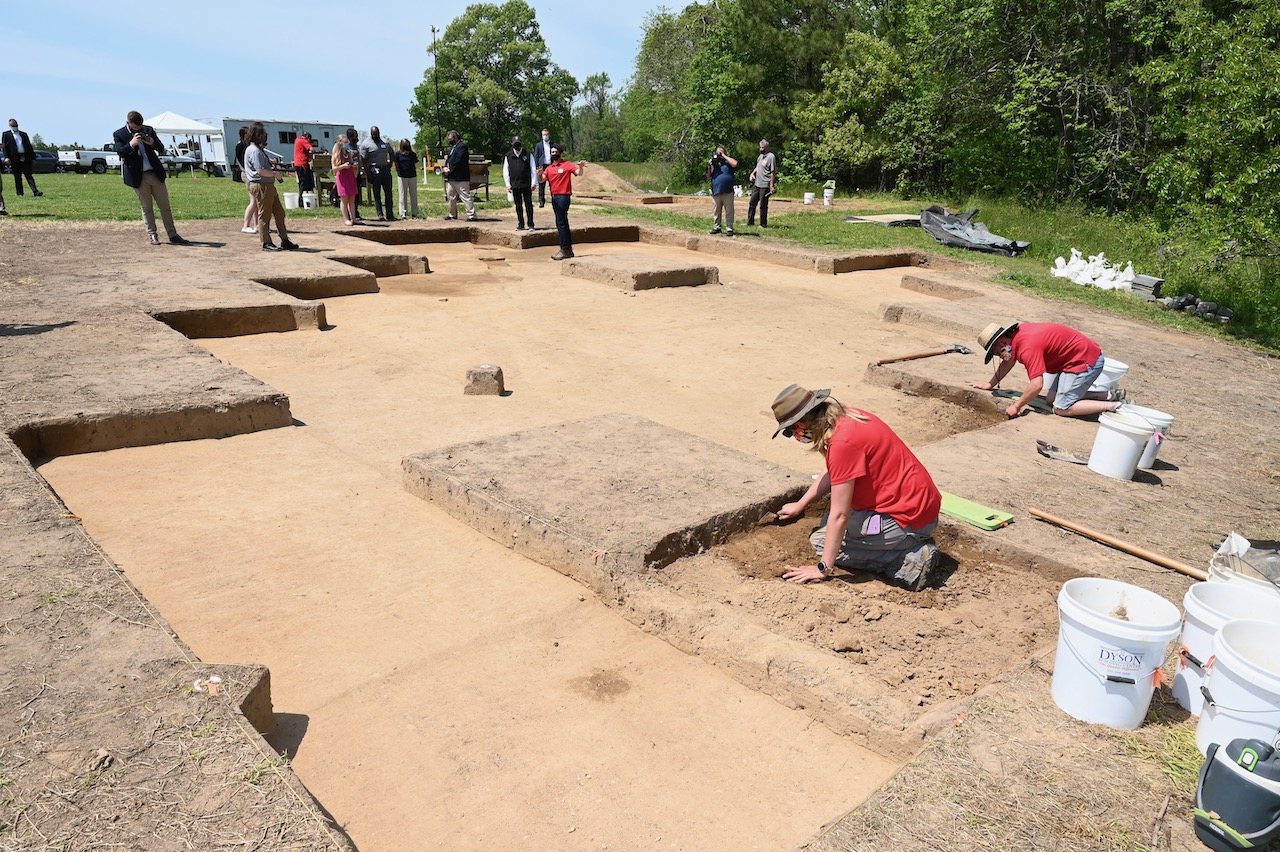
The announcement of the uncovered artifacts comes just weeks after Parno and Hogan announced the official discovery of St. Mary’s Fort in March of this year. (The announcement was postponed as coronavirus delayed further excavations, and work restarted when Hogan allocated supplemental funding to continue the research.)
The finding of the earliest colonial settlement in Maryland marked the end of a nearly 90-year search for the site. The newest artifacts pose more questions for future research, and an avenue to question the dark history of colonialism, according to Parno.
The excavation and research project at St. Mary’s Fort is part of a larger initiative with HSMC, which partners with members of the local Piscataway tribe to explore the history of colonization in Maryland. In addition to researching St. Mary’s Fort, The People to People project is also investigating two nearby sites, first inhabited by Native Americans almost 5,000 years ago, according to Parno.
“When we showed [the Native groups] the [St. Mary’s Fort] discovery, they said, ‘this is really great, but it’s not really a native story. It’s a colonial story that impacted native peoples,’” Parno says. “I think in some areas of this country, people get really comfortable with Thanksgiving stories, like ‘Oh it was English people and Native people coming together, the Native people taught the colonists, and everything was fine. I think what this project is designed is to sort of problematize that a little bit.”
According to Parno, the excavations at St. Mary’s Fort have also turned up several artifacts that indicate a strong military presence, like cannon balls and musket equipment.
“That shows the other side of colonialism, that this was about land expansion, this was about empire,” Parno says. “It wasn’t just an effort to come over and make nice with Native people.”
A similar archaeological project with researchers from Maryland’s Department of Transportation discovered 300-year-old slave quarters in St. Mary’s County in October of last year, and just last week, archaeologists joined Maryland state officials to announce the discovery of Harriet Tubman’s original home site along the Eastern Shore, unveiling artifacts like pipe stems and shirt buttons from her formerly enslaved father’s home.