Ally Schweitzer
After years of public engagement, months of white-hot debate, and likely millions of track changes in Microsoft Word, the D.C. Council on Tuesday advanced amendments to the city’s all-important Comprehensive Plan.
In the first of two votes, city lawmakers approved a version of the plan that responds to many concerns from activists and the Council’s newly established Office of Racial Equity that Mayor Muriel Bowser’s proposed changes to the plan would exacerbate gentrification.
The Comprehensive Plan establishes the contours of development in the city over a 20-year period, but it doesn’t actually implement those plans or change the city’s zoning map. Development that requires zoning changes — such as putting a tall building in a medium-density neighborhood — must still get approval from the city’s Zoning Commission.
Nevertheless, developers and the mayor have sought extensive changes to the plan for several years, saying updates are needed to ensure the timely approval of new housing developments, including affordable housing. The Zoning Commission can only approve projects they deem “not inconsistent” with the plan. (Confused? See our explainer on the Comprehensive Plan and why it’s important.)
The Council must take a second vote on the legislation before it moves to the mayor’s desk. Further amendments can still be made before the next vote, which could take place in two weeks.
Councilmembers generally praised 26 pages of amendments offered by Chairman Phil Mendelson, who said during Tuesday’s legislative meeting that his changes focused on strengthening language around displacement and advancing racial equity as the city grows. (More on those amendments, below.)
“We started on a Comp Plan that focused basically on meeting the mayor’s goals,” said Councilmember Elissa Silverman (I-At Large). “But I think with all the work that we’ve done, these changes really do avoid the mistakes of the past that have displaced many Black and Latino families.”
Councilmember Janeese Lewis George (D-Ward 4), who previously expressed alarm about findings in the Council’s racial equity analysis, said the chairman’s amendments resolved some of her concerns, but not all. The chairman’s amendments define affordable housing as homes within reach to families earning 80% of the region’s median family income, which translates to more than $100,000 per year for a four-person household.
That’s “almost double the median income for Black families,” Lewis George said. “I think defining affordability for Black families would be closer to 40% of MFI.” (That’s equivalent to about $52,000 per year for a four-person household.)
Lewis George said she plans to draft an amendment that would redefine “affordable” accordingly, ahead of the second vote.
A proposed amendment from Brianne Nadeau (D-Ward 1), which the councilmember said would make way for more affordable housing on public land along U Street, was also approved after Nadeau removed a provision that would have enabled residential or commercial development at the site of the now-shuttered Garnet-Patterson Middle School.
Some activists in the city sought to shelve Tuesday’s vote entirely, saying neither the Bowser administration’s draft nor the chairman’s amendments ensure that residents will not be displaced by future development.
“Neither version of the bill meets the standard of planning and development in which we can be proud. Nor should either version be enacted by our nation’s capital, especially after experiencing a year of Racial Reckoning and a global pandemic,” members of the D.C. Grassroots Planning Coalition wrote in a statement. “We need the Council and Mayor today to get back to work and provide a Comp Plan which [the Council’s Office of Racial Equity] can affirmatively conclude a Bill that ‘fundamentally advances Racial Equity in the District of Columbia.'”
Before the vote, lawmakers pointed out that the Comprehensive Plan alone won’t undo a legacy of racist land use policy in the District, and that the Council also must fund more affordable housing to match the plan’s language. (Since Bowser took office, D.C. has been spending, on average, $100 million a year to build and preserve affordable housing.)
“Below market-rate housing just doesn’t get built unless and until the mayor and the Council put our money where our mouths are,” said Councilmember Charles Allen (D-Ward 6).
The current amendment cycle will be followed by a full rewrite of the Comprehensive Plan, a process that’s supposed to take place every 20 years. But members approved bumping up the timeline so the rewrite process begins on Jan. 7, 2025, instead of 2026.
Here are some of the most notable housing-related amendments that passed on Tuesday. (Take note that the plan also maps out policies around transportation, education, environmental issues and a raft of other areas, but those aren’t discussed here.)
Housing affordability, public housing, and racial equity
- Proposes that 40% of new affordable units in the city should target extremely low-income households (defined as four-person families earning $38,700 per year or less), with the remaining 60% for low- and very low-income households (defined as four-person families earning between $38,700 and $103,200).
- “Affordable housing” is expressly defined as “housing in which occupancy is limited to households earning 80% or less” of the region’s median family income, equivalent to about $103,200 per year.
- New language calls to prioritize deeply affordable housing — not just affordable housing — on city-owned land.
- When the city redevelops existing public housing, it must prioritize tenants’ right to return, and the developer has to provide a “comprehensive relocation plan” for tenants before the property is redeveloped.
- A new provision calls for informing and engaging affected community members in public housing renovation plans.
- Where some language previously called to “minimize” displacement of existing residents, it now says “prevent” displacement. Also, a previous draft said that Small Area Plans — which map out potential development in particular neighborhoods — “should” be conducted using a racial equity lens; it now says they “must” use a racial equity lens.
Single-family zoning
- Language around single-family zoning — which some housing advocates say furthers racial segregation and keeps housing out of reach for lower-income residents — has been revised. A new passage calls for “additional study” to “develop strategies to diversify housing options and affordability” in single-family areas, while still “support[ing] and maintain[ing] the District’s established low-density neighborhoods.”
Industrial land
- Amendments specify that the District should maintain its current level of industrial land — also known as PDR, which stands for production, distribution and repair — while also acknowledging the relationship between industrial zoning and racial segregation. “A challenge today is recognizing that industrial land is almost entirely located proximate to predominantly low‐income (i.e. Black) neighborhoods,” a new passage says. At the same time, “supply of PDR-designated land should not fall below its current level,” it says, and “efforts to convert PDR land to other uses must be resisted.”
- Industrial land should “ideally” be “designated throughout the District,” not concentrated in lower-income areas.
- Amendments also require the Office of Planning to deliver a PDR land use study by January 2024, instead of January 2025.
Neighborhood-level changes
- Language that previously said “preserving the character of Adams Morgan” now says “creating an inclusive Adams Morgan,” and specifies that any residential density added through the Future Land Use Map (or FLUM) “should be used to create additional affordable housing above and beyond existing legal requirements, in order to contribute to the neighborhood’s share of dedicated affordable units, which is currently one of the lowest in Mid-City.” There’s also a new passage about supporting and retaining minority-owned businesses in the neighborhood.
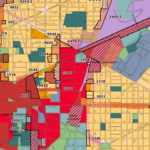
- The FLUM allows more density around Mount Pleasant and Kenyon Streets NW to allow “additional opportunities for residential development.”
- Amendments from Nadeau allow high-density residential, medium-density commercial or local public facilities zoning designations at FEMS Engine 9 and MPD Third District Headquarters and the Housing Finance Agency Headquarters.
- More capacity is permitted around 4401 Sheriff Road NE and the intersection of Pennsylvania Avenue SE and 30th Street SE to make way for affordable senior housing development.
- Also new: “Future development and operational proposals for the Omni-Shoreham hotel should include analyses of impacts on adjacent residential and commercial areas and appropriate mitigating issues, prepared by the property owner.”
Next steps for the Comprehensive Plan
- Moves up timeline for beginning the rewrite of the District Elements of the Comprehensive Plan, from January 5, 2026 to January 7, 2025. Revisions must be submitted to Council by June 6, 2027.
- Attempts to make the rewrite process more transparent and overall less confusing to the public. “Prior to starting the rewrite,” new language says, “the Mayor shall provide to the Council and make available to the public a short paper describing the proposed rewrite process and timeline, including how it will evaluate the issues described above.”
This story was updated to include more information about Median Family Income (MFI) calculations.