 Jordan Pascale
A new $40 million pot of money in Virginia will be used to set up fare-free programs for local transit agencies in coming years.
The Transit Ridership Incentive Program was approved by the General Assembly as part of a sweeping transportation package in 2020, but the implementation was delayed because of the COVID-19 pandemic.
Many transit agencies waved fares during the health emergency as a safety measure, but the idea of making free transit survive beyond the pandemic is gaining momentum among local politicians and transit officials, including some D.C. councilmembers, Alexandria’s mayor and some WMATA board members.
Now the goal is to increase ridership and reduce the barriers to transit use for low-income people.
“During COVID, it became very evident to us how essential, how vital public transportation was to essential workers,” Virginia Transportation Secretary Shannon Valentine said during Tuesday’s Commonwealth Transportation Board Meeting. “And so how do we keep people connected? Fares turned out to be an obstacle. So we are really trying to use this as an opportunity… and I think we will learn a lot through this process.”
Virginia’s program could target low-income individuals through passes or by eliminating fares on certain high-capacity corridors or for entire transit systems. The state would put in 80% of the cost the first year and reduce its share as ridership increases. It appears the program is geared more toward local and regional transit agencies in Virginia and not so much the multi-jurisdictional WMATA system.
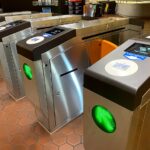
Another $88 million pot of money will help provide regional routes to promote better connectivity. About $38 million of that will go toward routes in Northern Virginia. That money could pay for increased service on key routes, creating new routes, providing better cross-jurisdictional routes, or even go toward creating bus-only lanes. It could also be used to create seamless ways to pay fares across multiple transit agencies.
Jennifer DeBruhl, chief of public transportation for Virginia’s Department of Rail and Public Transportation, said the pilot’s main goal is increasing ridership but also needs to consider accessibility, congestion mitigation, and environmental benefits.
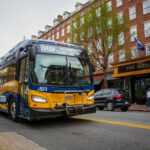
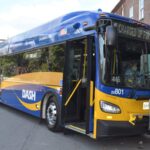
Alexandria’s DASH bus, Fairfax County’s Connector, and the Potomac and Rappahannock Transportation Commission’s OmniRide have all expressed interest in the programs, according to documents.
Formal applications from transit providers are due this summer and the programs would start in fiscal year 2022. The routes program is up to three years long and the free-fare program is up to five years long.
“We heard that short-term, one-year funding would really not help support meaningful pilots and meaningful and sustainable increases in transit ridership,” DeBruhl said. “So what you’ll see in the policy, as I walk through the remaining slides is a philosophy that provides funding over a certain number of years, that declines as those projects come online and see that ridership increase.”