Jacob Fenston
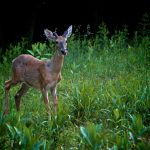
Fifty years ago, it would have been no easy task to find a white-tailed deer in the District of Columbia. The hoofed ruminants, native to North America, were hunted to near-oblivion by European colonists. But in recent years, an overabundance of deer is threatening local ecosystems, according to the National Park Service. NPS is proposing to expand deer culling operations into more parks in D.C. and Maryland, including Anacostia Park and Kenilworth Park and Aquatic Gardens.
“We’re trying to protect and restore our native plants and forest,” says Megan Nortrup, an NPS spokesperson.
“Deer are causing a lot of damage; they’re eating tree seedlings that would be the forest of tomorrow. So they’re impacting not just plants, but all the other creatures that live in the forest,” Nortrup says.
NPS has been conducting regular deer hunts in Rock Creek Park since 2013. But this practice of killing cute, furry native fauna has always been controversial. The Rock Creek deer management plan was delayed by a lawsuit, and protested by neighbors and animal rights groups.
But NPS officials say the deer management program in Rock Creek Park has been so successful, they want to replicate it in other local parks.
In D.C., the new areas to be targeted include most of the national parkland east of the Anacostia River: Anacostia Park, Kenilworth Park and Aquatic Gardens, Fort Mahan Park, Fort Dupont Park, Fort Davis Park, Fort Chaplin Park, Fort Stanton, Fort Greble Park and Shepherd Parkway.
In Maryland, NPS wants to cull deer in Fort Washington Park, Fort Foote Park, Piscataway Park, Oxon Cove Park, Harmony Hall Park, Greenbelt Park, and Baltimore-Washington and Suitland Parkways.
NPS is holding a virtual public meeting on the proposal on June 15, when it will make full details of the plan available to the public. Public comment will be accepted online through July 15.
Animal rights groups and other opponents of deer culling say it’s cruel and ineffective.
According to the Humane Society of the United States, killing deer leads to higher reproduction rates in the remaining animals. “When deer numbers are reduced after killing programs, the remaining female deer will often respond to greater food abundance by giving birth to twins or triplets. Fawns also have higher survival rates and earlier onset of sexual maturity,” says the organization’s website. “The end result is a quick ‘bounce-back’ in numbers.”
Opponents also say deer are not to blame for the loss of native flora, the primary issue cited by NPS. In a letter to NPS in 2018 asking for a review of the culling program, a lawyer representing local residents wrote, “The real culprit for any decline in native vegetation is the pervasive presence of exotic non-native vegetation that has migrated into the park from neighboring residential and commercial gardens.”
Indeed, invasive vines are a major problem in parks throughout the region, crowding out native understory plants and tree seedlings, and even killing mature trees.
According to NPS, however, the evidence is clear: seedling densities have nearly tripled in Rock Creek Park since deer culling began. In Catoctin Mountain Park, in Frederick County, Md., seedling densities have increased 13-fold since deer management started. “It’s allowing the forest to recover in a way that it hadn’t been able to before,” says Nortrup. “So we know it can work.”
Opponents counter that there are other, non-lethal ways to keep deer populations in check, such as using birth control. NPS has considered these alternatives, says Nortrup, but found culling to be the best option.
“This is the most effective means and quickest means to manage the deer population for the benefit of all of the animals in the forest,” Nortrup says.