 Jordan Pascale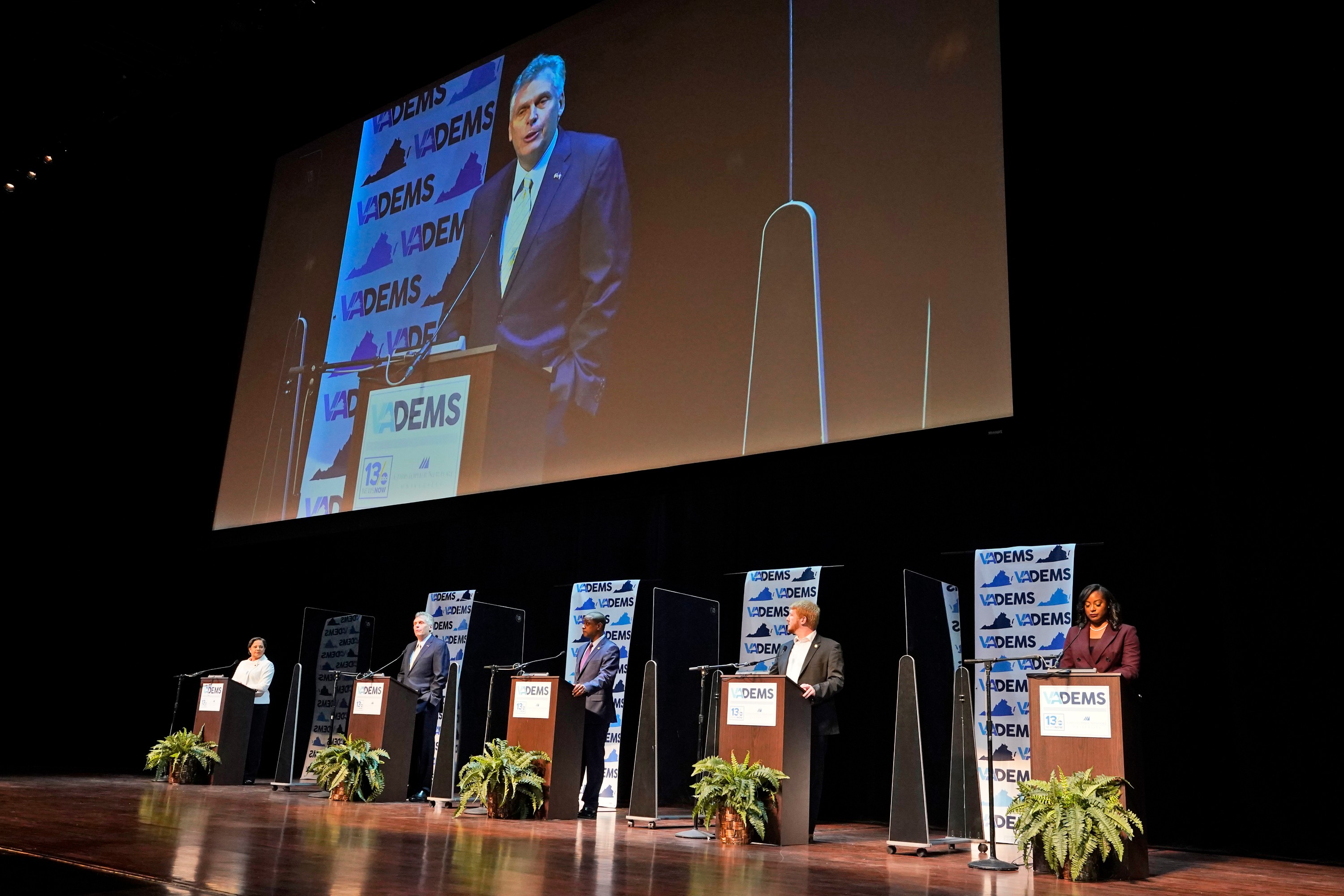
Virginia voters will see a familiar name on their primary ballot this coming Tuesday: former governor Terry McAuliffe.
McAuliffe, ousted in 2017 by Virginia’s unique rule prohibiting back-to-back terms, is dominating the Democratic contest for governor in fundraising, name recognition, and polling. A Roanoke College poll published Friday gave McAuliffe 49% support among likely voters, almost double what the other four candidates on the ballot are drawing.
Political analysts say that despite a strong class of new wave contenders — former Del. Jennifer Carroll Foy, State Sen. Jennifer McClellan, Del. Lee Carter, and Lt. Governor Justin Fairfax — it’s McAuliffe’s race to lose. And they say that McAuliffe’s candidacy speaks volumes about where Democratic politics are headed in the commonwealth.
Virginia has certainly moved farther to the left in the past four years, and has notched a lot of “firsts” as a southern state — getting rid of the death penalty and legalizing marijuana among them.
But while the commonwealth is trending blue, analysts say the overall electorate hasn’t gone full-blown progressive yet. (A Christopher Newport University poll from last month found that most Virginia voters identify themselves as moderate learning conservative, though they do support progressive platforms on issues like health care and the environment.) McAuliffe is probably the most center-left, business-friendly candidate. His big issues are to create a booming, but fairer economy and invest in education.
Mark Rozell, dean of the Schar School of Policy and Government at George Mason University, says much of the Democrats’ electoral progress in recent years was a reaction against the Trump presidency.
“Democrats need to be very careful in how they read their electoral mandates,” Rozell said. “For those who are concerned that the Democrats have lurched too far to the left, and that creates an opening for the Republicans, well, then you have Terry McAuliffe, emerging as what appears to many the likely nominee for governor. And he’s always ran as a center-left candidate, not a far-left progressive candidate. He has always had appeal to the more centrist wing of the Democratic Party, which I think is still very strong in Virginia.”
How Virginia got McAuliffe again
You may remember McAuliffe toyed with running for president before deciding against it after Joe Biden got in the race.
And before that, McAuliffe stepped in as an elder statesman and campaign surrogate for Democrats during a tumultuous upheaval of the entire roster in power in 2018. Gov. Ralph Northam and Attorney General Mark Herring were struggling through Blackface scandals and Lt. Gov. Justin Fairfax had multiple sexual misconduct allegations leveled against him. (They have never been legally resolved.)
With two front runners damaged, McAuliffe saw an opportunity.
Now he’s eyeing the job again, bringing his “sleep when you’re dead” mantra back on the campaign trail. His pitch: Look how much I got done four years ago with a Republican General Assembly, and think about what I could do with a Democratic one.
McAuliffe has out-fundraised other candidates three to one, and the polling has all gone his way. Like the Roanoke College poll released Friday, a Christopher Newport University poll from April put his support among voters at 47%, with the other contenders not even breaking double digits.
Rozell and Dr. Jatia Wrighten, a politics professor at Virginia Commonwealth University, both say that McAuliffe’s advantage comes from his existing name recognition and the fact that a relatively small number of people pay attention to the commonwealth’s off-year primaries. Those that do are either hyper plugged in — or just going off shortcuts and cues.
“Everyday voters are not sitting around thinking about policy… it’s name recognition, what party do they belong to?” Wrighten said. “People recognize his name and remember his term.”
“The race largely comes down to name recognition, fundraising, the kind of campaign that the candidates are running, and McAuliffe has most of the advantages there,” adds Rozell.
This comes despite a field stacked with heavy hitters.
There are two progressive Black women that have been in the General Assembly and who have the chance to be the first Black female governor of any state: McClellan, who has been in the legislature for a dozen years, and former delegate and defense attorney Jennifer Carroll Foy. Princess Blanding is running as an independent.
Wrighten, who researches Black women in state government leadership, says it’s unfortunate McAuliffe ran, potentially taking away the opportunity to have the first female Black governor in the U.S.
“It’s frustrating, because I think there’s so much potential for these Black women moving Virginia sort of in the direction that it’s been going,” Wrighten said. “It does sort of feel like the Democrats are taking a step back if Terry McAuliffe is nominated. McAuliffe has been out of the game for a bit — he reflected what (Virginia) was and Carroll Foy and McClellan reflect what it can be.”
Wrighten says despite both having success in the legislature and great qualifications, Black women don’t get the same level of fundraising, largely because of embedded racism and sexism.
“No matter how often they’re running, how often they’re winning seats, how productive they are in the legislature, how many of their policies are being passed… there’s still a huge inequality between running and winning these higher leadership positions,” Wrigthen said.
Then there is Del. Lee Carter, the most progressive contender out of the group, who Rozell says is a “statement” candidate looking to give progressive issues a hearing that may otherwise have been neglected. As for Lt. Gov. Justin Fairfax, Rozell says the reputation damage from the unresolved sexual assault accusations has really stuck.
Wrighten and Rozell both agree that the four Democrats would’ve been wise to coalesce around one candidate to go head to head with McAuliffe, instead of splitting the vote against him. Still, Rozell says some of the candidates are running for name recognition this time around and will likely be front runners next cycle. Wrighten agrees.
“If they don’t end up winning, the fact is we see competent, competitive Black women running for a governorship in the state of Virginia,” Wrighten said. “We have never seen that. There’s no history of this ever. And so this sets a precedent and I think it matters that people see that diversity.”
Other races on the ballot
Republicans have already picked their candidates for governor, lieutenant governor and attorney general: former Carlyle Group executive Glenn Youngkin, former Del. Winsome Sears and Del. Jason Miyares, all of whom won during a convention in May.
But both Republicans and Democrats will vote for House of Delegate candidates and a handful of local races, like Alexandria mayor and an Arlington County board seat.
Democrats will also vote on a very diverse list of six candidates for lieutenant governor, including Hala Ayala, the first Hispanic female member of the legislature and Sam Rasoul, the first Muslim member of the legislature. Alexandria-area Del. Mark Levine, Norfolk councilwoman Andria McClellan, Fairfax County NAACP President Sean Perryman, and NFL player agent Xavier Warren are also in the race.
Voters will also pick between incumbent Attorney General Mark Herring and Del. Jay Jones.
The primary is Tuesday and any registered voter can participate. The polls are open from 6 a.m. to 7 p.m.