Jacob Fenston
Data and calculation errors led Maryland officials to dramatically underestimate greenhouse gas emissions from landfills in the state. Maryland landfills emit four times more methane and carbon dioxide than previously reported by officials, making them by far the largest source of methane emissions in the state. Maryland environmental officials acknowledged the mistake this week and updated official data, after a report by the Environmental Integrity Project shed light on the error.
Landfills produce greenhouse gases, especially methane, as organic materials like food scraps and yard waste decompose. Nationally, landfills are the third biggest emitter of methane, after cattle and the natural gas industry. Methane is a highly potent greenhouse gas, and makes up about 10% of total greenhouse gas emissions in the U.S.
In Maryland, emissions from landfills have the same planet-warming impact as driving 975,000 cars annually, according to the EIP report. Another comparison: Maryland’s landfills have almost twice the greenhouse gas emissions as the largest coal-fired power plant in the state.
The new data shows landfills account for 37% of Maryland’s methane emissions, rather than the state’s previous estimate of 13%.
So how did state officials get the numbers so wrong?
“There were some small human error examples, of the numerator and denominator flipping, or not including a couple of different smaller landfills in the overall baseline — all understandable human error,” says Ben Grumbles, Maryland’s secretary of the environment. “We appreciate our partnerships with the public and with environmental organizations that can sometimes catch some errors that hadn’t been detected yet.”
Ryan Mahar, an attorney with EIP, first spotted the problems with the data.
“I had worked with the dataset for a couple of other projects, and started to notice some discrepancies,” says Mahar. “One thing that really tipped me off was there was a landfill that I could not locate for the life of me — I could not find its coordinates — and that led to just looking at the data directly.”
He found the state data included emissions from one non-existent landfill, while excluding emissions from five landfills that should have been included. But that was far from the biggest problem.
The major error was a basic math mistake, having to do with the rate at which bacteria in the soil eat up some of the methane released by landfills. According to the EPA, these methanotrophic bacteria reduce methane emissions by 10%, in a process known as surface oxidation. But state officials, in their calculations, mistakenly applied a 90% reduction.
“So the state agency responsible for measuring landfill emissions basically inverted the surface oxidation factor, and that really just undercuts the entire estimate,” says Mahar.
Mahar and Grumbles both say the newly corrected data points to a more urgent need to cut landfill emissions.
“It reinforces the need to move forward with additional regulations and incentives to reduce greenhouse gas emissions from landfills, and also significantly increase the state’s efforts on recycling and composting and collecting of food scraps,” says Grumbles.
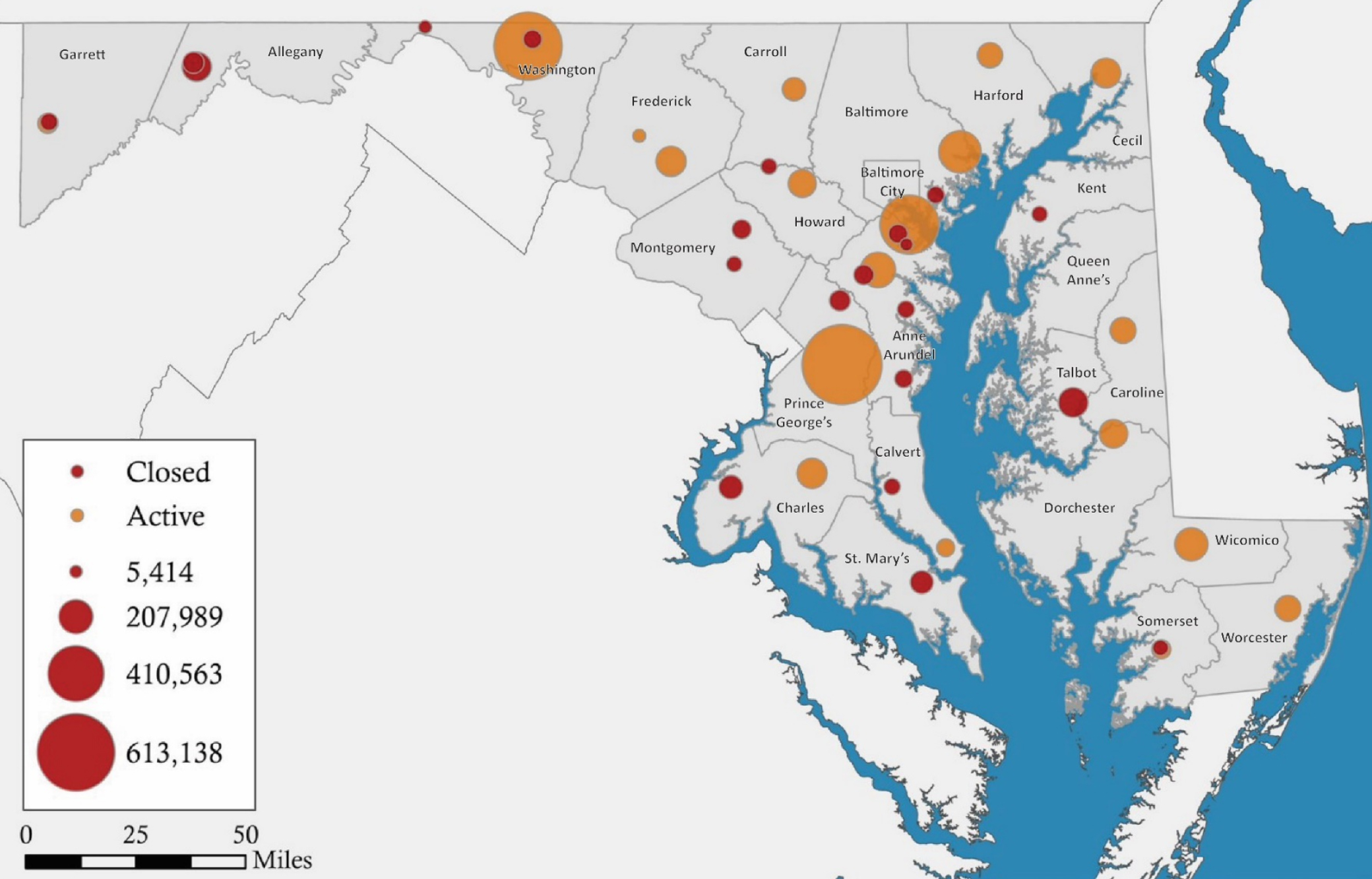
Currently, only the largest landfills are required by the Environmental Protection Agency to install equipment to capture emissions. Those regulations only apply to four out of Maryland’s 40 landfills, while another 17 have installed emissions control systems voluntarily.
Maryland has been in the process of updating landfill regulations since 2017, and has a public meeting on the regulations scheduled for June 23.
Mahar says Maryland should follow the example of California, which adopted stricter regulations of landfill emissions in 2010. If Maryland were to adopt California’s standards, Mahar says, 28 landfills in the state would be required to install emissions control systems, rather than the current 4. Furthermore, he says, new technology developed in the decade since California’s regulations were put in place would allow control systems on even smaller landfills — in Maryland, as many as 38 out of 40 could be required to install such systems.
But there’s another way — besides landfill regulations — to cut these emissions: keeping the stuff that creates emissions out of landfills to begin with.
“Greenhouse gases from landfills really start with organic material,” explains Mahar. “The decomposition of materials like food, but also paper products, are what cause these gases in the first place. So the first real approach to addressing these emissions is keeping organics, like food, out of landfills.”
In Maryland, food waste is the largest category of trash that ends up in landfills, accounting for 17% of landfilled material by weight, according to state data. Organic material and paper products together make up just under 50% of material dumped in landfills in the state.
There are a number of ways to tackle the problem of organic material in landfills, including creating less organic waste (throwing away less food, for example), as well as composting food waste, a process which sequesters carbon into a material that’s a beneficial addition to soil, rather than releasing it into the atmosphere. According to the EPA, composting can cut methane emissions from decomposing food scraps by 95%.
Mahar notes that Maryland took a step toward embracing composting earlier this year, passing a new law requiring some supermarkets, schools and other large food waste producers to divert food scraps from landfills. However, the new law points to another problem: a lack of large-scale composting facilities in the state. The law only applies to entities within 30 miles of such a facility.