 Cydney Grannan
 Colleen Grablick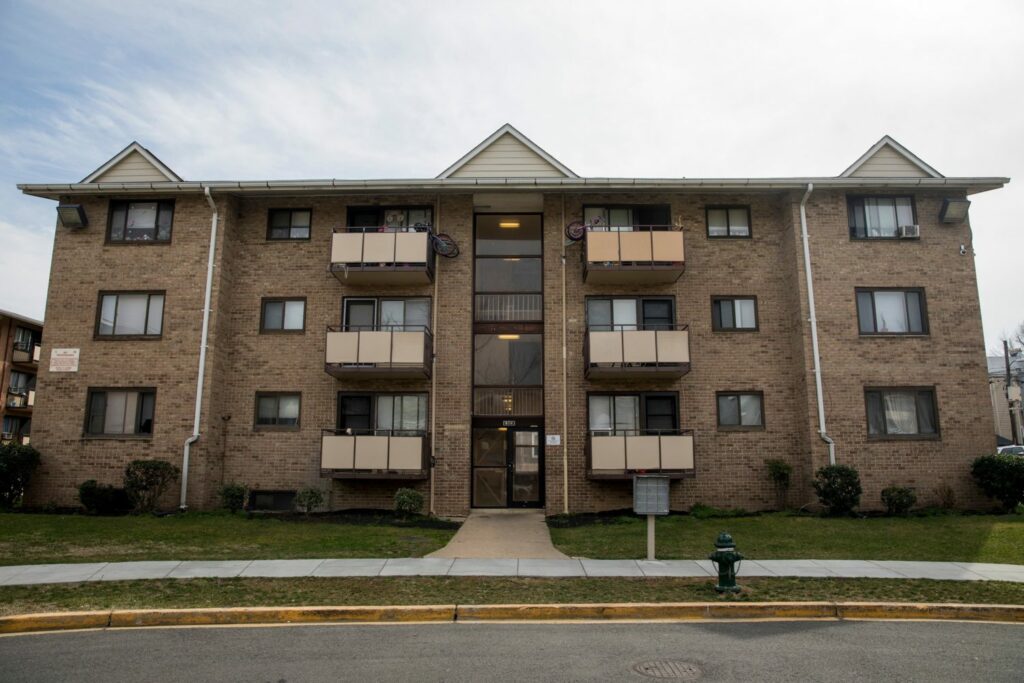
Update: In an about-face, D.C. Mayor Muriel Bowser will now allocate enough money to redevelop the Park Morton public housing complex, after originally planning to only fund repairs that would make the Park View complex livable.
Washington Business Journal first reported the news.
Deputy Mayor for Planning and Economic Development John Falcicchio told Washington Business Journal that the administration reversed its decision after the public decried Bowser’s proposal to only rehabilitate the complex.
A spokesperson for Falcicchio told DCist in a statement that “funds were added to advance the project further.”
Bowser made the requested budget change in late June, adding $23 million to Park Morton’s redevelopment, according to a letter sent to D.C. Council chairman Phil Mendelson. The $23 million will fund 189 new homes in 2023, on top of the existing $15 million included in the 2022 budget.
Original:
After years of stalled plans to raze and redevelop the Park Morton public housing complex in Park View, D.C. Mayor Muriel Bowser’s administration is offering an alternative: rehabilitate the existing buildings instead.
The possible new plan is reflected in Bowser’s 2022 budget, which allocates just under $15 million to rehabilitate Park Morton. The Washington Business Journal first reported on the mayor’s new proposal.
The idea is drawing pushback amid concerns about creating more delays in addressing poor housing conditions at the Park Morton complex, as well as frustration about what residents consider to be a lack of transparency in the decision-making process.
The project has been part of the New Communities Initiative, a troubled, 16-year effort jointly overseen by the D.C. Housing Authority and the Deputy Mayor for Planning and Economic Development. The idea was to redevelop four public housing communities and replace them with mixed-income housing; city planners would minimize displacement by building new housing first.
It has yet to work as planned at any of the projects.
In Park View, neighbors are waging a legal fight over the second location chosen for development, Bruce Monroe Park, throwing the project into limbo. Last year, the D.C. Court of Appeals sent the plan to D.C.’s zoning commission for re-examination. In the meantime, the city had decided to pushed ahead with demolition of some of the Park Morton buildings.
The original plan would create more than 500 total units across the two sites, with just under 200 units available as affordable housing, and seven homeownership units for Park Morton residents.
Under Bowser’s new proposal, the city would rehabilitate around 174 existing units — many of which are currently boarded up and unoccupied — instead. The rehab would happen through a federal housing program, which would likely shift both the timeline and the ultimate oversight of the project. Projects done through the U.S. Department of Housing and Urban Development’s Rental Assistance Demonstration program are typically developed by private or nonprofit management companies.
Shonta’ High, president of the Park Morton Resident Council, said she was surprised to learn about the change in plans, which she first heard about from from D.C. Councilmember Brianne Nadeau (D-Ward 1) a few weeks ago. She’s been unhappy with what she considers a lack of transparency from DCHA and DMPED.
“The residents need to know what the decision for their community that ultimately affects our lives, our future, and the future of our children,” she said in an interview with DCist. “We need to know what is going to happen, so we need to be at the table.”
High said that residents haven’t reached a consensus on if they would prefer rehabbing the building or the original plan to tear-down and rebuild, and that the number of meetings she’s had with residents since the new proposal was unveiled is “overwhelming.” But High said she would support a plan that ensures that voices are heard and the redevelopment happens in a timely manner.
At a virtual budget oversight hearing Tuesday, Deputy Mayor for Planning and Economic Development John Falcicchio said that even though funding for rehabilitation is in the budget, the administration would not automatically pursue moving the project through the federal RAD program without community input.
“What we have in the budget is $14.8 million, which would fund a RAD if that was the direction the community wanted to go,” Falcicchio said. “However, if the redevelopment is the path that the community wants to go, then we’re going to be committed to follow that out and to make sure the funding is right to get there.”
Falcicchio has argued that pursuing a rehab would be quicker than continuing the redevelopment process, something that Nadeau disputes.
“It is completely false that changing from the existing plan to a simple rehab would be faster,” Nadeau said in an interview with DCist. “We actually have construction beginning this fall already, whereas moving to a simple rehab would delay the timeline another two years.”
In an interview with DCist, Falcicchio said that, in his view, the current plan hasn’t begun in earnest, since 35 families are still living at Park Morton, eight of whom are in areas that are set to be redeveloped first.
“Those families have to be engaged in order to really advance anything,” Falcicchio said, particularly when it comes to where they will relocate during the redevelopment. “What we don’t want to do is start something where we don’t have the replacement units that we promised.”
The deputy mayor said the cost of fully redeveloping Park Morton under the original plan would be about $35 million: the $14.8 million already in the FY22 budget, plus an additional $20 million over the next two to three years.
Nadeau said she will work with her colleagues to make sure that funding is in place for the full redevelopment. The New Communities Initiative redevelopment plan includes the building of parks, community rooms, a fitness room, a rooftop lounge, and bigger floor plans that are more family-friendly than the current two-bedrooms.
“Walking away from this project now would lose us the trust that we have built so carefully with the residents of Park Morton,” Nadeau said.
Falcicchio counters that “the difference of the approach is not as great as it may seem.”
High, the president of the Park Morton Resident Council, said throwing a new plan into the mix has been a lot to wrap her head around, especially as Park Morton residents have been preparing for the original project.
“As a resident, and speaking as a mom, and what will happen to me and my girls, you know, it worries me,” High said.
High is still getting feedback from residents and said it is too early to say which plan they prefer.
But the bigger problem for High is that Park Morton residents didn’t have a seat at the table from the beginning, when the alternative plan was first being considered. And to her, the issue of residents’ voices not being heard is especially concerning when viewed through the lens of racial equity.
“If Black Lives Matter, then we really need to make that happen by making all of Black Lives Matter, by making Black communities, Black businesses, Black homes, Black children, Black education, Black everything matter,” said High. “And that includes our voices.”
Previously:
D.C. Court Of Appeals Further Stalls Public Housing Redevelopment At Park Morton
As The Legal Battle Over A Park Continues, Public Housing Residents Say They’re Being Displaced