Debbie Truong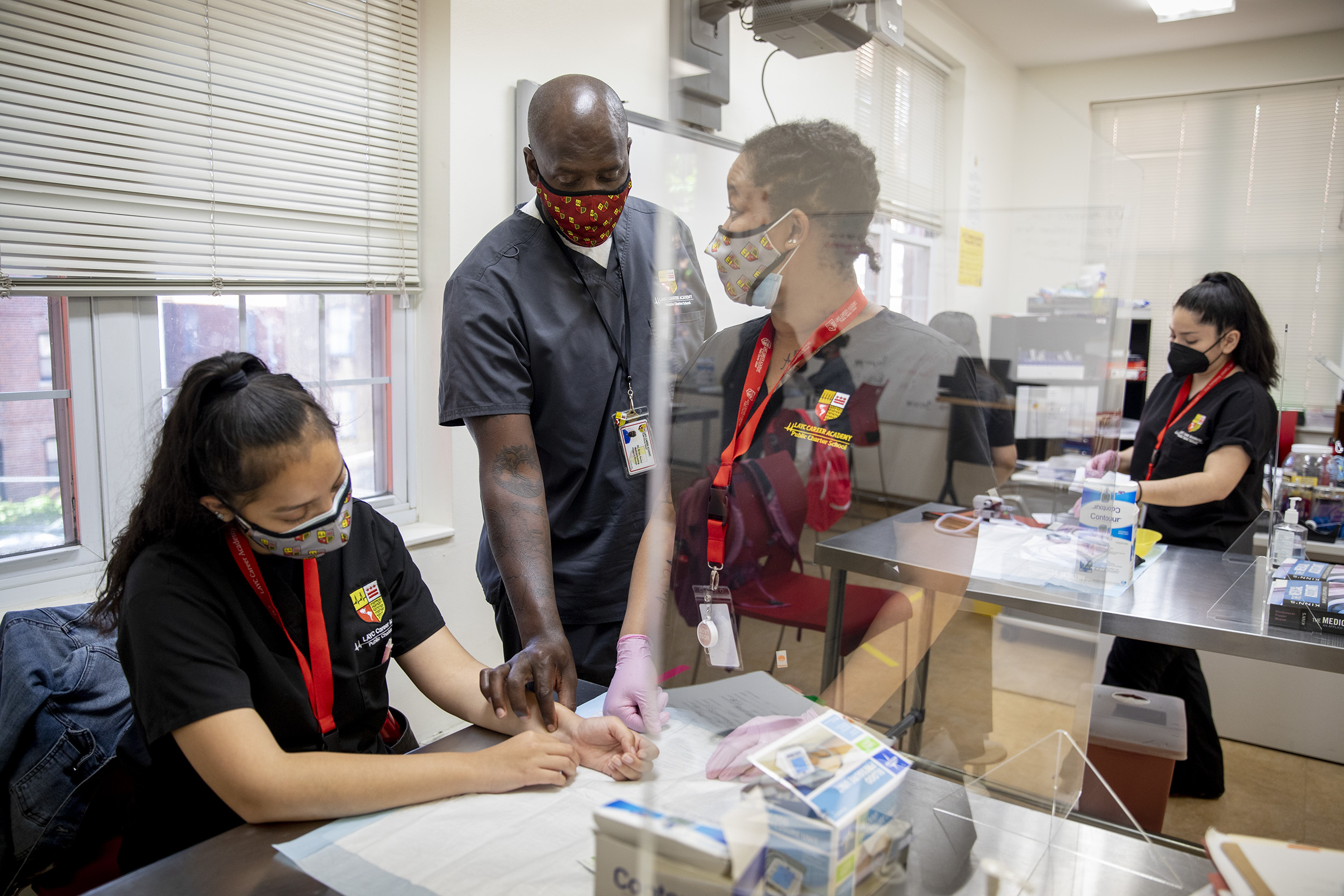
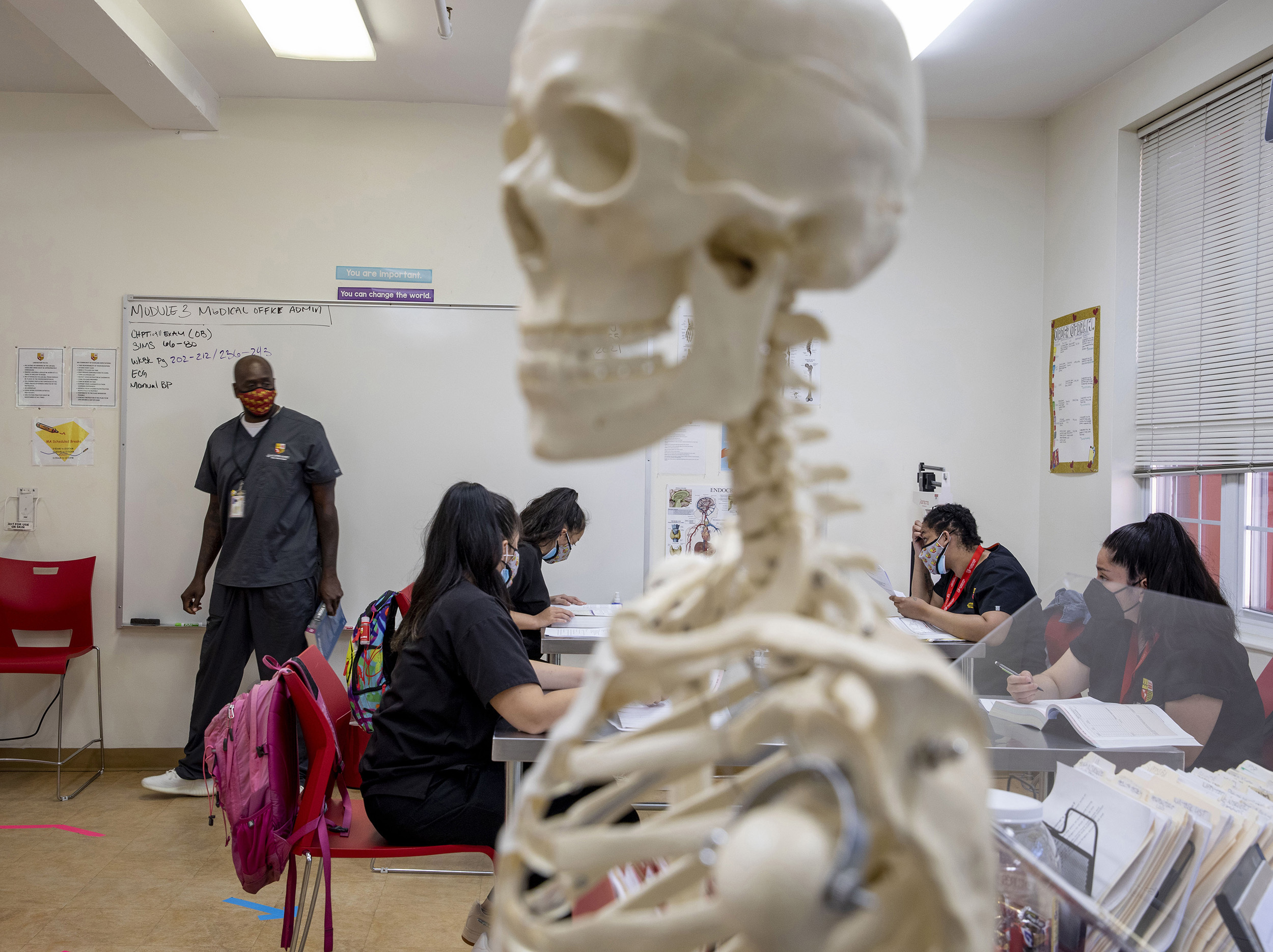
By the time Dominique Bishop reaches her medical assistant class at the LAYC Career Academy in Mount Pleasant shortly after 9 a.m., she has already sent her 9-year-old son off to school and crossed the city by bus and train to drop her two-year-old daughter at daycare.
She juggles her classes with a part-time job at a department store. Many nights, she does not start homework until after her daughter goes to bed.
“My kids are my biggest motivation,” the 25-year-old said. “I’m grateful for my job but it’s not good enough. It’s really not. I want something better for them.”
Bishop was among the first students in the District’s adult public charter schools to return to in-person learning in November. But she has watched many of her peers leave the school during the pandemic, mostly so they could work to make ends meet.
It was one of the many ways the pandemic disrupted learning for students in the city’s eight adult charter schools, which provide training for jobs in fields such as healthcare and information technology. The instability forced school leaders to reimagine the way they teach and support adult education, which is considered crucial to building the city’s workforce.
Most students enrolled in the schools, which also provide GED courses and English language classes, are Black or Hispanic. Educators say many of those students are still recovering financially from the pandemic, even as the region emerges from the public health emergency.
Public school enrollment in D.C. dropped slightly across the city during the pandemic, with some of the steepest declines in adult education. In the 2020-2021 academic year, 4,690 students were enrolled in adult education, according to city data. That was about 700 fewer students than the year before.
At the LAYC Career Academy, which stands for Latin American Youth Center, enrollment has rebounded slightly in recent months, according to Nicole Hanrahan, the center’s co-founder and executive director. But the school is still serving only 100 students — about 40 fewer than before the pandemic. Some who left in the middle of the last school year have not re-enrolled.
Students left for retail and service jobs after family members lost work during the pandemic, becoming breadwinners because they were the healthiest working-age people in their families, Hanrahan said. And many are still scarred by the sickness they saw grip their communities over the last year and a half.
“Every student we have has known someone who has had a bad case of COVID and a lot of them have lost people,” Hanharan said, adding that many students are not yet comfortable getting vaccinated. “There’s a lot of fear.”
Filling gaps
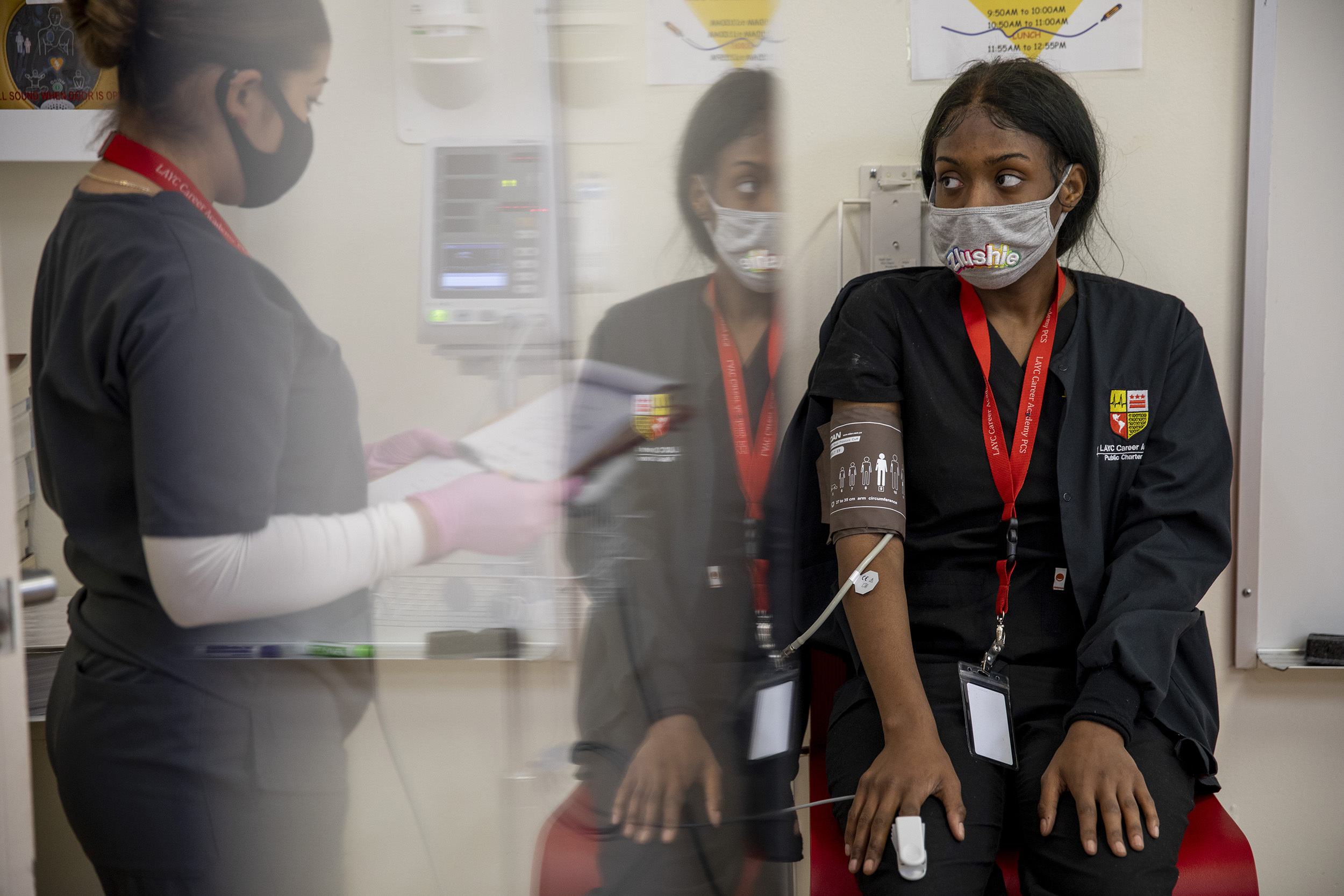
When the coronavirus shut down school buildings more than a year ago, one group of LAYC students was three months from finishing the medical assistant training program. Students who spent every weekday in the clinic, taking blood pressure readings, drawing blood, and timing pulses, were suddenly stuck at home.
Brian Sevier, who directs the school’s medical assistant program, said the students had completed enough coursework to practice on their own when learning moved online. He gave them blood pressure kits and kept in touch through a class WhatsApp group.
Sevier also taught an introductory “pre-pathway” course, which prepared students for the medical assistant program by teaching them basic concepts.
It was harder to keep students in that introductory class engaged. One, who never missed a class before the pandemic, told Sevier she needed to leave school to work more hours at a restaurant because her dad and sister lost their jobs, he recalled.
“We have had issues where we try to reach students and students would just disappear,” he said. “Some students walk away because if they were having difficulty before COVID hit, now they’re definitely having problems.”
The school adjusted to account for difficulties in students’ lives, repairing computers so everyone could have a device at home for distance learning and updating grading policies so students could submit work late without penalty.
A community room was converted into a pantry filled with canned goods, toiletries and school supplies. Staff members sent daily texts to every student with reminders and links to resources such as rent assistance.
It was the type of service that students told the school they needed.
More than 60 percent of LAYC students said in a survey they were homeless at the start of the pandemic, a figure that includes those who were couch surfing and living temporarily with relatives. The school began offering limited in-person learning to students in recent months but about half opted to stay entirely virtual.
Finding a quiet space to log on to classes and complete work was another hurdle, said Ivette Cruz, director of academics for LAYC. Even with accommodations the school has provided, some students still could not continue their studies during the pandemic because they struggled to focus.
“The reason why we exist is because we want these students to succeed, to improve economically, to elevate,” she said. “When you hear that, it’s just like, ‘what can we do to remove all those barriers?’
‘There’s no flow to follow’
For Kathy Medrano, adult classes provided a sense of stability.
The teenager graduated high school in spring 2020. After school closures forced learning online during her senior year, Medrano felt unmoored from her teachers. Heading straight to college would have been too disorienting, so she decided to enroll in the medical assistant program at LAYC.
“I’m more of a go with the flow person. But with [the pandemic] there’s no flow to follow,” she said. “I had a mid-life crisis at 18.”
Some adult schools saw greater interest in programs for jobs that are more insulated from the pandemic, such as information technology and healthcare.
Many students enrolled in adult education over the last year were previously working in industries devastated by the pandemic, including retail and hospitality, according to the results of a survey published by Ashley Simpson Baird, an education researcher.
Eighty percent of adult learners who responded to surveys from Baird last year said they lost income after losing work or having their work hours reduced.
Baird said students who were unemployed had more time to dedicate to their studies. But the lack of steady work also meant some were more likely to accept short-term gigs that pulled them away from school without much notice.
“It puts a lot of things in flux for adult learners and makes their lives more unpredictable,” she said.
At Community College Preparatory Academy in Anacostia, about one-third of students each year leave within about a month of starting school.
“The kind of drop we had this year, it came earlier than we thought and it came heavier,” said Connie Spinner, the school’s chief advocacy officer and president, adding many students left to guide their own school-age children through distance learning. “You got to wonder: what are we going to have to do to get that person back?”
The school provides training for people who are hoping to become HVAC technicians or are seeking certifications in computer programs such as Microsoft Office. It also prepares students for Accuplacer, a placement test for community college students.
It might take longer for low-income students who left career training programs during the pandemic to re-enroll, even as health conditions improve and the economy recovers, said Louis Soares, chief learning and innovation officer at the American Council on Education, an organization that focuses on postsecondary education.
Soares said students who are struggling financially will try to secure employment before returning to school. Getting those students back in classrooms will depend in part on how well schools provide non-academic resources to students, including access to food and child care.
“The programs you see that are successful in the next year or so will be those that provide a lot of supporting services,” he said.
Silver linings
LAYC Career Academy did not have much of an online curriculum before the pandemic. And the virtual offerings made it easier for some students to keep up with classes while juggling other responsibilities over the last year.
They logged on to classes during breaks from work. They peered at their phones as they rode on buses, faces masked.
Hanrahan hopes to maintain online options as more students return for in-person learning.
“It just makes more sense to change our schedule around their lives rather than having to change their lives around our schedule,” she said.
LAYC is not the only adult charter that plans to hold onto some changes it made during the pandemic.
Briya Public Charter School, which provides English as a second language classes and workforce training to parents, offered virtual instruction for the first time during the pandemic, said Elizabeth Bowman, senior director of adult education.
That enabled students to finish assignments independently, at their own pace.
It also meant the school had to provide laptops for classes and help connect students to the internet, a commitment they plan on keeping for future school years.
“All of our students now have access to the equipment that they need to be able to engage in online learning,” Bowman said. “They didn’t have that pre-pandemic.”
Spinner at Community College Prep said the school had long planned to shift its classes online so students could have more flexibility. But the public health crisis pushed administrators to invest in the necessary technology sooner.
The school, which sits in a part of the city with large numbers of low-income families, started providing each student a hotspot and laptop when they registered for classes.
Many students did not know how to use the devices, Spinner said, so the school taught them.
“COVID did for us what no one else could do — it forced us to begin to push the envelope in terms of getting people to virtual learning, independent learning,” she said. “The pandemic is going to be a game changer.”
This story was produced as part of the Higher Education Media Fellowship at the Institute for Citizens & Scholars. The Fellowship supports new reporting into issues related to postsecondary career and technical education.