Colleen Grablick
A day after a pedestrian bridge collapsed in Northeast D.C., residents say that an underserved, predominantly Black community in the city now faces yet more barriers to crucial amenities.
They also say the bridge’s condition — which the city has now confirmed was poor, after first releasing a statement that said otherwise — is further proof of chronic disinvestment in neighborhoods east of the Anacostia River.
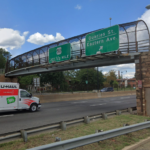
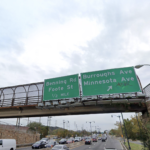
Shortly before noon on Wednesday, the pedestrian bridge connecting Kenilworth Avenue and Lane Street in Northeast collapsed onto DC-295, an incident officials said was caused by a truck crashing into the bridge and knocking it off its moorings.
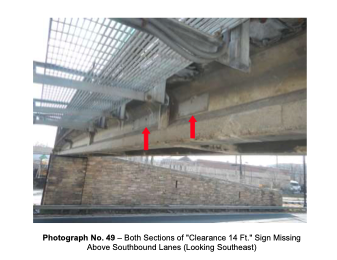
In a press conference at the scene that afternoon, D.C. Mayor Muriel Bowser said the bridge was last inspected in February, adding that officials did not identify any structural problems. But later Wednesday night, Deputy Mayor for Public Safety and Justice Chris Geldart walked back that statement. When the bridge was inspected in 2019, it received a rating of “fair” — or 5 on a national scale of 0 to 9. The latest inspection in February 2021, however, dropped the bridge down to a 4 or “poor condition” — the threshold to begin a multi-year process of replacement, according to a statement from Geldart Wednesday evening. The 2021 bridge inspection report, obtained by DCist/WAMU on Thursday, indicates “consideration should be given to replacing the bridge.”
Still, officials maintain that the collapse was the result of a truck attempting to pass underneath the bridge, not a problem with its infrastructure. According to a Metropolitan Police Department incident report, the driver of the truck had just left a nearby concrete plant and forgotten to lower its boom, causing the collision with the bridge. But the latest inspection report notes that the 14-foot clearance sign is missing above the southbound lanes — the direction the truck driver was traveling at the time of the collision.
Three other cars were involved in the crash, and five individuals were transported to the hospital with minor injuries.
DC-295 reopened around 2 a.m. Thursday morning (much earlier than the original reopening estimate of 10 p.m. Thursday evening), but D.C leaders have not yet released a timeline for replacing the bridge, which connects residents in Kenilworth and Eastland Gardens to the Deanwood Metro stop.
At-Large Councilmember Christina Henderson tweeted Thursday morning that she’d contacted both the Deputy Mayor for Public Safety and Justice and the D.C. Department of Transportation, asking for further information on the structural status of the bridge and alternative transportation options for residents who relied on the bridge to access the Metro. (Spokespeople for Geldart and DDOT did not immediately return DCist/WAMU’s request for repair timeline or plans to provide additional transportation to the Deanwood Metro.)
“I was disturbed about the report that was recently done about the structural soundness of the bridge being in poor condition, because we know that at least for the Kenilworth and Eastland Gardens community, that pedestrian bridge is like a lifeline, especially if you don’t have a vehicle or a car,” Henderson told DCist/WAMU. “Without this pedestrian bridge it’s going to take twice as long and a more dangerous way to walk further down to cross 295 safely.”
Henderson says the bridge collapse, now separating two communities east of the Anacostia River, demonstrates how the construction of DC-295 — and the interstate highway system as whole — contributed to racial inequality by segregating communities or building over them entirely.
“How did 295 come to be, and you have one community on one side and one community on another?” Henderson said. “I’m not saying we get rid of 295, but ensuring that residents can cross safely and not get completely cut off if you do not have a vehicle or if you do not have the luxury of waiting however many hours it might take for the Metro bus to come through your neighborhood…we need to fix this, this needs to be a priority.”
Ward 7 ANC Commissioner and organizer with Black Lives Matter D.C. Anthony Lorenzo Green made a similar point in an interview with WUSA 9.
In response to the collapse, other residents called out the way infrastructure in whiter, wealthier parts of the city is prioritized over maintaining essential transportation options in predominantly Black Wards 7 and 8.
Kyle Reeder, a Capitol Heights, Maryland native told DCist/WAMU he used the bridge frequently to get around on his bike. In a tweet, he highlighted the long-stalled Georgetown gondola project, which Ward 2 Councilmember Brooke Pinto breathed new life into earlier this year in her budget request. The gondola would stretch across the Potomac river, connecting Georgetown with Rosslyn, Virginia, and has previously garnered support from local private sector business heads.
https://twitter.com/KyIeReeder/status/1407743022146674690
“It’s not that this gondola project isn’t cool, I love transportation projects,” Reeder said. “But what ends up happening is that these cool transportation projects only benefit the folks that can afford it. There aren’t private sector dollars that want to be invested in Kenilworth and Capitol Heights — the private sector doesn’t even want to open a grocery store here.”
Like Henderson, Reeder said that DC-295 essentially cut through the community, making the bridge a “bandaid” to a halved neighborhood. Now with it down, he says it’s like “shit hit the fan.”
“Now these people literally don’t have a connection to the other side of their community,” Reeder said. “This is a dire impact for a community that was already in distress.”
This story has been corrected to reflect that bridge connects Kenilworth Avenue and Lane Street NE.