Colleen Grablick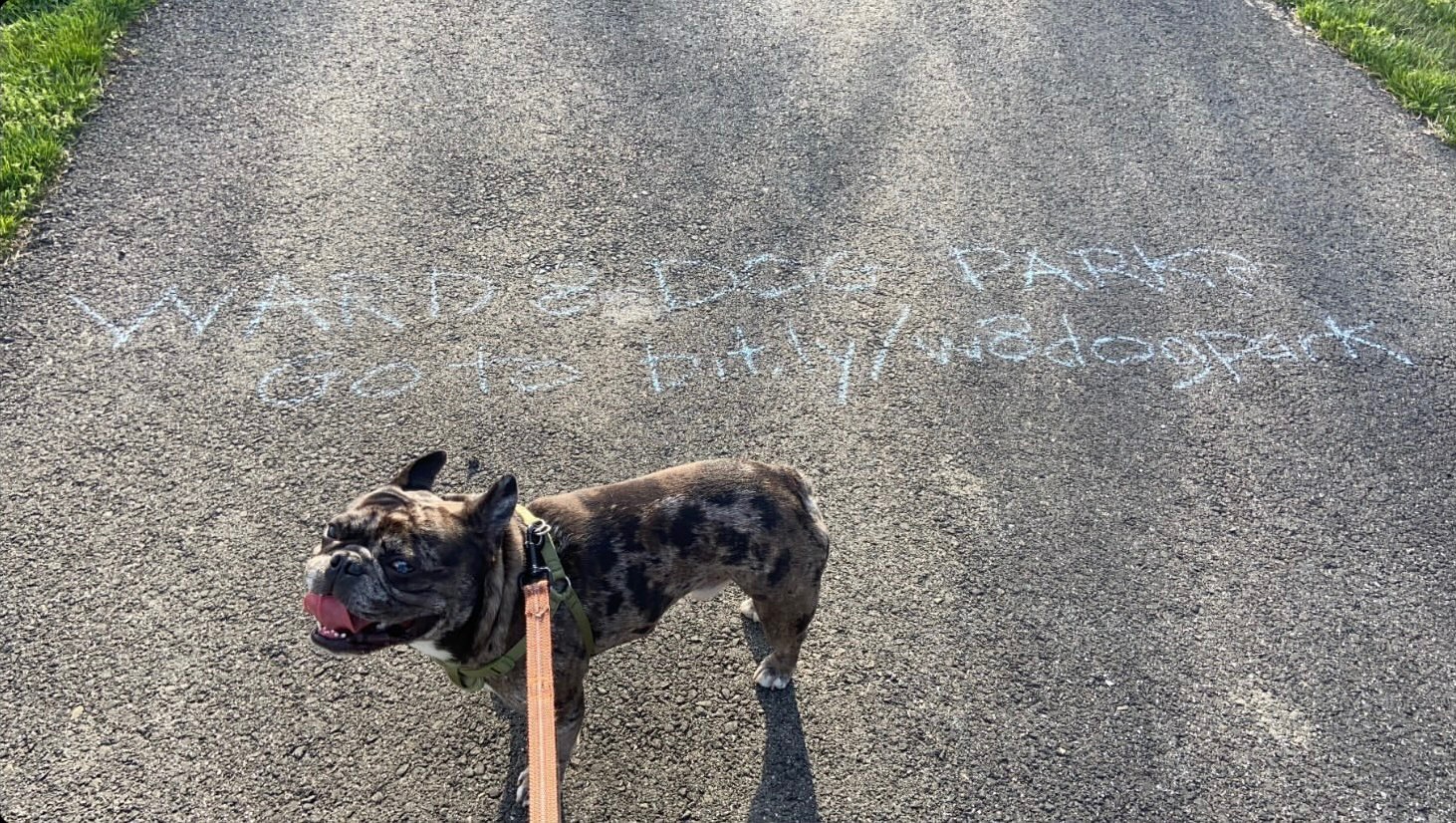
Darren Thompson lives in Ward 7’s Benning Ridge neighborhood with his six-year-old bullmastiff-rottweiler mix Barrow. But for Barrow to roam freely off-leash, Thompson usually drives out to Arlington, Virginia to access a public dog park. Of the city’s 16 dog parks managed by the Department of Parks and Recreation, not a single one is located in wards 7 or 8.
Thompson has been trying to change that for years. Now, a pair of Ward 8 residents have joined him in the push to bring a dog park east of the Anacostia River.
“This dog park, it’s for everybody who lives in Ward 8,” says James Earle, one of the two Ward 8 residents behind the Oxon Run Dog Park Group. “Portraying [dog parks] as a luxury for wealthier or white people is just inaccurate.”
After months of work, Earle and Parris Weaver-DuBose, a special education teacher and fellow Ward 8 resident, have secured support from three Ward 8 ANCs and managed to get more than 200 resident signatures on a petition for the new dog park. Last month, they sent an application for the dog park to the city, which kickstarted what could be a long process to make it a reality.
While dog parks might seem like petty arenas for neighborhood drama or fodder for a lively Nextdoor comment section, the process of creating more dog-friendly spaces is often less about four-legged friends, and more about larger issues of neighborhood development — and who’s controlling it. For Earle, Weaver-DuBose, and Thompson, their efforts have illustrated the impacts of gentrification, the inequities of public investment East of the River, and the imbalance of political power between the city’s whiter, wealthier wards and predominantly Black wards 7 and 8.
“In some people’s minds, dog parks are more for white neighborhoods,” says Sadim Adofo, the chair of ANC 8C. “I think there’s this myth that if you do this in a traditionally Black neighborhood, that that means the [gentrification] happening in those other neighborhoods is going to happen here…we’ve just been in this mindset of whenever we tried to make some improvement in Black and brown for communities, then that means that we’re trying to push them out, and that’s just not necessarily true.”
As a white Ward 8 resident, Earle says he has tried to approach his proposed change to the neighborhood with an open mind – and an open ear. While he and Weaver-DuBose say they know dozens of neighbors who support and would utilize a new dog park, they also hear the concerns of residents who see the addition as a harbinger of gentrification, threatening to price native Washingtonians out of their neighborhoods.
“As a white guy living in Ward 8, it underscores the fact that I really need to be doing everything I can to make sure that I’m approaching this with as much of an open mind and that I’m doing a lot more listening than I do talking,” Earle says.
Courtesy of the Department of Parks and Recreation
Thompson, who spent the past three years working to get a dog park in Ward 7, has heard the same concerns from some long-time residents and neighbors, who see dog parks as an amenity created for white residents, often foreshadowing future development. He recalls an interaction he had at Shaw’s dog park, one of the city’s first official off-leash dog parks. Walking up to the park one day, he says he saw a Black man walking two dogs along the sidewalk, but not entering the dog park.
“I said ‘Oh, you’ve got two dogs, why don’t you take them to the dog park?’ And the guy looked at me and said, ‘brother that’s not for us,” Thompson says. “And so, to me when I do get pushback from our community, I know that that’s the thought. We’ve seen dog parks come into our communities and they weren’t for us. That’s why it was very important for me and my group, that we have people who understand the community really involved in this process.”
Earle and Weaver-DuBose have approached their work in the same way, earnestly listening and heeding the perspectives of resistant residents. Weaver-DuBose, who is Black, grew up in Richmond, Virginia, and her husband grew up in Northeast D.C. She says that she has been called a gentrifier in conversations around the park proposal, and understands that there are nuanced conversations to be had when suggesting change in a community that she’s relatively new to.
“It’s not just based off of race,” Weaver-DuBose says. “That’s the point we’re trying to raise…if it’s those that are within the community, that represent the community, that are asking for it – let’s focus on that rather than it being a white or Black issue.”
One of the main points the pair has tried to articulate (and that Earle explains at length in a blog post) is that the creation of a dog park won’t take funding away from other much-needed — and arguably more important — necessities. DPR has a fixed budget to spend on public amenities like dog parks, but Weaver-DuBose and Earle say that some residents might be unaware of D.C. budget minutiae, questioning why the city would spend time and money investing in a place for dogs, instead of basic human services, like a new grocery story or health care.
“Those are absolutely valid concerns,” Earle says. “We’re not saying that the priority in Ward 8 should be giving us a dog park. We should be organizing on [other inequities] and we should be calling on the [D.C.] Council, on the mayor to invest more in Ward 8. But we deserve nice things too, and DPR has a budget for it.”
For Thompson, a D.C.-area native, the three-year-long saga to get a dog park in his Ward 7 community has drawn out the same critiques about priorities — an understandable reaction, he says, for predominantly Black communities that have watched the real estate prices in their neighborhood tick up as wealthier white transplants move in. But he adds that this debate around priorities reveals the disparity between the attention given to amenities in the wealthier, whiter parts of the city, and majority-Black wards 7 and 8.
“I do understand when our community says there’s more important issues because our community is the only one that has to choose,” Thompson says. “Lived experience tells us that over here, if we take time to do that unnecessary thing, we’re not getting the other stuff we need done. I get it, especially if you don’t have a dog and you’re struggling to get by, you’re asking yourself why we don’t have a hospital.”
But Thompson was determined that his neighborhood should have the same kinds of amenities afforded to other places across the city. In 2018, he pushed forward a proposal for a dog park on Texas Avenue near Fort Chaplin Park. Three years of regulatory and bureaucratic hurdles later, DPR tells DCist that the Ward 7 dog park is finally slated to open by the end of the year.
“This is typical for Ward 7,” Thompson says of the stalled project, hobbled by back-and-forths with DPR and other administrative problems. Meanwhile, he says similar requests in other parts of the city face less tedious scrutiny.
Earle, Weaver-DuBose, and Thompson say that despite the opposition from some neighbors, their initiatives are largely supported by dog owners and pet-free residents alike. A petition Thompson started earlier this month calling for quicker action from D.C. on the Texas Avenue park has more than 800 signatures, and both Earle and Weaver-DuBose say that just walking down their streets, they’ve connected with dozens of residents who want a place for their pets to roam.
“It was really easy to see the need and the desire for a dog park here in Ward 8, it’s just about doing it right, and making sure that it’s something that’s going to serve the whole community,” Earle says.
As much as a dog park is a place for pets to meet, it’s also a place for neighbors to talk. This, according to Thompson, is where political power on local levels can build. He jokes that Ward 7’s dog park could end up being him and “the 70 white people who live in Ward 7,” convening for a “gentrification meeting.” But he also sees the park as an opportunity for residents to organize around other concerns they have with their community, pitch business ideas, or mobilize to lead political action.
“You go to the dog park, you hear people talk about ‘oh, I’m thinking about doing this business, I’m thinking about opening a coffee shop. I have all these dog owners who will tell me if they’ll come or not,’” Thompson says. “And that is a great thing that we don’t have in Ward 7.”
While Thompson’s Ward 7 neighborhood may see their park materialize in the next few months, Weaver-DuBose and Earle could be waiting a while. They’ve been communicating with other dog park organizers throughout the city, who have told them it could take years before the project finally materializes. But Earle and Weaver-DuBose say they’re in for the long haul.
“I don’t see us going anywhere, we’re both committed,” Weaver-DuBose says. “We’re not a nonprofit, we don’t get any benefit from this, we just generally want somewhere for our dogs to play…and really just trying to be more of a community.”