Matt Blitz
Anna remembers the first time she experienced racism at a Loudoun County school. She was in the fourth grade.
“I remember…these two girls said I couldn’t play with them because [I] was Black,” Anna, who is now a rising eighth grader, says. (DCist/WAMU is withholding her last name to protect the privacy of a minor.) “I told my teacher about it, but she actually did nothing. And she told me to sit down because it’s not a big deal. That’s how I came to a waking point that I’m actually Black and that it’s different [for me].”
In recent months, Loudoun County Public Schools has been thrust into the national spotlight for the ongoing conversations there around equity, transgender rights, racism, and critical race theory.
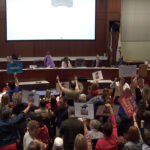
School board meetings, normally reserved for recognizing high-achieving students and budget discussions, have become political flashpoints filled with tension, anger, and chaos.
Five parents are now suing the school board to prevent the implementation of a more culturally responsive curriculum and a new reporting system for racist incidents in schools. LCPS believes these new policies would help fix long-running systemic wrongs, like discriminatory admission practices for high achieving programs.
The lawsuit alleges those plans are violating “the Constitution’s guarantees of free speech and equality before the law.” While the lawsuit itself does not mention “critical race theory,” a field of academic study that has become a national lightning rod for conservative outrage, both the law firm and the plaintiffs believe the action plan is explicitly tied to the teaching of it.
Meanwhile, students and school officials believe the controversy and attaching the phrase “critical race theory” to their equity work is little more than a political ploy.
Robin Reaves Burke, the NAACP Loudoun Branch chair of education and second vice-president, is the parent of a high schooler in Loudoun County.
She’s dismayed by what she sees at meetings, in the media, and from fellow parents.
“The NAACP has been fighting systemic racism in Loudoun County Public Schools for 80 years,” she says. “We didn’t hear… any discontent about the way the equity work was going until critical race theory was politicized. It makes me feel as a parent that I can not believe that the equity work has been hijacked for political gain.”
At the center of the parents’ lawsuit is a 22-page draft plan called “Action Plans to Combat Systemic Racism,” guidance created in August 2020 that is set to be implemented this coming school year.
The plan calls for numerous things, from implicit bias training and protocols for addressing racial slurs to prohibiting symbols that represent “hateful ideology,” like Confederate flags and swastikas. It establishes a “student equity ambassador” program designed to give a group of students a chance to collect student complaints related to experiences of racism, inequity, and injustice, and then anonymously share them with staff members. It would also create a separate electronic reporting system that would allow school officials to investigate reports of racism and discrimination.
“These opportunities will be used to amplify the voice(s) of Students of Color,” says the action plan.
Plaintiffs allege in their lawsuit that the student equity ambassador program, as well as the school system’s policy allowing students to anonymously submit experiences of racism, creates “explicit racial distinctions between its students” and “discriminates against students on the basis of their viewpoint.”
The suit aims to delay the action plan’s implementation in late August when students return to school and, eventually, dismantle the school board’s efforts all together.
All of this has come to a head in a growing, affluent suburban Virginia county known for its abundance of tech jobs.
But the county has undergone a significant demographic change in recent years – non-white students comprise 56% of the population, compared to 42% just 20 years ago. It has also seen a huge political shift in the last few election cycles, from a county that traditionally voted Republican to one that now decisively favors Democrats.
Yet there remains significant resistance to a curriculum that highlights that diversity and tries to correct systemic wrongs.
“There’s been a concerted effort by some to distort what the school division does, distort the nature and roots of our equity work [and] our diversity work,” Loudoun County Superintendent Scott Ziegler tells DCist/WAMU. “Some groups and organizations are distorting our message and making it controversial when it really should not be controversial.”
It’s not totally clear how critical race theory, a field of academia studying how racism is woven into American policy and laws, became associated with the equity work that LCPS are attempting to do.
But Loudoun County seems to be ground zero for the belief among some conservatives that primary schools across the U.S. are integrating this theory into their curriculum – a fear fomented by the Donald Trump administration, which banned teachings and trainings about it in federal agencies late last year, calling the theory “un-American propaganda.”
“We’re not teaching critical race theory. Critical race theory is a subject for academics. It’s not a course in K-12 education,” Ziegler says, reiterating what he’s said publicly for the past several months. “Now, it becomes difficult to even talk about things like equity and diversity, because those two words have been placed by some under the umbrella of critical race theory.”
Patti Hidalgo Menders is one of the plaintiffs in the lawsuit and is a mom to six boys, several of whom have attended Loudoun County schools over the years. Her youngest is 16 and in high school. Both she and her son are listed as plaintiffs in the lawsuit. (Menders declined to make her son available for an interview, citing privacy concerns).
She says LCPS’s action plan, the county school board, and Superintendent Zeigler all use language that, to her, means that the school system is teaching something akin to “critical race theory.”
“The superintendent can use different words – equity, diversity, inclusion, culturally responsive training,” Menders tells DCist/WAMU. “It’s all similar political ideology. And I wish that they couldn’t teach that to our children.”
Attorney Daniel Suhr of the Liberty Justice Center, a Chicago-based firm that is leading the lawsuit, also believes the policies are blatantly political.
“The problem is that Loudoun County is implementing this new political ideology in our classrooms in a way that shuts down students’ free speech and that discriminates between students based on their race,” he says.
But LCPS – and half a dozen students interviewed by DCist/WAMU – emphasize that these programs, plans, and policies are needed because the school system has long fostered an environment that discriminated against students of color.
In February 2019, a Loudoun County elementary school gym teacher had students act as runaway enslaved people while running through an obstacle course representing the Underground Railroad. The incident made national headlines. The school has since apologized for the “culturally insensitive” lesson.
Prompted in part by that incident, the county’s school system hired a third party to audit its curriculum. The auditor concluded that Loudoun schools had a “hostile learning environment” for students of color, particularly for Black and African American students. The June 2019 report noted that Black/African American, Muslim, and Latinx students, as well as those learning English, frequently experienced “the sting of racial insults/slurs or racially motivated violent actions.”
What’s more, LCPS staff were “unclear and fearful” around conversations about race as well as in responding to “racially charged incidents.” When disciplinary actions were taken, so says the report, they negatively impacted students of color.
Then, the NAACP Loudoun Branch filed a formal complaint about discriminatory admission practices related to the Academies of Loudoun, a STEM program for LCPS students. That led to an investigation by Virginia’s attorney general, who earlier this year determined that major reforms were needed.
“It was a combination of events that all happened, not in rapid succession, but really close to one another that led the school system to take action,” Ziegler tells DCist/WAMU.
Menders, for her part, says she doesn’t see any problems with racism or inequality in schools.
“I’ll be honest, we don’t talk about race. My kids don’t look through a lens of different skin colors,” Menders, who says she’s part Cuban, says. “I know the Attorney General said there is racism [in the school system], but I lived here for 23 years. What do they see that I don’t see?”
That’s different from what a number of LCPS students, both Black and white, told DCist/WAMU.
Several students said they consistently hear racial slurs and threats in the hallway and wish teachers were more responsive to calling out and punishing racist behavior.
“One of my friends got threatened that she would get her hijab pulled off,” says 14-year-old Shayne Mitchell, who’s white and a rising 9th grader at Rock Ridge High School. “We talk about that stuff a lot… we wish [school] could be more inclusive and made to feel safer.”
Anna, the soon-to-be 8th-grader, says she’s had slurs directed at her.
“Some people call me the N-word going to school,” she says. “Sometimes people can get away with being racist with little to no consequences at all.”
She says every day, she and her friends talk about race and what it’s like to be Black at their school. The hate speech prevents her from enjoying school, she says.
“It just makes me very angry and it just, kind of, messes up my day,” she says. “It makes me not want to go to school with the type of people I go to school with.”
Ziegler admits he’s heard similar sentiments from his own recent conversations with students.
“Our kids are saying, ‘You need to do better – for some of us, schools are not welcoming… Schools don’t feel safe. We don’t feel appreciated and welcomed in our schools,’” says Ziegler. “You know, it’s heartbreaking.”
Robin Reaves Burke remains hopeful that the steps being taken by LCPS, which also include the Comprehensive Equity Plan, are ones that will make LCPS be a place that’s welcoming to all. But there’s still work to be done including the need to have “hard town hall type conversations” with school officials.
For Anna, it’s obvious that the racist incidents that have taken place at Loudoun County Public Schools still profoundly impact her and her friends.
But these experiences taught her something about herself.
“I’ve learned that I’m an advocate and I stand up for what I believe in,” says Anna. “I try as much to help fight racism in the schools that happen to my friends or to me.”