 Cydney Grannan
Two Metropolitan Police Department officers provided harrowing testimony today as the House hearing on the Jan. 6 insurrection got underway.
MPD Officers Michael Fanone and Daniel Hodges joined U.S. Capitol Police Sgt. Aquilino Gonell and Private First Class Harry Dunn in offering details about their experiences that day and answering questions from House select committee lawmakers.
In their opening statements, Fanone and Hodges recounted being called to the Capitol that day to assist Capitol Police, describing in detail how they were attacked and beaten by insurrectionists.
Fanone, an officer with MPD for nearly two decades, has spent most of his career investigating narcotics traffickers and violent crime. Fanone told lawmakers he started his law enforcement career as a U.S. Capitol Police Officer, feeling called to serve after the September 11 attacks.
“Although I regularly deal with risky situations on the job, nowhere in my wildest imagination did I ever expect to be in that situation, or sitting here before you talking about it,” Fanone said in his opening testimony.
Fanone described hearing calls for help on Jan. 6. He and his partner, MPD Officer Jimmy Albright, went to the Capitol to assist officers. They headed to the Capitol’s Lower West Terrace tunnel, where Fanone describes 30 police officers, four or five abreast, bleeding and overwhelmed as they tried to hold a line against insurrectionists.
Fanone said that he and Albright asked the officers if they needed a break. “There were no volunteers. Selflessly, those officers only identified other colleagues who may be in need of assistance,” Fanone told lawmakers.
Fanone described how, upon joining the tactical line, he was dragged away by insurrectionists.
“They ripped off my badge, they grabbed and stripped me of my radio, they seized ammunition that was secured to my body. They began to beat me with their fists and with what felt like hard metal objects,” Fanone said. “At one point, I came face-to-face with an attacker who repeatedly lunged for me and attempted to remove my firearm. I heard chanting from some in the crowd, ‘Get his gun, and kill him with his own gun.'”
Fanone said he attempted to appeal to the insurrectionists’ humanity by saying, “I’ve got kids.” After that, Fanone said a few people protected him from the attackers until other officers could step in.
Fanone said he suffered a heart attack, a concussion, a traumatic brain injury, and post-traumatic stress disorder as a result of the Jan. 6 events.
After describing his experience, Fanone made a direct appeal to lawmakers, calling out those he says have minimized the events of Jan. 6.
“What makes the struggle harder and more painful is to know so many of my fellow citizens, including so many of the people I put my life at risk to defend, are downplaying or outright denying what happened,” Fanone said in his opening testimony. “I feel like I went to hell and back to protect them and the people in this room. But too many are now telling me that hell doesn’t exist or that hell actually wasn’t that bad. ”
Fanone continued, slamming the table for emphasis: “The indifference shown to my colleagues is disgraceful.”
Fanone expressed frustration that the investigation into the insurrection has become partisan.
“I agreed to speak here today and have talked publicly about what happened, because I don’t think our response to the insurrection should have anything to do with political parties,” Fanone told lawmakers. “I’ve worked in this city for two decades and I’ve never cared about those things, no matter who was in office. All I’ve ever cared about is protecting you and the public.”
D.C. Police Officer Daniel Hodges started his day on Jan. 6 at 7:30 a.m. with Civil Disturbance Unit 42, tasked with maintaining high visibility on Constitution Avenue. He described seeing men wearing tactical gear, including ballistic vests, helmets, goggles, and military face masks.
After de-escalating an encounter between a group of men and a counter-protester, Hodges said his unit heard a call over the radio for a rapid response to the Capitol at 1:30 p.m. His unit drove to the Northwest side of the Capitol grounds and attempted to march through the crowd.
Hodges described interacting with the mob. “One man tried and failed to build a rapport with me, shouting, ‘Are you my brother?'” Hodges told lawmakers. “Another takes a different tack, shouting, ‘You will die on your knees.'”
Hodges described those who overran the Capitol as “terrorists” throughout his testimony. He said he and his unit were attacked making their way to the Capitol. He said he was struck in the head by a heavy object, which likely led to a concussion. Hodges said he engaged in a struggle with one insurrectionist who attempted to disarm him.
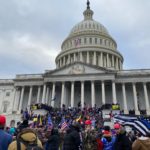
When Hodges got to the Capitol’s West Terrace to assist Capitol Police officers, he says insurrectionists were breaking apart metal fencing and bike racks, presumably to use as weapons. Others were scaling scaffolding to reach the Capitol building.
“The sea of people was punctuated throughout by flags,” Hodges said, including variations of American flags, Trump flags, Gadsden flags, and Christian flags.
“To my perpetual confusion, I saw the Thin Blue Line flag, a symbol of support for law enforcement more than once being carried by the terrorists as they ignored our commands and continued to assault us,” Hodges said.
Hodges described being called to help officers block off an entrance from a mob attempting to enter the Capitol. When he got to the front of the police line, Hodges said he pushed his way to the doorway and put his back against the metal door frame for support.
The mob began overpowering the officers, and Hodges described being pinned against the doorframe, unable to break free. Hodges said one attacker used a shield stolen from police officers to slam him into the doorframe. Another man took Hodges’ gas mask and used it to beat his head into the door.
“He never, ever uttered any words I recognized, but opted instead for guttural screams. I remember him foaming at the mouth,” Hodges said.
Hodges said the mob of insurrectionists started to coordinate their efforts, shouting “heave ho” as they pressed against the police line. The attacker in front of Hodges grabbed his baton and bashed him in the head and face.
“At this point, I knew I couldn’t sustain much more damage and remain upright. At best, I would collapse and be a liability to my colleagues. At worst, be dragged out into the crowd and lynched,” Hodges said. “Unable to move or otherwise signal the officers behind me that I needed to fall back, I did the only thing that I could do and screamed for help.”
Hodges said his fellow officers helped extricate him from where he was wedged between the mob and the door frame.
At the end of today’s testimony, select committee Chairman Rep. Bennie Thompson of Mississippi asked the officers what they would like to see the committee to do.
Both Fanone and Hodges urged the committee to go further and investigate the actions of elected officials and their staff that might have contributed to the Jan. 6 insurrection.
“In the academy, we learn about time, place, and circumstance in investigating potential crimes and those that may have committed them,” Fanone said. “And so the time, the place, and the circumstances of that rally, that rhetoric, and those events, to me, leads in the direction of our president and other members [of Congress].”
“I need you guys to address if anyone in power had a role in this, if anyone in power coordinated, or aided or abetted or tried to downplay, tried to prevent the investigation of this terrorist attack. Because we can’t do it,” Hodges said.
“I think the majority of Americans are really looking forward to that as well.”
According to the U.S. Attorney’s Office for the District of Columbia, more than 535 people have been arrested for crimes related to the U.S. Capitol breach.