Jacob Fenston
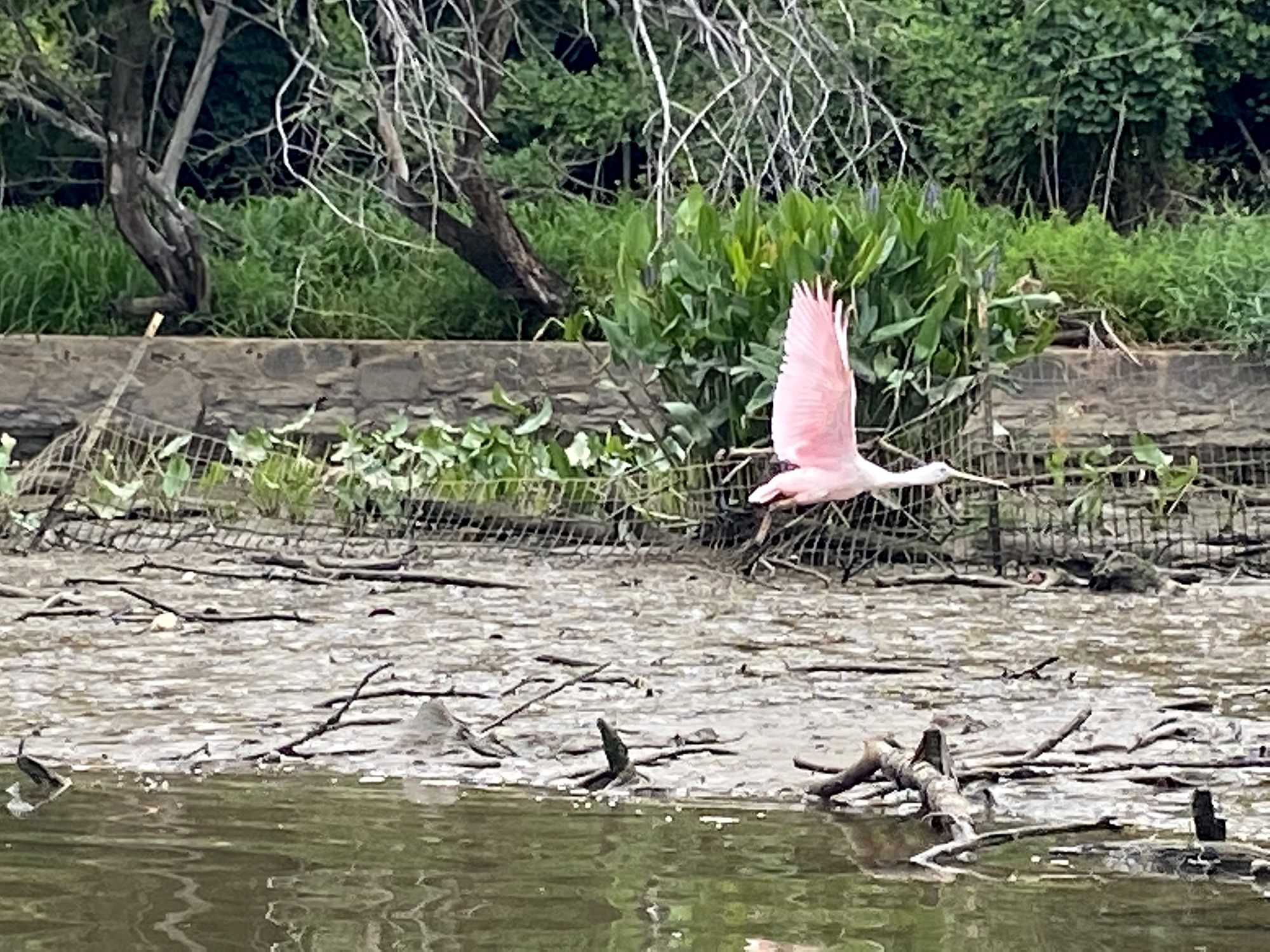
On a cool Saturday morning, rowing on the calm waters of the Anacostia River, you’d probably be surprised to see a large, bright pink bird hanging out on the mudflats near the Benning Road Bridge.
“My heart caught in my throat,” says rower and birder Jill Barker, of Arlington, who spotted the unusual bird this week during a sculling class. She instantly knew what it was: a roseate spoonbill. “It’s a very recognizable bird because it’s the color of a flamingo.”
As the name implies, it’s a pink bird with a long spoon-like bill. This one was a thousand miles north of its usual range, casually mingling with a flock of egrets. Barker’s sighting on July 31 was the first documented report of a roseate spoonbill in the District (outside, of course, the National Zoo). You’d expect to see a flock of the birds in Florida’s Everglades, or in Cuba or the Dominican Republic.
But in recent weeks, individual roseate spoonbills have been spotted throughout the Northeast, as far north as New Hampshire and upstate New York. Dan Rauch, a wildlife biologist with the D.C. Department of Energy and Environment, says an unusually early hurricane season could be the reason so many of the birds are straying north.
“Hurricane Elsa, when it came through — we’re talking about the middle of July — could have easily picked some of these birds up and gave them a good push and helped them to get a little further than normal,” Rauch says.
The spoonbill’s appearance in the District could also be related to climate change. Earlier and more frequent hurricanes are a result of warming oceans. Also, as the planet heats up, spoonbills are expected to expand their range hundreds of miles north, from Florida into North Carolina, according to the Audubon Society.
Rauch says the spoonbills spotted in the Northeast are not likely a sign of range expansion, however, given how suddenly they appeared.
“I don’t expect to see a colony of roseate spoonbills on the Anacostia anytime soon,” he says. “They will eventually reorient themselves and will head back back down to their normal range.”
When Barker saw the bird from her rowing shell, she pointed it out to everyone she passed on the river, “A few people were interested,” she says. “Birders are a weird group,” Barker says, because other people often don’t understand why they’re so excited about seeing a particular species.
Barker waved over her coach, Bob Reichart, who coaches with Capital Rowing Club, and told him what she’d seen.
“Not being a birder, I wasn’t very impressed,” Reichart says. Barker convinced him to motor over to see the bird to take some photos. Once he saw it, his attitude changed.
“It’s absolutely gorgeous,” Reichart says.
Reichart, who has been rowing on the Anacostia for a decade, says there’s been a noticeable increase in wildlife around the river in recent years, including bald eagles, osprey, blue heron and egrets. River otters, coyotes and beavers have also been spotted.
“With the new stormwater infrastructure that the city has been putting in, the water quality has been improving pretty consistently,” Reichart says.
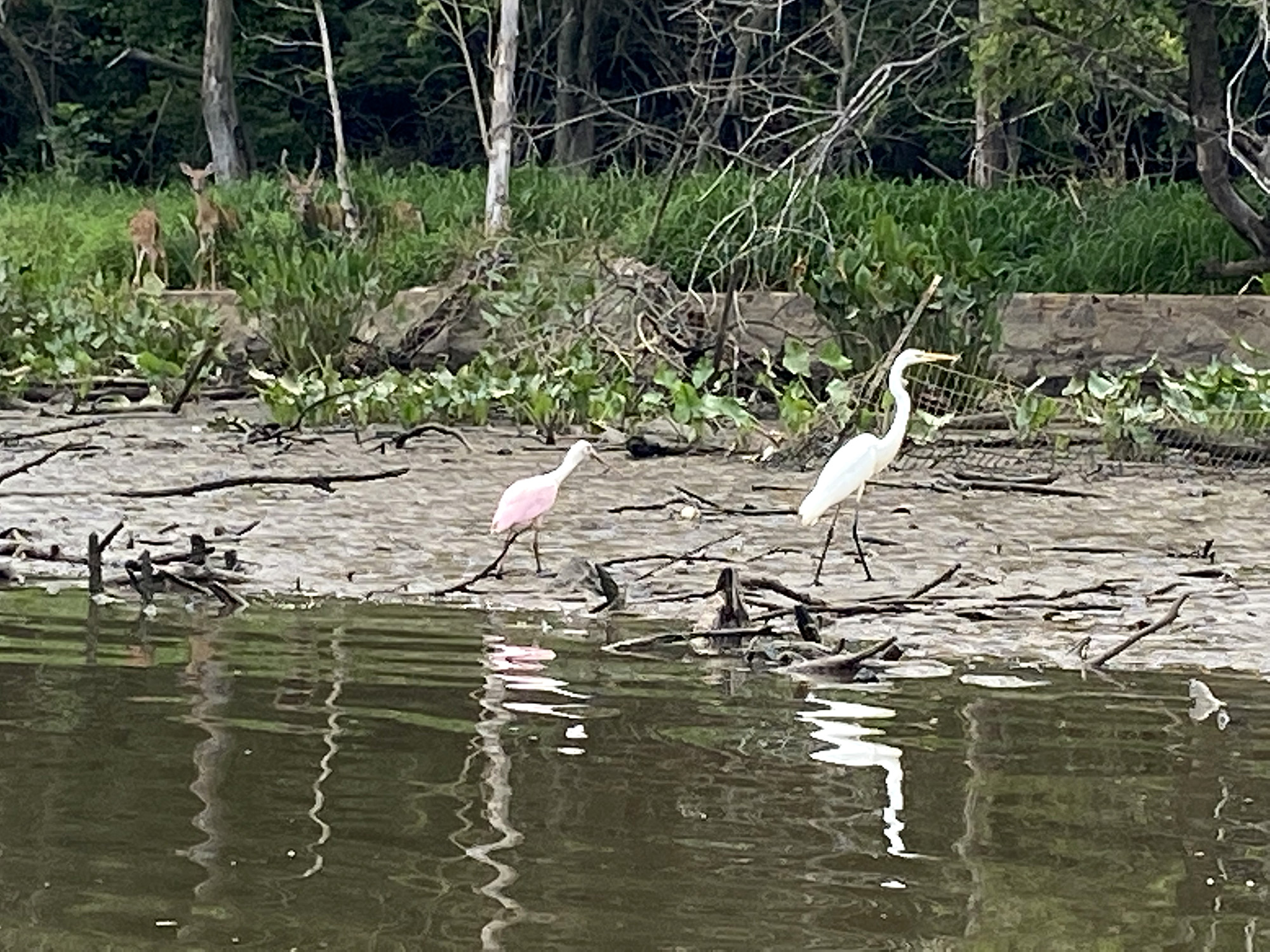
Rauch says the spoonbill hanging around the Anacostia could be a sign of the river’s improving health. “It could be a really good indicator that there are the crayfish and the small minnows and the other invertebrates it would need to survive in the mud banks or wetlands.”
Throughout the weekend, birders descended on the area to catch a glimpse of the rare bird. Dozens of them reported sightings and uploaded photos to the online portal, eBird. “We were all thrilled by such a special bird occurring in the District of Columbia,” says local birder Gerry Hawkins, who reported the bird at Kenilworth Aquatic Gardens on Sunday.
Hawkins says birding in D.C. is a special challenge — it’s a lot easier to find an unusual bird in a big state like Virginia or Maryland. “Any time you see a new bird in the District, it’s really, really thrilling for us,” Hawkins says.
Recently, there have been several local sightings of birds far outside their normal ranges. In December 2020, a barnacle goose sent birders on a frenzied goose chase around Hains Point and the Tidal Basin. In January 2021 a painted bunting, with shocking blue, yellow, green, and red feathers, drew crowds of birders to the C&O Canal.
When he spoke to DCist, Hawkins apologized for the noise in the background. “I’m actually at Kenilworth Aquatic Gardens,” he said. He was searching for another bird seldom seen in the area — a tricolored heron. “We’ll see if lightning strikes twice.”