Margaret Barthel
 Tyrone Turner
At just after 6:30 a.m. on Monday, the sun is coming up over the scoreboard on the football field at Annandale High School — and members of this year’s senior class are gathered in small groups eating bagels and lounging on blankets. This is Senior Sunrise, a yearly tradition marking the last first day of school for seniors.
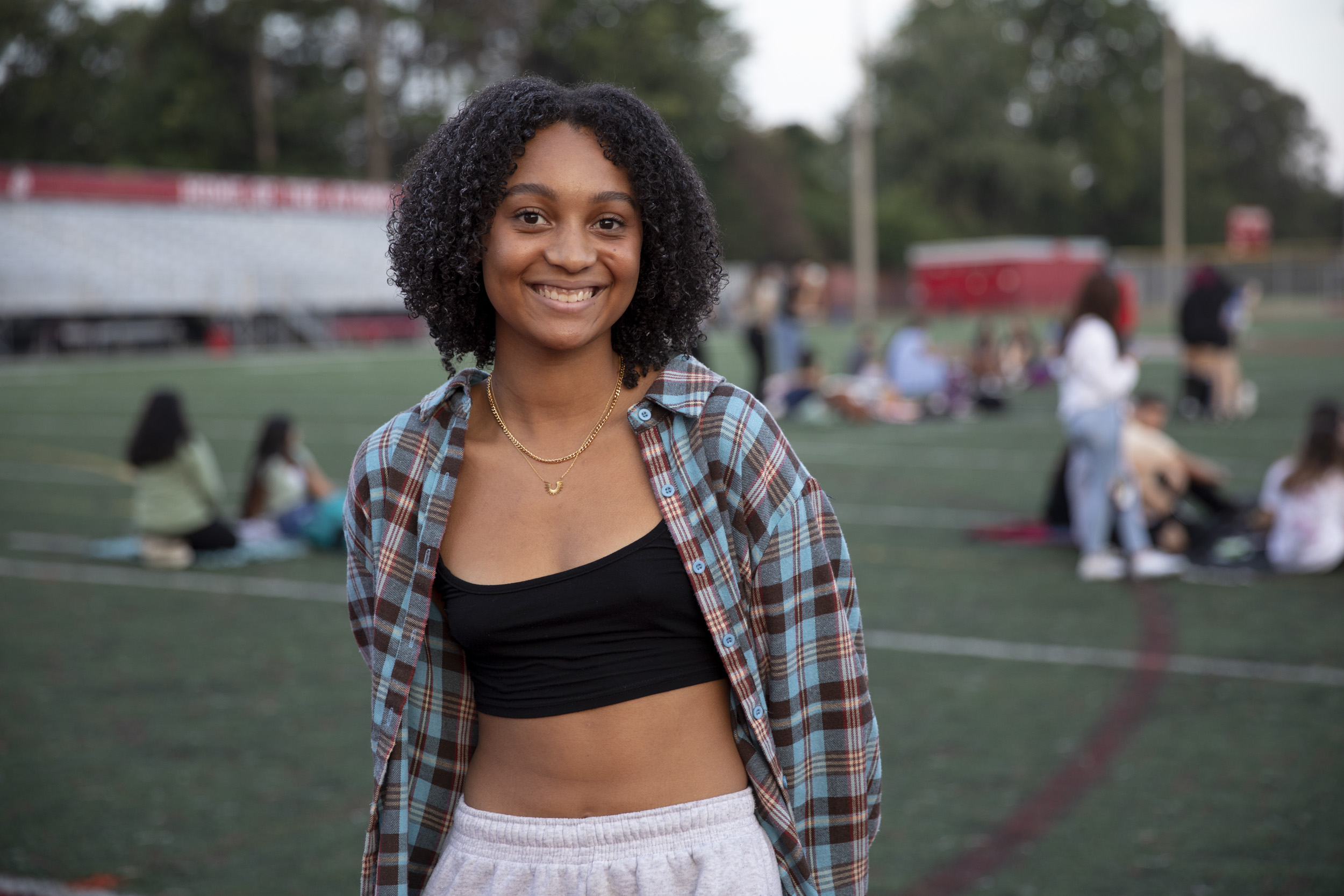
Class president Lauryn Mills, who helped organize the event, has a lot on her mind.
“I’m super excited but at the same time I definitely feel nervous, socializing again, speaking in front of people,” she says. “That’s definitely new to me. It’s my first year of being class president.”
Mills isn’t alone with this mix of excitement and nerves. The pandemic drastically changed the past two school years at Annandale and at schools around the D.C. region, forcing students to learn remotely. Last spring, some students returned to the building for hybrid learning, but this morning, as the seniors gather for their ritual, the school is gearing up to welcome the more than 2,200 students back to its classrooms five days per week for the first time since March 2020.
This year, Annandale will have a lot to contend with: the big transition from virtual to in-person learning; the wide range of social and emotional needs students may have while living through a global pandemic; and very real concerns about the pandemic itself, which, driven by the Delta variant, is surging again around the D.C. region.
And not all students have a sense of connection to the school itself. The freshmen and most of the sophomores have never been inside the building. Even the seniors at Senior Sunrise have only had one fully normal in-person school year here at Annandale, when they were freshman, senior Maxwell Lanham points out.
“Another normal year would probably be really good,” he says.
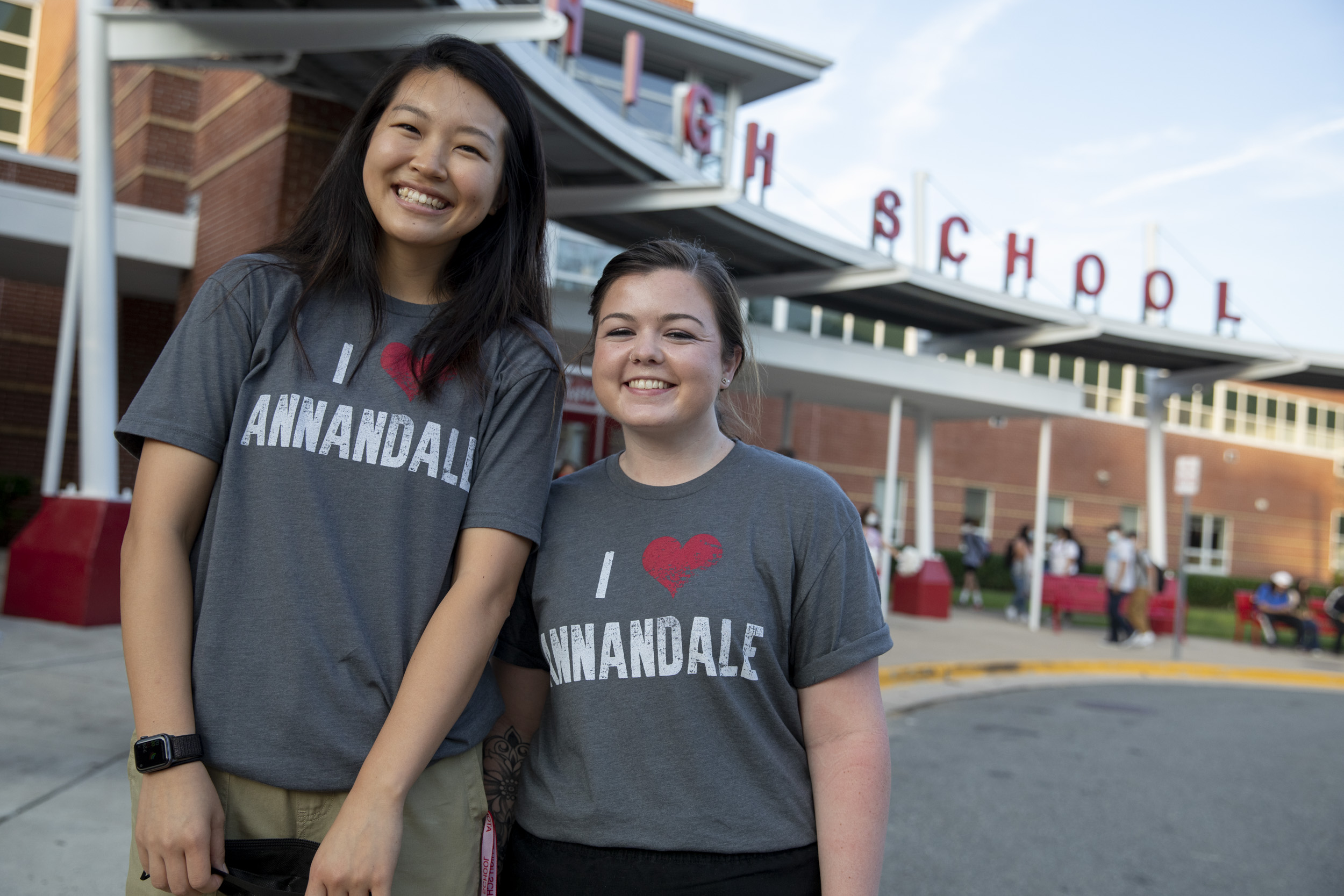
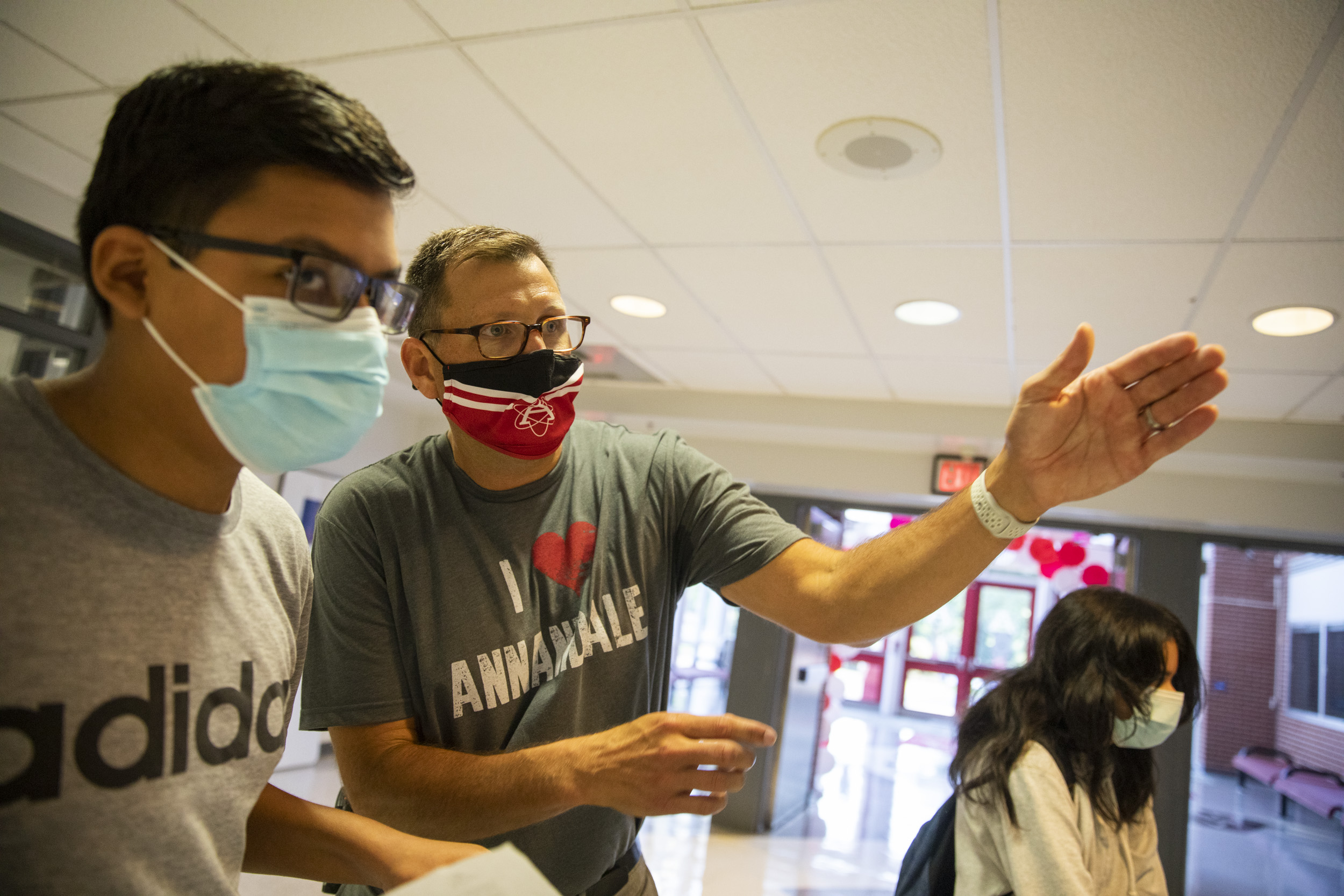
Annandale Principal Shawn DeRose is thrilled to welcome students back — he and all the other staff are wearing grey “I ❤️Annandale” t-shirts for the first day of school — but he’s also cognizant of the challenge facing the school this year.
In particular, he’s preoccupied with the social and emotional wellbeing of the school’s students, who come from more than 65 countries and speak over 60 languages — and who have likely all weathered the pandemic differently.
“We know that every student has been impacted, but specifically how they’ve been impacted, we really don’t know in most cases,” DeRose says. “So it’s this opportunity of just welcoming them back into the building, getting to build a relationship with them and understanding their story. And from there, then we can work towards academic growth.”
Math teacher Nicole Ferree agrees.
“I know there’s probably a lot of anxiety around being in the school again, so I think focusing on that and less of like, ‘oh, where are my students in their math content?’ will be more beneficial as a teacher,” she says.
That’s a lesson Ferree and fellow math teacher Allyson Pak learned in the pandemic, when they combined some of their classes for extra (virtual) social exposure. They’d spend significant class time — as much as 30 minutes — just talking with students about what was going on in their lives and how they were coping with the pandemic, in an attempt to break down the barriers of camera-off Zoom squares and connect.
“For a lot of us, the biggest part of teaching isn’t actually teaching the curriculum, but rather the relationship with the students,” Pak says.
While she’s thrilled to have students back in her classroom, Pak also notes that many teachers are coming into this transitional moment already worn out, even with school leadership emphasizing teacher wellness.
“Honestly, I think tired would be an understatement,” Pak says. “It just felt like we were working 24 hours a day, seven days a week, especially working from home. There was just no putting your laptop away.”
At least some of their students agree that the transition to in-person learning will be hard, but worth it.
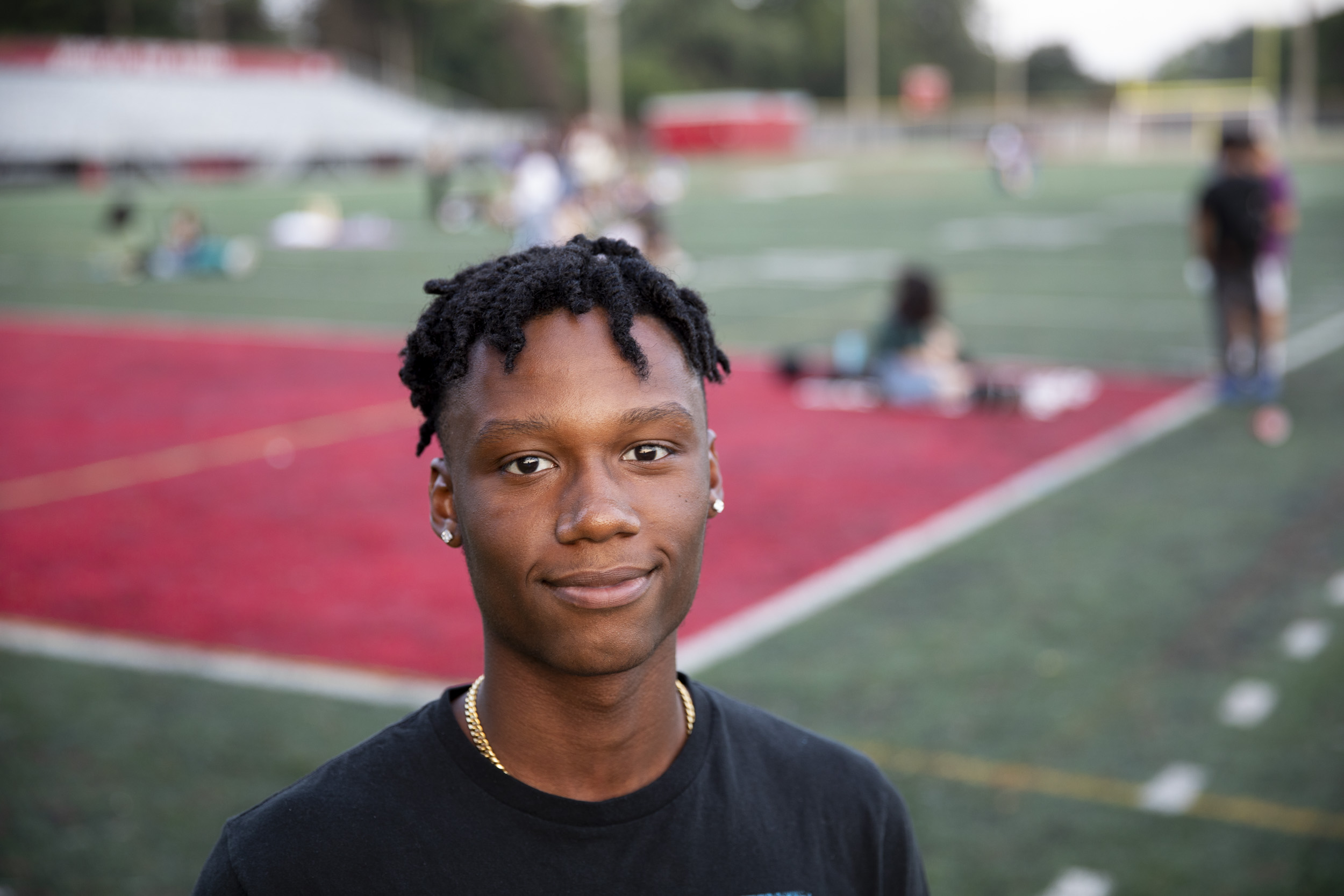
Maxwell Lanham says he thinks “getting back to it” academically will be the hardest thing about the new school year. He struggled to keep up with math in virtual class.
“[I’ll] probably learn a lot more this year than I did last year, that’s for sure,” he says.
For now, Lanham is trying to live in the moment: anticipating his return to basketball and track, and feeling pleased about his first day of school outfit, a Boyz N the Hood t-shirt, shorts, and a pristine pair of Air Jordan III sneakers.
“I’m used to getting up right before, like five minutes before school starts [at] 8:30,” he says. “Now I got to wake up [at] 7:10, drive my brother to school. I can’t be in my pajamas all day. I got to actually look decent.”
For her part, Mills says she’ll miss parts of virtual learning, which allowed her time to take mental health breaks to make herself a snack or do some painting, an activity which helps her deal with the stress of being an International Baccalaureate program candidate. And she has some concerns about the public health risks of in-person schooling.
“I keep my mask on and just not just for the safety of me, but for the safety of others,” she says. “[Annandale is] definitely a community where we live also with our older generations, which is something to consider. And you always don’t know who may have an underlying condition.”
COVID-19 transmission in Fairfax County is currently classified as “high” by the Centers for Disease Control and Prevention. The county’s new case rate is back at levels not seen since April of this year, before the peak of the vaccination drive. For all the excitement and joy of the return to classes, there’s a real possibility that this long-awaited in-person school year will be seriously disrupted by the pandemic.
George Mason University epidemiologist Amira Roess is concerned that transmission in schools will prolong the delta variant surge in the D.C. region. She says frequent testing and swiftly imposed quarantines will be key this school year, especially given the transmissibility of the Delta variant.
“We need testing to be done frequently and we need results to be turned around in a very timely manner in order to quickly identify positive individuals, especially asymptomatic positive individuals, and make sure that classes are sent home as early as possible following the identification of a positive individual in order to prevent widespread transmission in classes and in schools,” she says. “If we can do that, I think we can get ahead of this and we can avoid having hundreds of kids infected within a month of school starting. But that’s a tall order.”
Fairfax County Public Schools is requiring masks indoors for students and staff. The system is also requiring staff to get fully vaccinated by late October or face weekly coronavirus testing, following the lead of most other local public school districts. They also plan to use contact tracing and quarantine students who test positive, and are asking students and parents to self-evaluate their health every day using a screening questionnaire, though families will not have to submit anything to the school system.
As for the robust testing Roess recommends, the details in the Fairfax County plan are still unclear. On its return-to-school website, the school system says it is “in the process of partnering with a third-party provider to provide access to screening testing among other health service supports for FCPS students and staff.”
“We recognize that screening testing of individuals who are not fully vaccinated is important given the recent surge of the Delta variant,” the website notes. Other local school systems have more extensive surveillance testing protocols already in place: D.C. public schools will test 10% of students and staff every week, and Montgomery County plans to test all students and staff weekly.
Students and staff at Annandale say they’re nervous about the public health situation, but are trying to take comfort in the fact that all of Annandale’s student population is of age to be vaccinated, and are better able to wear masks for extended periods of time. A spokesperson for Fairfax schools said the system is not tracking the percentage of vaccinated students at Annandale. In Fairfax County, about 80% of kids 12-17 are partially or fully vaccinated.
Principal Shawn DeRose says the school has been trying hard to offer opportunities for students and their families to get vaccinated; the high school has so far hosted four vaccine clinics, with a fifth planned for this Saturday.
Parent Teacher Student Association president Norma Foti, the mother of a junior, is crossing her fingers that the student body will adhere to the public health protocols.
“You just have to hope that they’ll be responsible and do what they need to do, as well as the school,” she says. “And we work together to keep each other safe.”
On this first day back, almost everyone appears to be complying with the masking requirement. As the clock ticks closer to the opening bell, the entrance to the school bustles with activity: a dozen cheerleaders, pompoms swishing, line up on either side of the entryway. Members of the school band play. Two masked teachers hug. And in the thick of it all, there’s Principal DeRose, directing traffic in the turnaround and offering fist bumps — putting his philosophy of making students and their families feel welcomed back into action.
And the joy of being back is palpable. But so is the uncertainty hanging over this school year.
“I’m hoping that everything works out because I don’t want to go back into online learning,” senior Maxwell Lanham says. “That’ll suck.”