Matt Blitz
It was Sept. 7, 1971 when John F. Kennedy Center for the Performing Arts opened its doors to the public for the first time.
People poured into the grandiose building on that warm late summer day, some in t-shirts and shorts, according to accounts, others in hot pants and bare feet.
Everyone wanted to see the city’s new $70 million cultural center.
Of course, not all loved what they saw. Washington Post critic Wolf von Eckardt called it “a monument to mid-twentieth-century mediocrity” while another critic called the Kennedy Center a “cross between a concrete candy box and a marble sarcophagus.”
But, for some, its expansiveness only added to its appeal as a place to enjoy the arts.
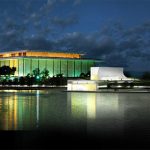
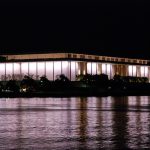
The Kennedy Center building is nearly 1.5 million square feet, sprawled across 17 acres of land, housing 10 performance spaces, some 400-plus rooms, and countless crystal chandeliers. At one time, it held one of the largest rooms in the world — the Grand Foyer — which is longer than the Washington Monument is tall. And that was before the Reach, the 2-year-old expansion with 130,000 square feet of public green space.
The center has played host to operas, ballets, screwball comedies, international festivals, presidents, icons honoring icons, fireworks, and countless other performing arts and events.
DCist/WAMU spoke with Kennedy Center archivist Sofía Becerra-Licha and vice president of international programming Alicia Adams, who’s worked at the center for nearly three decades, about the building’s unique history and the inside story of how the Kennedy Center came to be.
President Dwight D. Eisenhower signed the law to establish the “National Cultural Center” in D.C.
The idea of a national theater for the arts in the District dates back to 1933 when first lady Eleanor Roosevelt wanted a place that could provide employment for out-of-work artists during the Great Depression. After her husband’s death, that concept shifted to making the national theater a memorial to President Franklin D. Roosevelt.
But because of political tape, it took another eight years before Eisenhower signed the National Cultural Center Act. The 1958 law called for a National Cultural Center to be constructed in D.C. with privately raised funds, though the federal government provided most of the land.
It was the first time in history that the United States government helped finance the construction of a space dedicated to the performing arts following a bipartisan effort from Congress.

The Kennedy Center is the only monument to the slain president that’s allowed in the city.
During his short tenure as president, John F. Kennedy and first lady Jacqueline Kennedy were well-known advocates of the arts. While they weren’t the initial pioneers for a national cultural center, Kennedy did help popularize the idea by spearheading a national telecast to raise money for it (a 7-year-old Yo-Yo Ma performed for that special). When he couldn’t raise enough money in time, he signed an amendment in August 1963 that gave the Board of Trustees an additional three years to raise the necessary $30 million.
Kennedy was assassinated in Dallas three months later. Within days, members of Congress introduced bills to rename the cultural center after him.
On January 23, 1964, less than three months after Kennedy’s assassination, President Lyndon B. Johnson signed a bill officially renaming the center to the John F. Kennedy Center for the Performing Arts, making it the “sole national monument to his memory within the city of Washington.”
It’s also a “living memorial,” a public space for gatherings that’s always changing and evolving.
“It’s like the Washington Monument or the Lincoln Memorial,” says Adams. “This one is for Kennedy. It just happens to be a living memorial.”
The original design looked like a spaceship protruding out into the Potomac River.
The preliminary design for the Kennedy Center, first presented in 1959, looked nothing like the structure does today. It was rounded, sloping into the Potomac, and looked sort of like a UFO had crash-landed in the nation’s capital.
“It was very dramatic,” Becerra-Licha says. “What’s now the Terrace Theater was actually going to have a circular stage that would have rotated like a turntable … to the perspective of the audience.”
The design didn’t stick because of costs, environmental concerns, and because of the center’s location near National Airport. Designers had to consider extra soundproofing because of airplanes’ flight patterns over the center, according to Becerra-Licha.
Everyone wanted a piece of the Kennedy Center when it opened — literally.
In the eight years following Kennedy’s death, the former president and first lady grew in mythic status. Along with the nation’s collective grieving, many saw Kennedy as an American martyr who, if he had lived, could have united the nation through the challenges it faced in the 1960s. For many, the Kennedy Center’s opening represented a physical representation of that feeling — and a lot of people wanted an actual piece of it.
“One of the things that that quickly became apparent was just the power that [the Kennedy Center] held over folks,” says Becerra-Licha. “Security actually had to be increased … because people were literally taking pieces of curtains, sinks, tablecloths, and all sorts of things.” There are no precise details on how much was ultimately stolen from the center.
Jackie Kennedy remained a major proponent and fundraiser for the center after her husband’s death, acting as an honorary chair for the Kennedy Center’s opening and even helping design some of its interior aspects.
“There were people who, I think, physiologically thought Jackie picked out the curtains and they wanted to have a piece of something that she had touched in some way,” says Becerra-Licha.
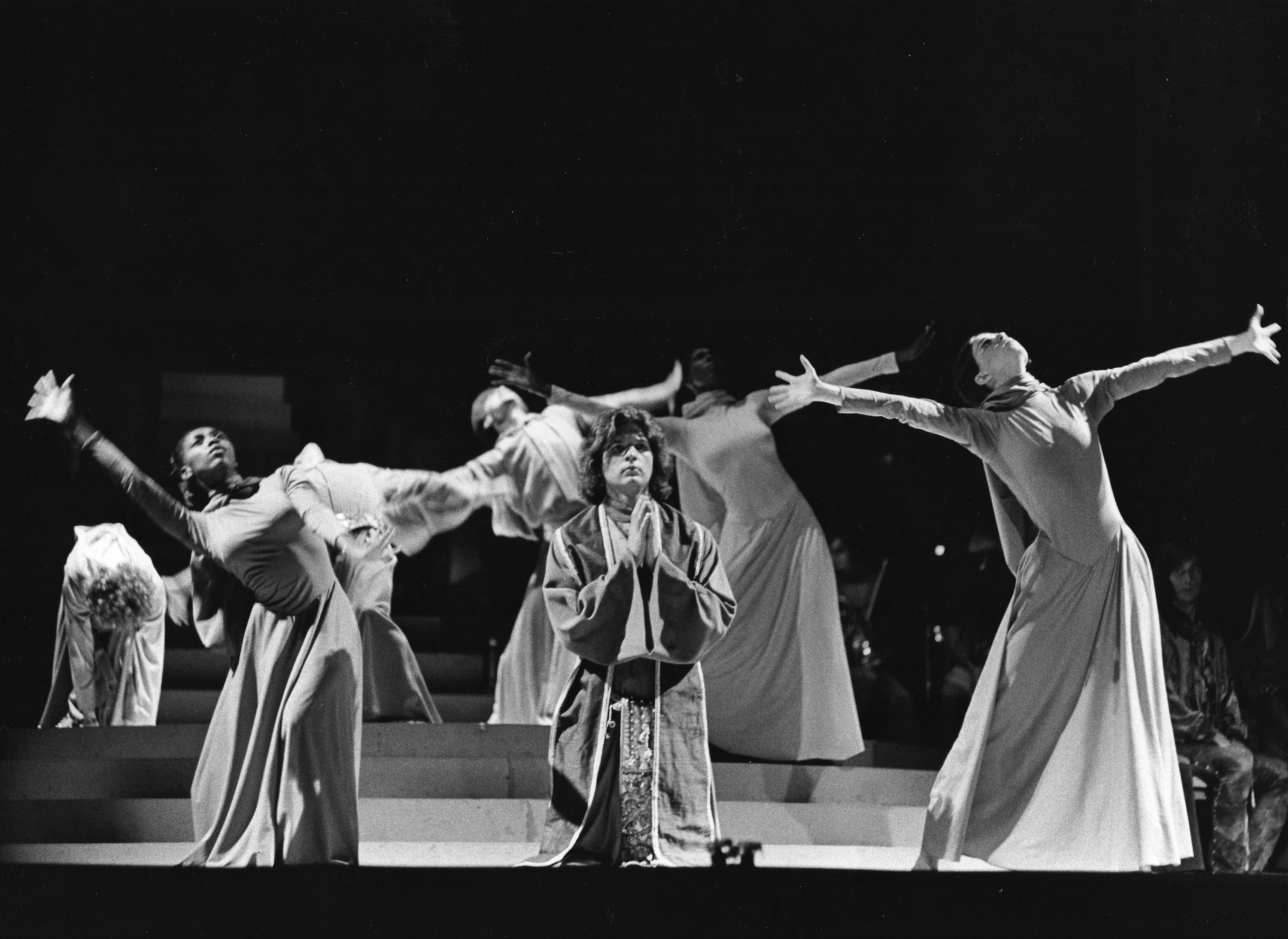
The Kennedy Center opened with a performance of Leonard Bernstein’s “Mass,” which President Richard Nixon didn’t attend due to its coded anti-war message.
Famed conductor Leonard Bernstein maintained a special relationship with Jackie Kennedy, having performed at her husband’s inauguration, his funeral, and at her brother-in-law, Robert F. Kennedy’s funeral.
When the time came, Jackie Kennedy personally asked the world-renowned composer to create an extravaganza for opening night at the Kennedy Center.
And he didn’t disappoint, creating “Mass: A Theatre Piece for Singers, Players and Dancers.” Using the Roman Catholic Mass as inspiration (Kennedy was the first Catholic to hold the office of the president), the 200-participant performance combined religious imagery with modern music and a secular narrative.
Unsurprisingly, it didn’t go over well with the church or then-President Nixon. In fact, the FBI believed the performance had hidden anti-government messages that were intended to undermine Nixon’s administration. The FBI told the president he shouldn’t attend and he obliged. Bernstein was no stranger to controversy, having once been blacklisted as a communist during the height of McCarthyism.
Jackie Kennedy, however, wasn’t there either. To this day, it’s unclear exactly why.
The Kennedy Center is full of prominently displayed gifts from across the globe.
Virtually anywhere you look while you’re in the Kennedy Center, you might see another gift from a foreign nation.
There’s the Lobmeyer Crystal chandelier in the Opera House from Austria. In the African lounge is a wooden sculpture representing Ghana’s grief over Kennedy’s death. There’s a mural based on the 4th-century calligraphy of Wang Xizhi, donated by the Chinese government.
Gifts also included stage curtains from Canada, dinner place settings from Finland, porcelain vases from Turkey, and mirrors from Belgium.
The building itself is built with 3,700 tons of Carrara marble, a gift from Italy that was worth at least $1.5 million in 1971 dollars.
That’s because Kennedy “was a believer in the arts as a mode of diplomacy,” says Becerra-Licha.
And items are still being found. As Becerra-Licha and her colleagues were cleaning out closets over the past year, they found a box of incense pieces among papers and files — a long-lost gift to the National Symphony Orchestra from the nation of Oman.
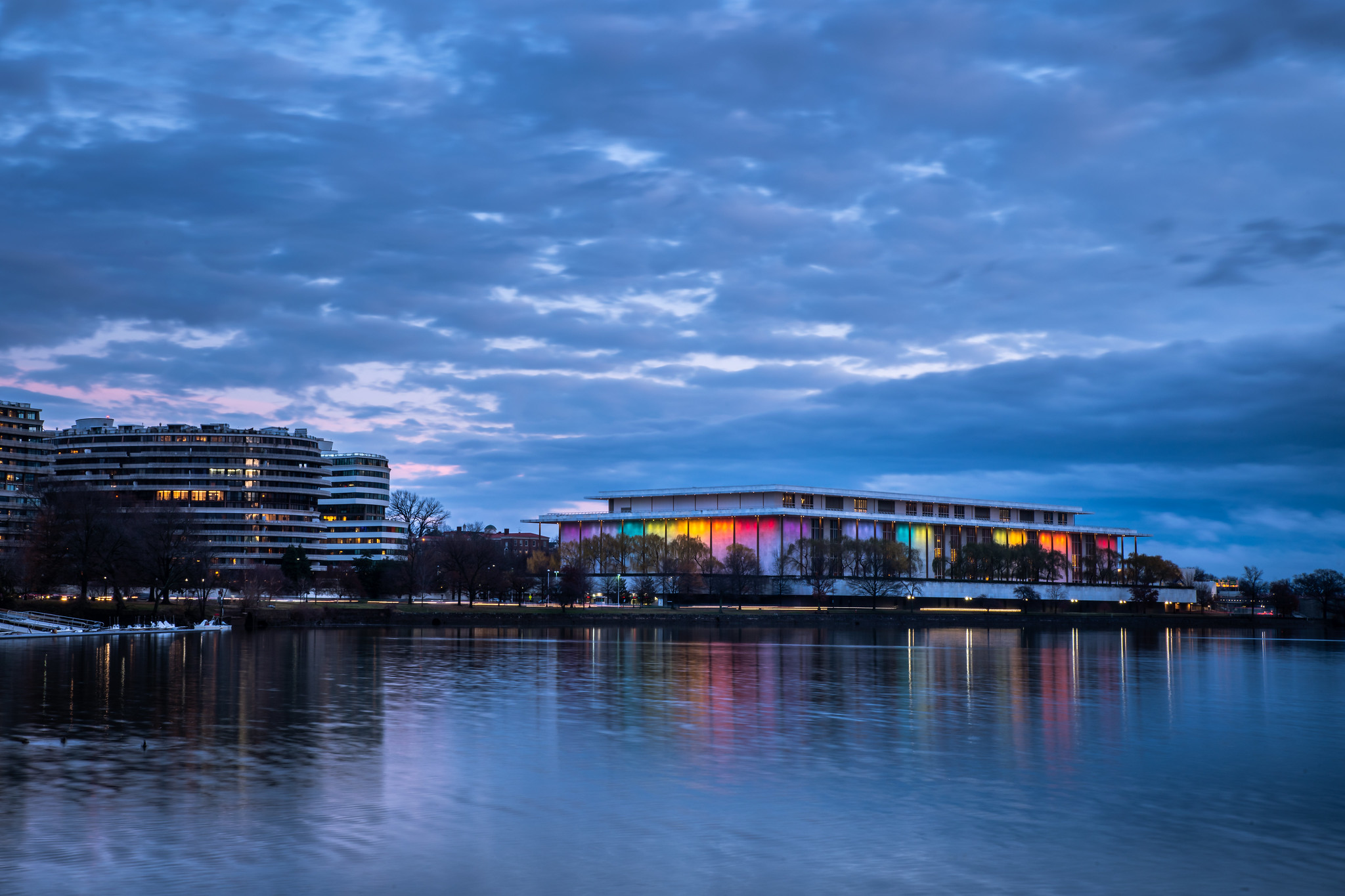
It’s played host to all types of performing arts — and a few other events in between.
Sure, ballets, symphonies, and Kennedy Center Honors with musical numbers from the likes of Aretha Franklin and Beyoncé tend to garner (well-deserved) attention. But those aren’t the only performing arts at the establishment.
Over the years, there have been dancers rappelling off the building’s roof, a celebrity armadillo race, and ice escapades performed on an 85×77 foot sheet of ice on the Opera House stage.
“As an archivist who is trying to keep water from pretty much everything, I feel for them,” says Becerra-Licha. “I have no idea how they pulled it off.”
The center also has played host to many international festivals, each with its own unique draw beyond the more traditional arts.
The 2005 Festival of China may have been the Center’s most ambitious, Adams says. She helped plan and execute the month-long celebration of Chinese performing arts.
There were 900 performers, 100 pianos, and three famed 2,200-year-old terra-cotta warriors.
“We were the first in the United States to bring the terra-cotta warriors [over],” Adams adds. “There were all of these protocols that go along with antiquities, special handling, security … it was challenging.”
The capper to the festival was a giant fireworks and pyrotechnic display — known as a “tornado” — on the Potomac. The fireworks show was so loud that some people thought a bomb had exploded.
“It made so much noise that people thought the city was under attack,” according to Adams.
What makes the Kennedy Center unique, Adams notes, is that it’s a performing arts space where such varied extravaganzas like this can happen.
“There is no other place in the country that can do what we do,” she says. “They’re big, they’re bold, and they involve many, many people.
You can learn more about the Kennedy Center and its 50th birthday by exploring its year-long free exhibit, “If These Halls Could Talk.”