Martin Austermuhle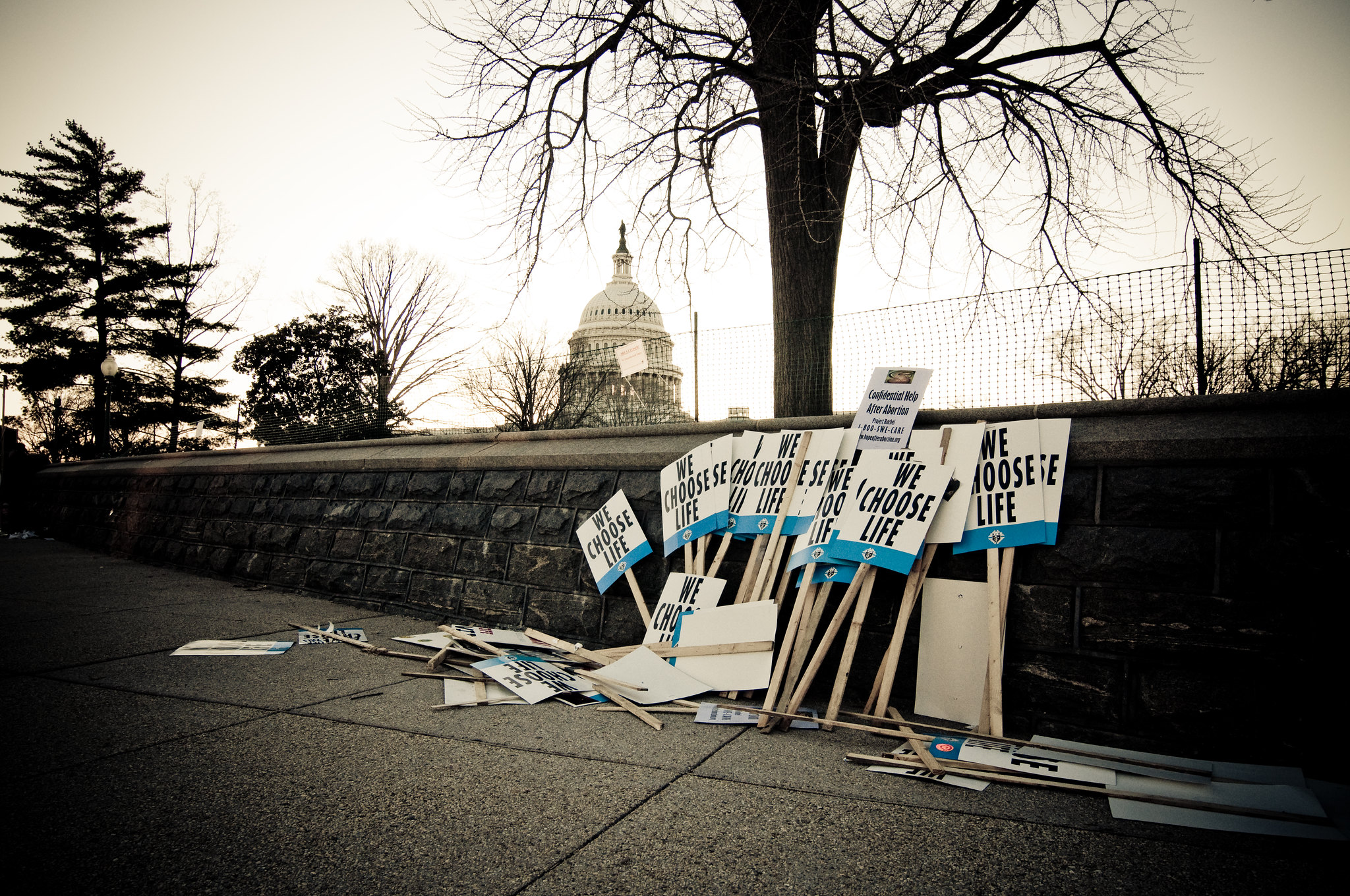
Democratic candidate Terry McAuliffe is pushing the issue of abortion rights to the forefront of his campaign against Republican Glenn Youngkin in the race for Virginia governor, seizing on a new Texas law that imposes significant restrictions on abortions and warning that Youngkin would do the same in Virginia.
“This should be a warning to all states in America that they could go the way of Texas unless we elect individuals who will be brick walls to protect women’s individual rights,” said McAuliffe on Thursday, the day after the U.S. Supreme Court declined to intervene against the Texas law, which largely prohibits women from getting an abortion after six weeks of pregnancy. “Here in Virginia is probably ground zero for this. I’m running against an individual who is probably the most anti-choice candidate in the history of Virginia.”
The controversy over the Texas restrictions comes only weeks before early voting starts in Virginia, and as polling finds McAuliffe holding a steady lead over Youngkin. (A poll from Christopher Newport University put him ahead 50-41, while another poll by Monmouth University had the Democrat ahead 47-42.) Still, Virginia’s off-year gubernatorial race has always shown a somewhat contrarian flare, with the winner often coming from the opposite party that holds the White House.
In seizing on the new Texas law, McAuliffe is hoping to energize Democrats. They “now have a powerful new issue, courtesy of the court,” tweeted Larry Sabato, the director of the Center for Politics at the University of Virginia.
He’s also aiming to press Youngkin on an issue that the former Carlyle Group CEO has largely tried to avoid since winning the Republican convention in May. While Youngkin touted his pro-life bona fides in the lead-up to the convention, he has since been more muted on the issue. In July, a liberal activist got him on tape conceding that abortion is a challenging issue in Virginia, where Democrats took control of the General Assembly in 2019 and no Republican has won a statewide election since 2009.
“When I’m governor, and I have a majority in the House, we can start going on offense,” he said of new restrictions on abortions. “But as a campaign topic, sadly, that in fact won’t win me independent votes that I have to get.”
In a sense, Youngkin was correct: for most voters, abortion isn’t a huge issue. According to the Monmouth poll, only 4% of registered Virginia voters said it was an important issue for candidates to address, trailing the pandemic, education, the economy, and jobs. (The poll was conducted before this week’s events, however.) And he’s also facing headwinds in Northern Virginia, the voter-rich area he calls home and where he needs to win votes if he is to prevail. According to the Christopher Newport University poll, McAuliffe is leading Youngkin there 59-33.
To that end, Youngkin has tried with abortion what he has done with issues like election fraud and Donald Trump: change the subject.
“What’s the difference between Terry McAuliffe and me?” he tweeted on Wednesday. “I spent today talking about creating jobs, restoring excellence in our schools, and keeping Virginians safe from rising crime. McAuliffe spent today fear-mongering about abortion.”
During an event in Northern Virginia that same day, Youngkin focused on taxes and jobs, at one point accusing McAuliffe of using the issue of abortion to “divide us again.” He was later pressed repeatedly by a reporter on where he stood on the Texas law. The Republican largely demurred, though he did say he supported exemptions to abortion restrictions in the case of rape, incest, or the woman’s health.
He then pivoted, saying that it was actually McAuliffe who is an extremist on the issue and that he was pushing to defeat “McAuliffe’s extreme agenda which promotes abortion all the way up through & including birth.”
On Thursday, Youngkin continued to push that line of attack, retweeting a conservative writer who said McAuliffe had once endorsed a proposal from Del. Kathy Tran (D-Fairfax County) that would have allowed abortion even during labor. (Tran said she had misspoken during a House debate.) His campaign later posted an online campaign ad making the same attack on McAuliffe.
Speaking to reporters on Thursday, McAuliffe said he supports Virginia’s current laws, which permit abortions until the third trimester, after which they are only allowed if the woman’s life is in danger. But he also said he wants to enshrine abortion rights in Virginia’s state constitution as a backstop for the possibility that the Supreme Court overturns Roe v. Wade, the seminal abortion rights case from 1973.
“I’d like to see Virginia enshrine Roe v. Wade because I’m really nervous about this Supreme Court and the antics they’re going to do,” he said.
And to the claim that he’s focusing on abortion at the expense of other issues, McAuliffe said that Texas-style abortion restrictions could have an impact on Virginia’s reputation as a business-friendly state.
“This will be so damaging to the Virginia economy if it passes,” he said, adding that he has pondered trying to poach businesses from Texas over the issue. “We should call Dell, we should call HP, we should call American Airlines and tell them, ‘Come to Virginia. We are a state that respects women’s individual rights.'”
It was less than a decade ago that Virginia was making headlines for imposing new restrictions on abortions, including a controversial law that would have required any woman wanting an abortion to get a transvaginal ultrasound. The bill was eventually passed and signed into law requiring just an abdominal ultrasound. In Jan. 2020, the new Democratic majority in Richmond voted to repeal the ultrasound law, as well as a separate provision requiring a 24-hour waiting period for an abortion.
The new Texas law could push abortion to the top of many political conversations in weeks to come, but how it plays out come November in Virginia remains to be seen. Pro-life forces could well seek to capitalize on the issue, and the March for Life will be in Richmond on Sept. 17 — the same day that in-person early voting starts across the commonwealth.