 Jordan Pascale
High price tags and infighting among local jurisdictions could play out in the future decision-making about Metro’s plans to expand the rail system to address capacity issues at the Rosslyn Tunnel.
Metro’s board, comprised of members from Virginia, D.C., Maryland, and the federal government, got its first chance on Thursday to digest the six options released earlier this week.
They range from doing nothing, which wouldn’t address the problem of congestion in the Rosslyn tunnel, to small tweaks like improving the bus network and shifting rail riders to the bus. Then there are several large ticket items like a $25 billion project to build a second tunnel under the Potomac River and running the Blue Line through Georgetown to Union Station, down to National Harbor, and then back across the river to Huntington.

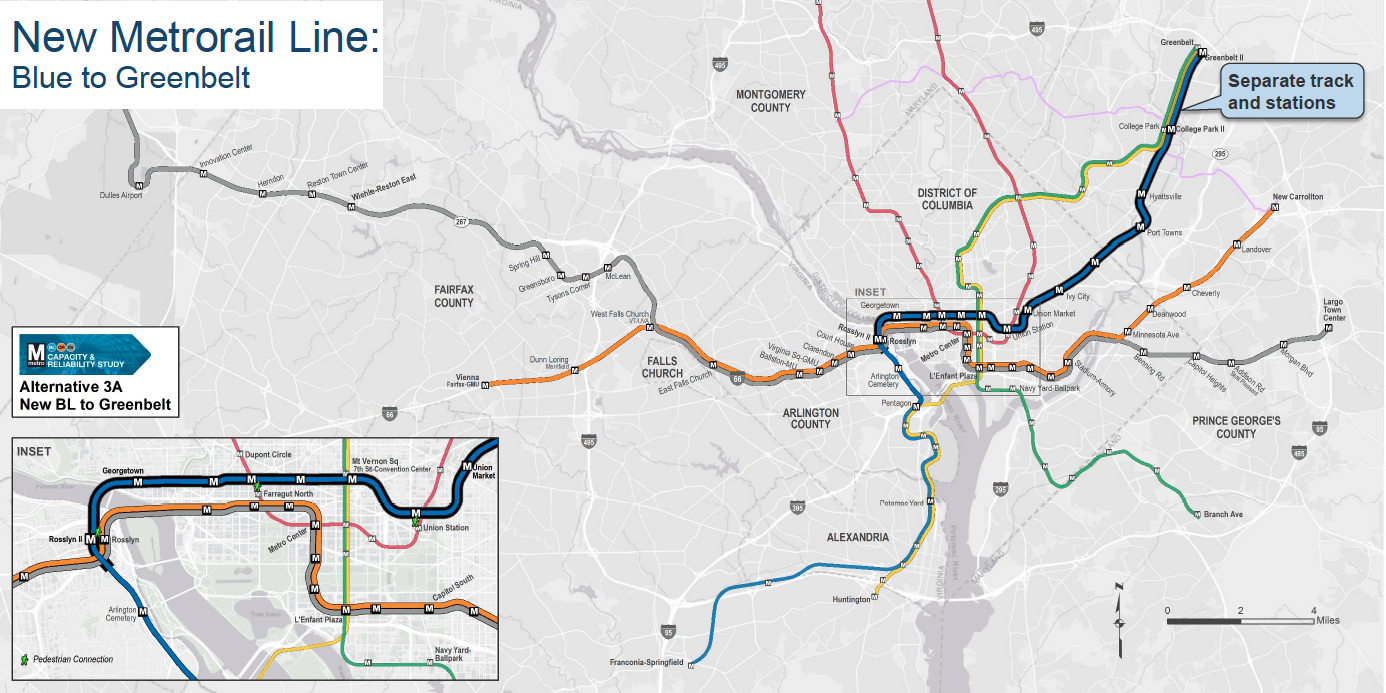


Most of the proposals include far more new stations in D.C. and Maryland, with various proposals adding stations in places like Georgetown, Union Market, and Ivy City in D.C. and Port Towns, Hyattsville, and Landover Hills in Maryland.
A Silver Line Express proposal would add a separate underground route, creating four new stops in Virginia, nine in D.C., and four in Maryland.
But a Metro analysis found that a new Blue Line loop to National Harbor would be the most costly at $20-25 billion to build and $175-200 million a year to run. But it would fix existing capacity issues at the Rosslyn tunnel; add the most additional trips, 180,000 more a weekday; and create the most revenue, $154 million a year.
It would create eight new stations in D.C., three in Maryland, and just one in Virginia — a second station in Rosslyn.
Already, Virginia’s representatives on the board, Chair Paul Smedberg, a Democrat and former Alexandria councilmember, and Matt Letourneau, a Republican on the Loudoun County Board, have expressed concerns about the cost and scope of the proposals.
“When you start floating projects that have $20 billion-plus price tags, they become sort of so impossible that I worry momentum won’t be there,” Letourneau said on Thursday. “There is some momentum, at least on the Virginia side to do something here while we have this moment [of focus on infrastructure]. I don’t want to miss that moment by shooting so big that we never get there.”
Smedberg agreed: “That is the consensus of a lot of people, not only in Virginia but around the region as well,” he said. Smedberg said he doesn’t think the issue is parochial, but regional since the trains run through all three jurisdictions. He said he’s open to any and all options and is looking forward to going through the study process.
But Smedberg and Letourneau also want to see narrower, less bloated proposals that address the main issue of tunnel capacity. Mark Phillips, a senior planner leading the project, said that was a complicated question with a complicated answer. In short, he said those proposals wouldn’t adequately address the crowding issues.
In one example, Smedberg wondered why Metro couldn’t just build a new tunnel and end in Georgetown or Foggy Bottom or connect back to the main system. Metro staff says that would create other issues and that most of these proposals need to end at a place where there is enough room for a turnaround or at an existing or new rail yard.
“I think if we’re just ending [the Blue Line] in Georgetown, then we wouldn’t be serving the primary destination points that Blue Line riders are going to,” Phillips said. “So we might take the Blue Line out of the tunnel, but we would just have transit riders who are going downtown to the McPherson Square area and Metro Center… they would just be transferring the origin Silver Line and we might not actually take care of the crowding issue.”
Jurisdictional self-interest and competing priorities have long been a part of the board’s history, whether it is trying to reduce costs for far-out suburban riders or fighting to get more bus service for riders in a respective state. Virginia got the most recent major Metro expansion, with 11 new Silver Line stations.
Representatives from Maryland and D.C. didn’t weigh in on the particular proposals but did have questions about the study process.
In an interview after the meeting, Letourneau said it was exciting to have a regional conversation about the future of Metro: where and who they need to serve.
“But at the end of the day, an element of realism needs to get injected. What can we reasonably accomplish?” he asked.
He says Virginia political leaders and the business community are plugged into the process, but he’s unsure they were prepared for proposals this size.
“I think there will be interest in Virginia for funding, but it needs to be a regional conversation with D.C. and Maryland to gauge level in interest in an investment this size,” he said.
On Tuesday, Metro General Manager Paul Wiedefeld said he hopes parochialism doesn’t become a factor in the process.
“I think it’s a good process. It’s a fair process. It’s a long process,” he said. “I understand someone may sit there and say, ‘Well, I know the answer is this.’ But we need to make sure we’re looking at all the potential answers, and then whittle it down, and then obviously, build consensus for whichever way you want to go.”
He also said he thinks any of the proposals are realistic, even with a high cost.
“If you start off thinking, ‘Oh my gosh, this is too expensive, we’ll never we get through the neighborhood and environmental issues,’ then you never move,” he said. “But I think these things coalesce, they build up momentum. We know there’s a bottleneck in the system and either we live with it for the next 50-plus years, or we start to do something about it.”
Wiedefeld stressed Thursday that the study is in its earliest stages. It launched in 2019 to address reliability, crowding, and other service issues caused by three lines sharing one tunnel under the Potomac.
“It’s really important to note that there is no staff recommendation today and no project has been selected at this stage of the study,” Wiedefeld said. “I think that’s very, very important that people understand that this is just another step in many steps along the way.”
Metro will host several events and other ways for the public to weigh in on the proposals this fall. The board will make a decision sometime next year. The environmental review, planning, funding agreements, and construction could take 20 or more years. It would also take a significant amount of federal funding.
Silver Line date moving again
Metro says they’re now hearing that the Silver Line expansion to Ashburn will not be substantially complete until November.
The Metropolitan Washington Airports Authority is managing the project and its contractors missed the previous Labor Day timeline for the project to be handed over to Metro. They are currently closing out a series of issues with the extension. Capital Rail Constructors say they are working on coordinating testing and “are working together to improve on the schedule, targeting a substantial completion in Q4.”
Meanwhile, Metro says it’s on track to hire the more than 450 people it will need to staff the extension. If the completion date continues to move back, MWAA would be on the hook for paying the salaries of the idle workers, according to Metro’s COO Joe Leader.
The transit agency previously said it would need six months of testing and training before the extension would be ready for riders. That means the opening date could be April or May. It was previously estimated to be February.
Federal government appoints three women to WMATA board
The number of women on Metro’s 16-person board increased from one to four on Thursday after three new members were sworn in during Thursday’s meeting.
The federal government appointed Sarah Kline and Kamilah Martin-Proctor as regular board members and Bryna Helfer as an alternate. They replace Steve McMillan, Devin Rouse, and Anthony Costa. D.C.’s Deputy Mayor Lucinda Babers was the sole female member of the board until Thursday’s additions were announced.
Kline is a former director of policy and government relations for WMATA and also worked at the non-profits Transportation for America and Reconnecting America. She now runs a transportation consulting firm.
Martin-Proctor is the chair of the Washington D.C. Commission on Persons with Disabilities and has consulted in the disability, diversity, and inclusion world for more than 20 years.
Bryna Helfer is the Assistant County Manager and Director of Communications and Public Engagement for Arlington County. She used to work as Deputy Assistant Secretary for Public Engagement for the U.S. Department of Transportation.