Jacob Fenston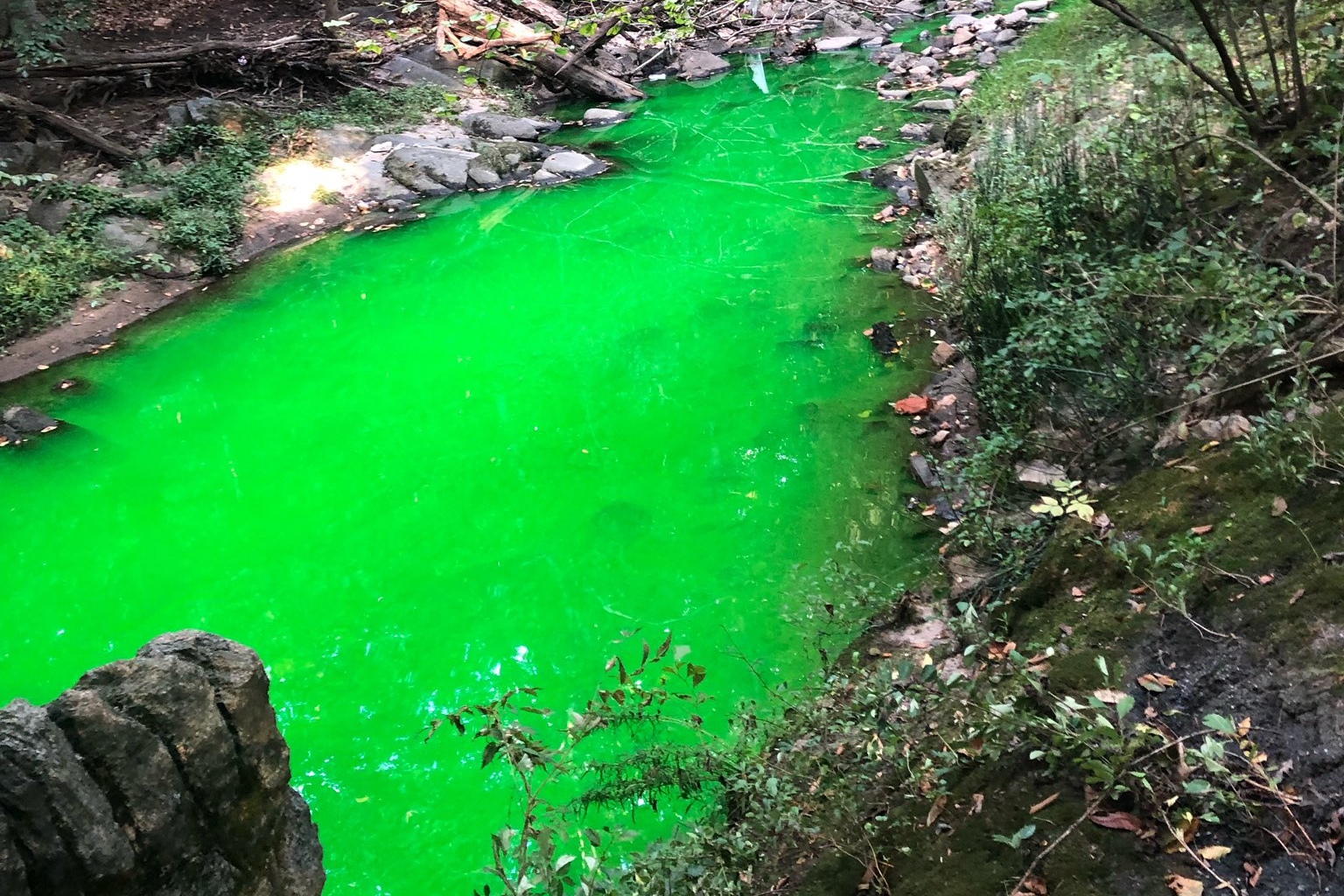
The water in Broad Branch, a tributary of Rock Creek, is never pristine; polluted by stormwater runoff, it seldom meets water quality standards for human contact. But on Sunday, the gurgling stream in Northwest D.C. glowed an unnatural, florescent green. Was this the toxic sludge that gave rise to the Teenage Mutant Ninja Turtles? Or an early St. Patrick’s Day celebration?
Just got these pics from a friend’s run this morning? Is this where Ninja Turtles come from? @McBorowik pic.twitter.com/BqbhUFm3Ry
— Christopher Naoum (@cnaoum) September 12, 2021
“We will round up the usual leprechauns and investigate,” DC Water wrote on Twitter.
Following the investigation, however, DC Water officials acquitted the mythical Irish fairies.
“As far as we know this was not the work of leprechauns or anything to do with St. Patrick’s Day,” DC Water spokesperson John Lisle tells DCist/WAMU. “It was actually just a dye test that was conducted by a member of our sewer services team.”
Lisle explains the technician used dye to try to determine the cause of flooding in a nearby house. After heavy rains in August, a family in the 3900 block of Military Rd. NW posted a video of their flooded backyard, with kids floating in a raft, saying it has been flooding for years.
@TenaciousTopper @dougkammerer @MayorBowser @DOEE_DC @DCDPW @capitalweather @washingtonpost Been #flooding like this for years no help from the #DCgovernment #cafritz bldg #militaryroad #connecticutavenue pic.twitter.com/RSzXruUs5w
— Colleen Quinn (@cmquinn22) August 20, 2021
DC Water used dye to confirm that drains behind the house feed into the stormwater system, which in turn feeds into Broad Branch.
“I’m hopeful for them that maybe it’s a problem in the the public sewer system — the stormwater line. If we can clear that out, that might provide them with some relief,” Lisle says.
Lisle says DC Water plans to return and attempt to flush out the the stormwater pipes, in case blockages are causing the flooding.
Broad Branch flows through the Forest Hills and Chevy Chase neighborhoods before emptying in to Rock Creek. The stream has been the focus of several years of restoration efforts, including “daylighting” a portion of the creek that had been in underground pipes. The house where the flooding occurred is about half a mile from the nearest daylighted portion of Broad Branch.
DC Water frequently use dye tests. But this case was slightly unusual in that it was conducted in the stormwater system; dyes are more often used in the sanitary sewer system.
“If there is a potential leak in a sanitary sewer, we use the dye to identify that leak and where it goes,” explains Lisle.
In other words: If you flush dye down a toilet and it ends up in the creek, you know there is a problem.
D.C.’s oldest neighborhoods — including Georgetown, Columbia Heights, and Capitol Hill — are served by an antiquated combined sewer system, where stormwater and sanitary sewage flow in the same pipes and overflow into local waterways during big storms. However, in relatively newer neighborhoods, including Upper Northwest where Broad Branch flows, there is a separate sewer system. This more modern technology means sewage from toilets and bath tubs won’t end up in creaks or rivers unless there is a leak.
Separate sewers, however, still dump plenty of pollution into waterways, including bacteria from pet waste and wildlife, road salt, sediment, and in this case, neon green dye.
Lisle says the dye is harmless in the concentration used, and dissipates quickly.