Jacob Fenston
The Fairfax County Board of Supervisors voted Tuesday evening to adopt a $0.05 fee on plastic bags, becoming the first jurisdiction in Northern Virginia to tax disposable shopping bags. The move was not without its detractors: among them, Fairfax resident Andrew Wheeler.
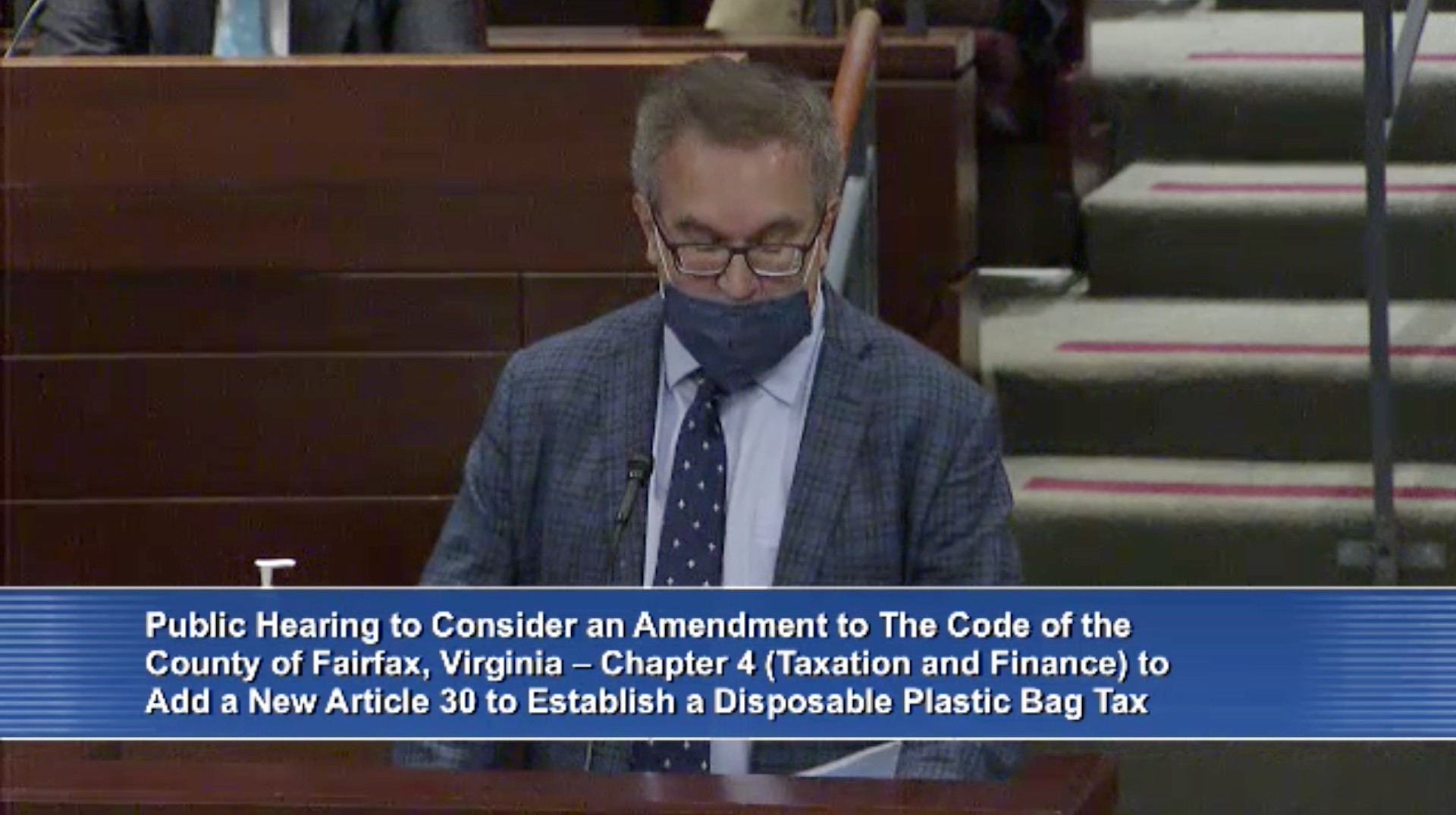
Wheeler, a former coal lobbyist who also ran the Environmental Protection Agency under President Trump, showed up at the Fairfax County Government Center to testify against the bag tax, wearing a dark blue gingham suit and a face mask not covering his nose.
“It is misguided, and could ultimately do more environmental harm than good,” Wheeler said of the bag fee, noting that reusable bags can also have a negative impact on the environment. He called the bag tax an “optical Band-Aid” that would have “little-to-no effect on the problem at hand.”
In a familiar Trump administration refrain, Wheeler blamed China. “The alarming truth of the matter is that over 50% of ocean plastics come from five Asian countries, China being the greatest offender by far.”
The board of supervisors voted 9 to 1 to adopt the bag tax, which will go into effect January 1, 2022.
By weight, plastic bags are a tiny fraction of the waste humans produce each day. But because of that minimal weight, they can easily be whisked into treetops, washed into storm drains, ultimately polluting local streams and rivers, the Chesapeake Bay, and the world’s oceans.
Plastic bags can be ingested by wildlife — sea turtles in particular are prone to mistaking them for jellyfish — and they can also break down into tiny bits, known as microplastics. High levels of microplastics have been documented in D.C. rivers and throughout the world. Microplastic particles work their way through the food chain, and into the diet of humans — one study found the average American ingests and breathes in between 74,000 and 121,000 such particles per year. While plastic particles contain a cornucopia of toxic chemicals, it’s not clear what effect they have on human health.
Nationwide, only 8% of plastics are recycled, but plastic bags are recycled at a much lower rate, as they are not accepted in most curbside recycling programs.
Wheeler argued the answer to the plastic bag pollution problem is not a bag tax, but for Americans to do a better job recycling.
“As Americans we don’t do a good job sorting our recycling materials,” Wheeler said at the hearing Tuesday evening. Wheeler is reportedly focusing on the issue of improving recycling during his post-Trump career.
Supervisor James Walkinshaw (Braddock District), who introduced the bag tax ordinance, disputes the idea that more recycling is the answer. “I want everyone to to be conscientious and recycle whenever it’s possible, but the reality is that plastic bag recycling is a difficult and expensive process,” Walkinshaw told DCist. “There’s a limited market for the materials, and the evidence of that is how few plastic bags nationally are recycled.”
Bag taxes have been highly effective at curbing pollution elsewhere. In D.C., which adopted one for the first bag fees in the country in 2009, 72% fewer plastic bags were collected at trash cleanups after the fee went into effect, and 80% of residents surveyed reported using fewer plastic bags.
Testimony on the bag tax in Fairfax was mixed, with many residents speaking in favor, and many against. Supervisor Pat Herrity (Springfield District) was the only lawmaker to vote against the measure.
“We’re in the middle of a pandemic and we’re going to add a tax burden on our residents, a regressive tax burden on our residents, the ones that least can and can least afford it,” Herrity told DCist. “To me, if we want to change people’s behavior, we should be doing it through education and giving people choice, not through taxing them into doing something.”
Money raised by the tax will go to litter prevention and cleanup efforts, as well as to provide reusable bags to low income residents.
Kambiz Agazi, director of the county’s office of environmental and energy coordination, said he hopes the tax doesn’t actually raise any money. “We are not looking to collect revenue, that is not the purpose of this plastic bag tax,” Agazi said in an interview with DCist. “The purpose is really to transform our community — it’s a way for us to rethink the way we use plastics.”
Agazi says the bag tax has been in the works for many years. “In Fairfax County we were talking about this in the early 2000s,” he says. But until last year, Virginia localities did not have the authority to establish such taxes. In 2020 the Virginia General Assembly passed legislation allowing counties and cities to tax disposable plastic bags. Paper bags were not included in the legislation, though some environmentalists argue paper bags should also be discouraged, as they are not without environmental impacts.
Now that bag fees are allowed, Arlington and Alexandria are also set to consider such policies. Both are set to vote on the issue at meetings on Sept. 18.
Elsewhere in the D.C. region, Montgomery County has a 5-cent fee in place, and Maryland state lawmakers have recently been pushing for a statewide disposable bag ban.