Martin Austermuhle
The fight over one of D.C.’s most infamous fast food restaurants is over. Or is it?
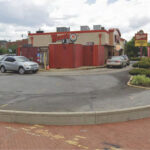
On Tuesday, the Wendy’s located at the notorious intersection of Florida and New York avenues NE, informally known as Dave Thomas Circle, closed. The closure comes after D.C. claimed eminent domain on the triangular shaped lot of land on which the restaurant stood for almost four decades, seizing the land as part of a broader plan to rework the dangerous and traffic-clogged intersection. (Wendy’s did not own the land, but rather leased it for a restaurant, which was run by a franchisee.)
Despite the fact that D.C. paid out $13.1 million for the land as part of the process, Wendy’s itself has been frosty about the whole situation — and is still pursuing legal claims against the city.
In court filings late last week, Wendy’s attorney Mark “Thor” Hearne — a well-known eminent domain litigator and attorney for former President Donald Trump in his attempt to stop vote-counting in Michigan — raised two issues: the fate of the site until construction on the new intersection begins, and whether Wendy’s will get any money from the city.
“Taking possession of Dave Thomas Circle without promptly demolishing the existing structures signs and trade dress associated with Wendy’s will result in a vacant property sitting at this location, which may be defaced with graffiti and used by trespassers and others in a manner that is detrimental to the community and will certainly diminish Wendy’s brand and significantly damage Wendy’s remaining property interest,” Hearne wrote. “Wendy’s has repeatedly asked the District to say when the District plans to remove and demolish the existing improvements from Dave Thomas Circle. The District has not answered.”
Hearne — who did not respond to a request for comment — is asking the judge overseeing the eminent domain case to order D.C. to demolish the restaurant as quickly as possible.
He is also asking for compensation for Wendy’s, under the logic that, even though the chain did not own the land the restaurant sat on, it benefited from the location.
“The land upon which Wendy’s has operated this restaurant is a popularly and internationally known location… the name, location and identity of this property as Dave Thomas Circle is a highly valuable property interest of Wendy’s,” Hearne argued. (The intersection, which handles some 70,000 cars a day and was among the most crash-prone locations in the city, has often been referred to using pejoratives.)
In a statement over the weekend, Wendy’s said it is looking to ensure “we are compensated appropriately for the restaurant relocation, and for our lost name and business association between the Dave Thomas Circle and the Wendy’s brand.”
The chain made a similar request for money earlier this year, which D.C. rejected when it said it would pay the $13.1 million to the owner of the land, not the fast-food chain itself. D.C. is helping the operator relocate the restaurant to another location, which has not yet been publicly identified.
In a court filing Saturday, D.C. Attorney General Karl Racine rejected Wendy’s demands for an immediate demolition of the restaurant, saying the chain does not own the building or what’s in it and that it is “speciously claiming speculative future damage to Wendy’s Properties brand from a vacant building.” Racine also wrote that D.C. plans to erect a fence on the property in early October — the restaurant’s operator will vacate on Sept. 30 — “to preserve public safety until demolition can occur.”
D.C. has only used eminent domain on a small number of occasions in recent years — in 2016 it took homes from a controversial developer for use as affordable housing, and in 2018 an auto repair shop along Kenilworth Avenue to build a new pedestrian bridge — and few attract much attention or prompt drawn-out legal fights.
One that quietly has, though, involves a few parcels of land along the Anacostia River owned by developer Doug Jemal that D.C. took three years ago as part of the construction of the new Frederick Douglass Memorial Bridge. While the city paid out more than $50 million in compensation, Jemal has reportedly asked for more. Racine’s office is preparing to go to trial to settle the matter, and this month posted an internal job listing for attorneys to take this case.
“This is a chance to go up against the legendary criminal defense lawyer Reid Weingarten and his team of five Steptoe attorneys representing iconic real estate entrepreneur (and recipient of recent Trump presidential pardon) Douglas Jemal, who by his own account, ‘takes no prisoners,'” reads the job listing. “Follow in the footsteps of the late F. Lee Bailey and help the District secure a major victory in the sure to be exciting jury trial.”