Jacob Fenston
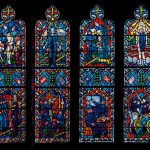
Renowned artist Kerry James Marshall will create new stained-glass windows for the National Cathedral with a racial justice theme, to replace two old windows depicting Confederate generals.
In addition, poet Elizabeth Alexander will write new verses to be inscribed on stone tablets by the windows, covering old tablets that venerated the lives of Confederate soldiers.
The Confederate windows were removed in 2017 following the deadly white supremacist rally in Charlottesville, Va., and amid a growing movement to remove monuments and names glorifying racist figures. The windows and inscriptions in question “were a barrier to our mission and an impediment to worship in this place,” said Reverend Randy Hollerith, dean of the cathedral, during a press conference Thursday morning. The windows, located on the southern wall of the massive building’s main worship hall, “had no place being in sacred space,” said Hollerith.
Hollerith, in announcing the selection of Marshall, called him “one of our nation’s greatest artists,” who will create new windows “that will be a richer and more fuller expression of the nation we want to be and the ideals that we strive for as a country.”
Marshall, who has been a respected artist since the early ’90s, is known for his depictions of Black life in America, with figures depicted in ebony black paint. He has been named one of Time’s 100 most influential people and has received a MacArthur “genius” grant. The New Yorker recently called him “a virtuoso of landscape, portraiture, still-life, history painting, and other genres of the Western canon since the Renaissance.”
One thing Marshall hasn’t done, though, is create stained-glass windows. He appeared unfazed by the new medium, however.
“Being an artist means that you work with images, you work with ideas,” said Marshall during the press conference. “Once you understand the dynamics of the medium, what the medium does best, you construct your images and your ideas around what you think the optimal qualities of the medium are.”
The removal and replacement of the Confederate windows is a long time coming. It was first proposed by Cathedral leadership in 2015. Then, in 2016, the Cathedral instead removed two Confederate flags from the Lee and Jackson windows, replacing the small rectangular planes with plain colored glass, but leaving the windows themselves in place. The windows were originally donated by the Daughters of the Confederacy and installed in 1953.
The old windows are currently on display at the Smithsonian National Museum of African American History and Culture, in an exhibition on the legacy of Jim Crow.

Since the windows’ removal, a committee has been working on a plan to replace them. Hollerith says the committee’s mandate for the new windows is “to create for all time an artistic embodiment of both darkness and light, the pain of yesterday and the promise of tomorrow, and the quiet and exemplary dignity of the African American struggle for justice and equality.”
Marshall called that challenge “a monumental task.”
“I think the creation of images is a really an immense responsibility, because the hope is that you could create images that can live way beyond the moment in which they were made,” said Marshall. To do that, he said images had to be “open enough and generous enough and meaningful enough for people to want to invest them with the kind of life and longevity that would make generations of people believe that they have value to them.”
Marshall grew up in Birmingham and Los Angeles, later moving to Chicago. He said it was his first visit to the National Cathedral, and he didn’t yet have any ideas for the window designs to share. But he did say the images couldn’t have “too much specificity.”
“It can’t rest too much on the identification of particular individuals, because the more it does that, the more it narrows the scope of the work’s performance.”
Meanwhile, poet Elizabeth Alexander, who grew up in D.C., was unable to attend the press conference, but said in a statement that she “spent time throughout my childhood in the hallowed cathedral.”
“I am incredibly honored to be a part of the National Cathedral’s effort to ensure that those who worship within its sanctuary know that it is truly a space for all people, and that the stories relayed through its sacred walls, windows and other iconography represent the truth of our nation,” Alexander said.
Alexander is president of the Andrew W. Mellon Foundation, which is one of the funders behind the window replacement project.