Jacob Fenston
Many parks in the D.C. region are long and skinny, along the banks of creeks and rivers, and criss-crossed with roads and trails. This fringe forest, with lots of sunlight and water, is perfect habitat for many invasive plants — they can soak up the sun, growing faster than native plants and outcompeting them.
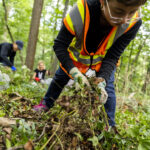
Hundreds of volunteers plant to tackle the problem in the first regional “weed wrangle” in the area on Saturday. There will be events at 20 weed-choked locations in D.C., Maryland and Virginia (you can see those locations and register to attend here).
“Our public lands are really important carbon sinks and are providing climate resilience for our region,” says Jeanne Braha, executive director of Rock Creek Conservancy, one of the groups organizing the event. “But those forests are really fragile and they’re threatened by invasive species.”
There is a long list of invasive plants in the region — everything from grasses to trees — but some of the most problematic are vines. Invasive vines in sunny locations can quickly climb into the treetops, killing trees by blocking out the light, toppling them with excess weight, or strangling them and cutting off nutrients. Braha says some of the main invasives being targeted this weekend are English ivy and winter creeper.
Jorge Bogantes, with the Anacostia Watershed Society, is organizing one of the Weed Wrangle events at the Langston Golf Course on Kingman Island. He says it’s a great workout, and a good way to release energy.
“You’re going to be cutting, uprooting, yanking invasives. That’s normally pretty cathartic for the many people,” he says.
Bogantes says Kingman Island hosts plenty of wild creatures, even around the golf course, which has thin strips of forest around the sprawling greens. There are foxes, coyotes, and lots of frogs and turtles, he says.
“Even in this sort of remnant, crappy urban habitat, you can find a lot of wildlife. What we’re doing is enhance it to make it even a better habitat for wildlife,” Bogantes says.
The invasive removal will be followed by plantings of native species in the fall.
“It is going to be a long war,” says Ana Chuqiun, botanist for Rock Creek Park. “The invasion hasn’t been something that happened right away. It’s happened slowly, little by little, through different means: through water, through air, through humans.”
Humans brought the invasive plants to North America from Asia and Europe, then helped them spread, sometimes inadvertently, sometimes purposely planting them.
Chuquin says the weed wrangle will not only provided much-needed volunteer labor, but will also help educate the public about the problem of invasive plants, and the role residents can play in fighting them — either through removal, or avoiding planting them to begin with.
The weed wrangle is scheduled to coincide with National Public Lands Day, which is dedicated to enjoying and conserving public lands.