Colleen Grablick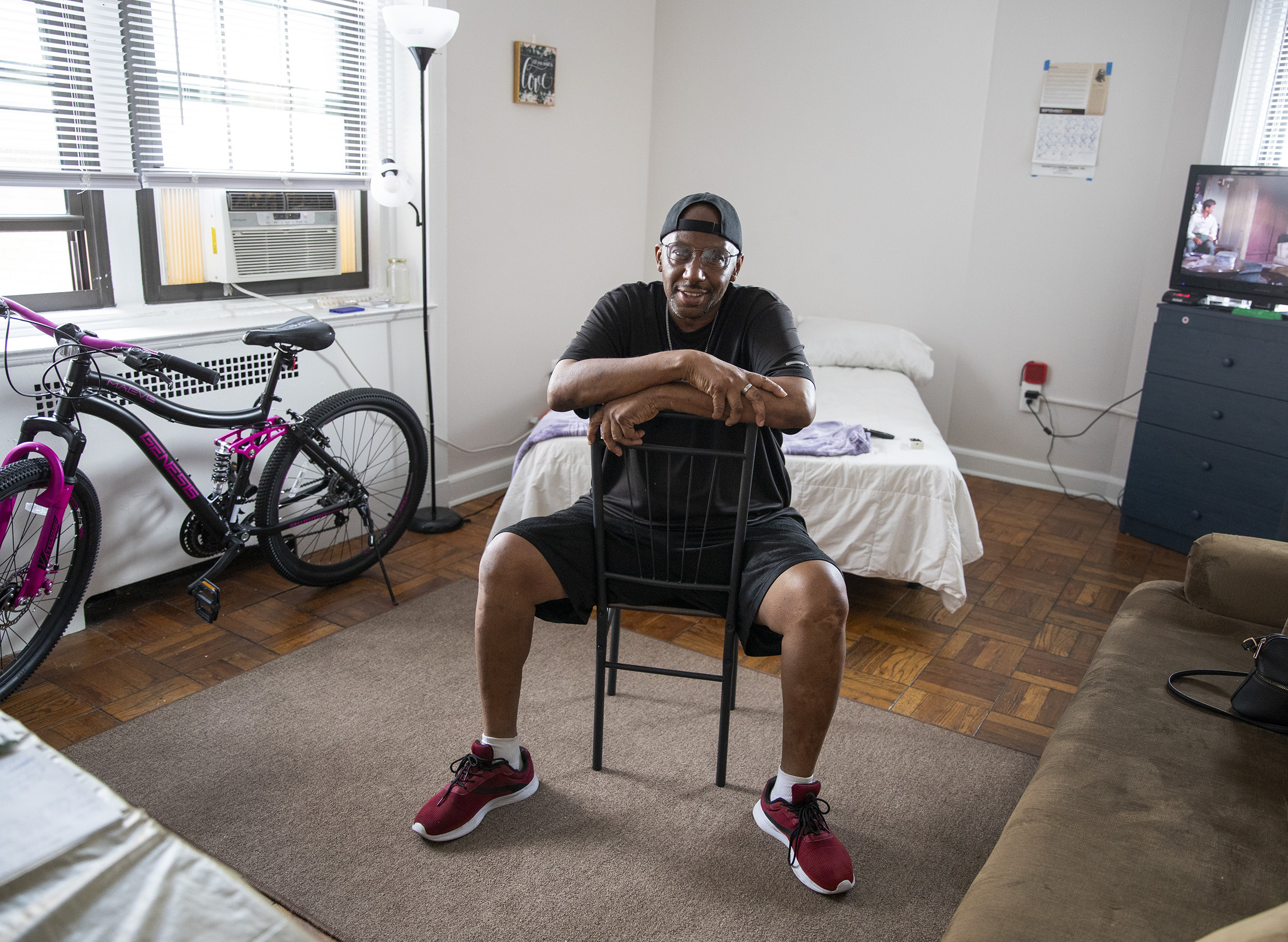
In the months that Lee Simmons stayed at the men’s low-barrier shelter on New York Avenue, he says he worked with his case manager every day to try to get out. The provided meals were helpful, but most other aspects of life there — crowding, bugs, and occasionally witnessing drug use — were unbearable.
“It was the worst,” Simmons says. “I was assigned a caseworker, and every day I called her, and talked to her, and said ‘listen, get me out of here.’”
Then, one day in January 2021, she called and said “Mr. Simmons, start packing.” He had been approved for a hotel room through D.C.’s Pandemic Emergency Program for Medically Vulnerable Individuals (generally shortened to PEP-V).
Launched more than 18 months ago, the program places unhoused residents most at-risk of falling seriously ill if they contract COVID-19 into hotels leased out by the city’s Department of Human Services — an effort to prevent the transmission of coronavirus in the city’s congregate shelters.
Unlike the shelters, or a previous shelter-hotel housing service where residents reported poor conditions and abuse by contractors, providers and residents have reported markedly better results with PEP-V’s model. Residents have access to on-site medical care, in addition to their own bathroom and a quiet place to sleep.
Where congregate shelters brought the anxiety of coronavirus transmission and sleepless nights, Simmons says his PEP-V space at the Holiday Inn on Rhode Island Avenue offered relief.
“I had my own room, and I just said thank you Jesus,” Simmons says.
Now, he is one of roughly 390 people to have exited a hotel and into permanent housing — PEP-V’s ultimate goal. Unless a resident chooses to leave on their own, they can remain in a room until they are matched with an alternative housing option.
PEP-V has been extended through the remainder of 2021, thanks to an extension of government funding, but its future beyond is unclear. City officials have previously said they wouldn’t extend the program after federal dollars run out.
But residents like Simmons and housing advocates say the program’s successes — not only in preventing death and illness from COVID-19, but in providing dignified shelter — demonstrate the need for its continuation, even beyond the pandemic.

Meeting an urgent need
As coronavirus swept through the city last year, D.C. started to place unhoused residents who had certain medical conditions or were over 80 years old, as well as those who were quarantining after COVID-19 exposure, into hotels. Within a month, a waitlist emerged as more and more residents received referrals for a hotel room.
The city would also revise the requirements for who would qualify for PEP-V several times, ultimately extending eligibility to any unhoused resident age 55 or older.
Almost a year after the pandemic started, with the number of people waiting on a hotel room nearly matching the number of people residing in PEP-V housing (more than 600), councilmembers and housing advocates called on DHS to expand the program, and take advantage of newly available federal dollars.
For the first several months of PEP-V’s operation, about three quarters of the program’s funding came from the CARES Act. But in February 2021, newly inaugurated President Joe Biden directed the Federal Emergency Management Agency to cover the entirety of the program’s cost through Sept. 30, and retroactively reimburse any local money spent on emergency non-congregate housing.
This past August, as the highly contagious delta variant drove up coronavirus case rates, FEMA pushed that funding deadline to November 30 — and DHS said the city would continue running the program through at least the end of the year.
Amber Harding, an attorney with the Washington Legal Clinic, says that it’s evident — given the risks posed by delta, the still lagging vaccination rates among unhoused residents, and the approaching hypothermia season — that PEP-V desperately needed to be extended.
“None of this is rocket science. Of course it protected people from getting COVID,” Harding says. “When they opened up PEP-V, the number of deaths completely stabilized. When they didn’t have enough PEP-V spaces, people were dying. It’s very clear PEP-V has saved lives and minimized transmission.”
While PEP-V appears to have helped prevent hundreds of residents from contracting coronavirus, unhoused residents in the city still face disproportionate rates of infection compared to the rest of the population.
As of Oct. 4, the city’s Department of Human Services reported 591 total cases in emergency shelters since the beginning of the pandemic — nearly 18% of the number of residents who were counted as staying in emergency shelters during the last point-in-time count. That is roughly double the general population
While staying in the low-barrier shelter, Simmons said he was tested for COVID-19 and frequently checked for symptoms — but that did little to quell his anxieties while living in a crowded space.
“I was scared because I was sleeping around a bunch of men. There was one time where we were mandated to take a test, the swab in the nose. When my ratings came back saying I was negative, I was like ‘thank you’” he recalls. “But then I said…’well, how long will I be negative?’ I had to make a move.”
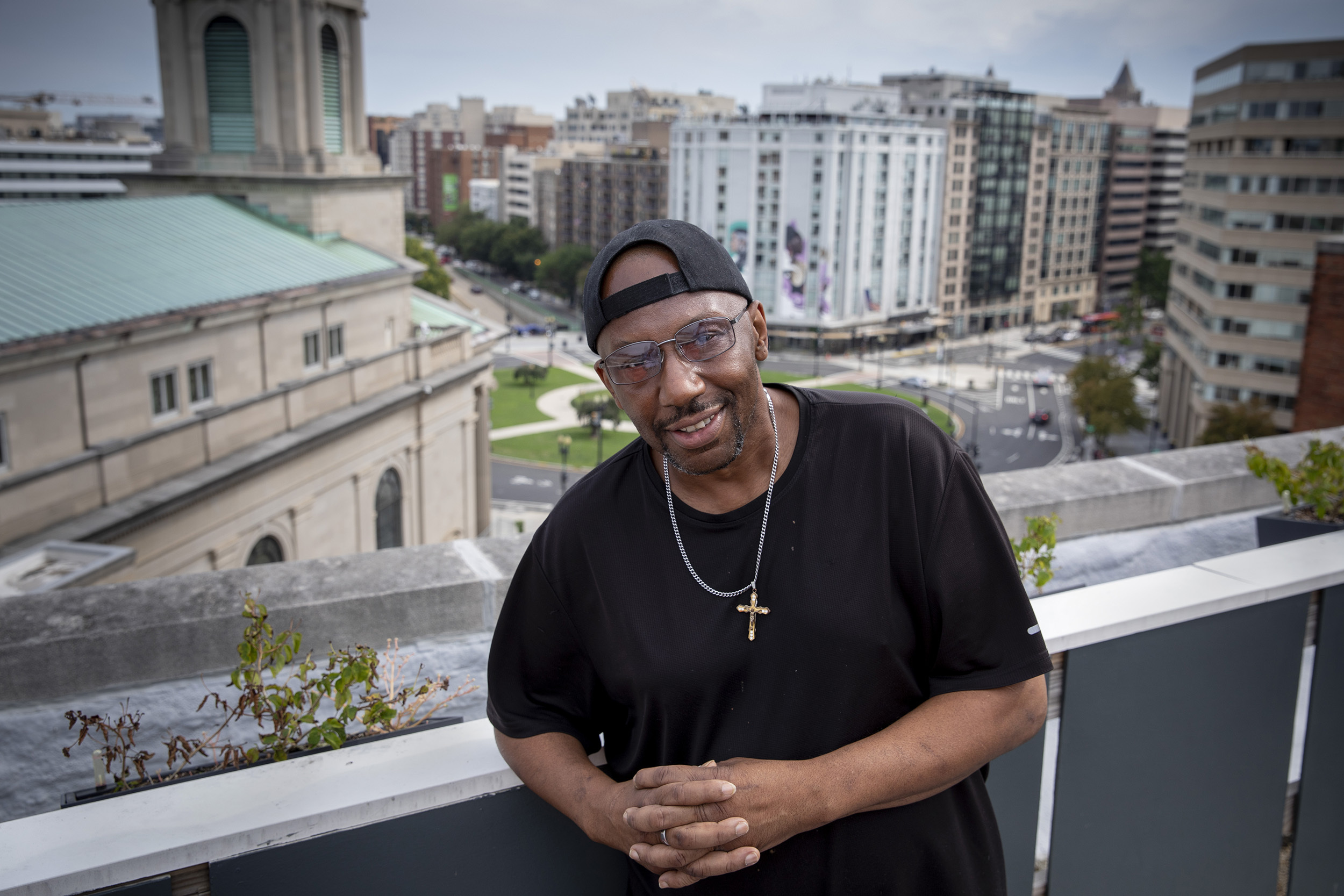
After weeks of repeatedly checking in with his case manager, he was connected with PEP-V through his case manager, and moved from the shelter into the Holiday Inn on Rhode Island Avenue. As a part of the program, case managers are assigned to link each PEP-V resident with government housing programs, depending on what qualifications they meet. Seven months after he moved in, Simmons secured a permanent supportive housing voucher and found a studio near Logan Circle.
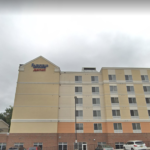
Some parts of his stay at PEP-V might not have been ideal; PEP-V residents are required to meet a curfew each evening, and there are limited with what items they can bring into their rooms, like alcohol. Street Sense Media previously reported allegations from PEP-V residents that bed bugs infested their rooms at the Fairfield Inn on New York Avenue and that the curfew cut time with loved ones short over the holidays.
But if it were not for PEP-V, Simmons says he wouldn’t be sitting, giving an interview in a space that for the first time, is his own.
“Yeah, there were times where I had to fall back, and say “okay, I had to swallow that pill,’” Simmons says. “But if it’s gonna put me in a better situation that I’m in now, why not?
Lessons learned
Laura Zeilinger, the director of D.C.’s Department of Human Services, says that the city may consider backfilling spots as residents exit PEP-V housing through this fall, something the department stopped doing in the spring when it appeared that the program would need to demobilize by the end of September. During a provider briefing last month, when asked how long the program will be extended, DHS officials answered honestly: they didn’t know.
In an interview with DCist/WAMU, Zeilinger couldn’t say what PEP-V’s future looks like into the winter.
“It may become necessary to backfill…so we’re working closely with other city agencies, and as we look towards winter months and what may be needed as well, as well as rates of COVID in the community…we’re really still considering and are putting together our final planning strategy around that, so unfortunately I cannot give you a definitive .”
With the recently passed fiscal year 2022 budget funding housing for more than 3,000 people experiencing homelessness, Zeilinger says every resident living in PEP-V currently should be connected with some form of housing when the federal funding ends and the program may need to shut down.
“People will all be matched to a resource to help them move to permanent housing,” Zeilinger says. “We’re going into the fiscal year… with more opportunities to house people than we have had really ever in our history.”
But while the future of PEP-V hasn’t been announced, advocates want the program to last beyond the pandemic. Karen Cunningham, the executive director of Everyone Home D.C., says the bridge PEP-V built between residents experiencing homelessness and government-supported housing resources serves as a lesson to be learned about trust-building, and offers a blueprint for future housing solutions.
“I hope that we can learn from this success and continue to use this model for something like bridge housing, where folks who are living outside, but maybe aren’t ready to move into permanent housing can go, and be safe, and stabilized and get help preparing all the things that they will need to be in permanent housing,” Cunningham says. “The pandemic forced us to do some things just to keep people alive and learn some really good lessons, and point us towards new things so that we can try to treat people with more dignity.”
For several reasons, residents experiencing homelessness may not want to enter a shelter, but may be more willing to accept a private room or a place of their own, with privacy, according to Christy Respress, the executive director of Pathways to Housing D.C., a housing provider that worked with the city to plan the original PEP-V model.
The program was intended to protect vulnerable people experiencing homelessness from COVID-19, but the benefits extended far beyond that goal.
“We cannot underestimate the value that having PEP-V has had on people’s health outcomes, both physical and mental,” says Christy Respress, the executive director of Pathways to Housing D.C., a housing provider that worked with the city to plan the original PEP-V model. “When you are forced to stay in a setting that is open and intensely populated with other people, that is a form of ongoing trauma for people. That lack of privacy, the lack of ability to sleep really well…sleep deprivation is, is one of the worst forms of torture we can do to ourselves and other people.”
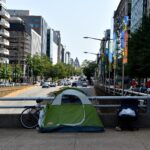
D.C. is currently trying another approach that circumvents the shelter system and moves people directly to permanent housing: a new pilot program is clearing out encampments around the city and placing residents directly in apartments. It has drawn a mixed response from advocates, who generally support programs that get people experiencing homelessness into housing but oppose the city’s plans to permanently shut down the encampments as part of the effort and question whether it has allowed people to essentially jump a long line of people looking for housing.
Meanwhile, pandemic-era solutions to the housing crisis are sticking around in other states. California Governor Gavin Newsom recently invested more than $2 billion in Project Homekey, an initiative born of the pandemic that purchases hotels, apartment buildings, or homes and turns them into housing for residents experiencing homelessness. Following California’s lead, Oregon launched a similar program, Project Turnkey, in order to house people displaced by wildfires.
In D.C., lawmakers have advocated for similar solutions. Ward 1 Councilmember Brianne Nadeau and Ward 5 Councilmember Kenyan McDuffie have both called for the city to fully purchase the PEP-V hotels and convert them into permanent supportive or affordable housing — funding that was made available in the American Rescue Plan.
Zeilinger previously told DCist/WAMU that the city wants to avoid using hotels as housing, after ending the hotel-shelter service in 2020, but that conversions of hotels may be possible — although that process could take years, likely too long for anyone currently living in a PEP-V room.
The recently adopted 2022 budget doesn’t specify any hotels planned for purchase, but does include a “game changing” investment in more permanent supporting housing vouchers, using revenue from a tax increase on wealthy residents.
For Simmons, going from the shelter to his room in a PEP-V hotel felt like a 180 degree turn. Now, finally connected with an apartment of his own through the program, he says he wakes up “thankful” every day. A trained cook (and a good one, he adds), Simmons has worked in several D.C. kitchens in his life. Now, for the first time, he’s cooking in own.
“When I was in the shelters and stuff, they’d say “Mr. Lee, where are you going?” and I couldn’t say my home. I would say ‘I’m going to my spot,’ he says. “Now when someone asks ‘where are you going?’ I say ‘I’m going home.’”
This article is part of our 2021 contribution to the DC Homeless Crisis Reporting Project, in collaboration with Street Sense Media and other local newsrooms. The collective works will be published throughout the day at DCHomelessCrisis.press. You can also join the public Facebook group or follow #DCHomelessCrisis on Twitter to discuss further.