Elliot C. Williams
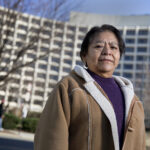
Wendy Cassidy says she’s finally starting to find gigs again, even if work is coming in a bit slower than before the pandemic. In the past two months, she’s provided technical support for two outdoor music events at the Kennedy Center and a corporate event at the National Cathedral, for a total of 100 hours of work — plenty more than she’s had in 18 months.
A local stagehand in the D.C. area since the 1990s and member of the local stagecraft union, IATSE Local 22, Cassidy says the past year and a half has been particularly excruciating for backstage workers like herself. Major theaters laid off swaths of their staffs as the pandemic set in: Shakespeare Theatre Company trimmed its staff of 116 by a third last summer, months after Arena Stage furloughed 75 of its employees. The Kennedy Center, meanwhile, laid off more than 700 hourly and part-time employees as the pandemic set in last spring. (Some of these employees have been hired back in recent weeks.)
Local stagehands and technicians in the performing arts often work across D.C., Maryland, and Virginia, which makes getting unemployment benefits especially difficult. (Securing unemployment benefits across all three jurisdictions has been nightmarish for employees in plenty of industries since the early stages of the pandemic.) “A lot of my union members really kind of just gave up,” Cassidy, 52, says.
But now that theaters and production companies are starting to reopen, hire their teams back, and begin their fall seasons, these workers are facing a new set of problems.
“We are all worried about the Delta variant and, frankly, other variants,” she says. “No one wants to close everything down again, but we also want to stay alive and healthy. It’s a tough balancing act of wanting to work and wondering if this is the safest thing for all involved. Should we be around hundreds to thousands of different people every night?”
Delta and rising case counts have forced many theaters to instate vaccine and mask mandates for indoor shows, continue virtual programming for longer than expected, or delay their seasons altogether. And even though furloughed theater workers have returned to work, many companies have reshaped their organizations in significant ways — like hiring smaller casts and crews, employing fewer part-time staffers, and hiring more digital content positions. As one local production stage manager told DCist/WAMU in mid-August, with the growing presence of the Delta variant, “It felt like we had a moment of hope and that just got yanked away.”
Even as they’ve begun to welcome back in-person audiences after more than a year of virtual, outdoor, or pre-taped theater, a poll this summer by Rockville-based firm Shugoll shows that audiences are hesitant to return to live performance spaces, with just over 50% of participants reporting that they are “very likely” to attend a show in October.
Susan Marie Rhea, artistic director of The Keegan Theatre, says she and others in the performing arts community have been thinking about a “dark, lingering cloud of questions.” In late August, Keegan had to push back its season opener, Good People, by about two weeks, citing changing health guidance.
“This question mark that hangs over us every day now as we march toward opening, which is: Is anybody going to come? Are audiences going to come support theater?” she says.
The changes and uncertainty have led some local workers to seek employment by other means.
Lauren Halvorsen, a dramaturg by trade (the person tasked with developing the play with key questions and literary research), says that after she was laid off from Studio Theatre last summer, she pivoted to freelance work and teaching college courses on modern American theater. She now writes an industry-focused newsletter, Nothing for the Group, which offers commentary and criticism on theater across the country. She’s careful not to write with the tone of an embittered, laid-off worker, but as someone who genuinely wants to see the industry improve as it finds its way back to “normal.”
Theater workers are forcing industry leaders to address issues of pay inequity and discrimination, Halvorsen says. As with most fields, the pandemic has led to a time of reflection and reckoning. In spring of 2020, for example, a collective of theatermakers of color penned an open letter, “Dear White American Theater,” that demanded a commitment to anti-racism. Among demands of investment in artists of color, the group’s list of principles calls for “a racial integrity index ensuring 50% minimum representation in all offstage positions corresponds to onstage optics.” (In other words, hire a diverse crew of backstage workers and creatives to match the diversity now seen on many stages.)
“Most of the jobs that I have been seeing that fall below living wages are for those positions,” she adds. “Some organizations, you go to their website to look at their jobs and they also have their anti-racism statement right there. There’s a real disconnect here.”
After working for nearly two decades as a production manager in D.C. and Maryland, Kyle Rudgers also left the local theater industry, moving his family to New Jersey this past July to take a job with Princeton University’s music department. He had gone without steady employment for about 16 months.
In March 2020, Rudgers had put in his two weeks notice at a theater company based in Baltimore and was planning to move to Boston to become a local theater’s production director, but by March 12, both theater companies had closed due to COVID-19 mandates. He watched as “basically everybody that had a direct connection with performances” got laid off or furloughed, and his start date at the job in Boston never materialized.
“Essentially, over the course of two days, I lost two jobs at the same time from the pandemic,” Rudgers says.
Two autumns into the pandemic, though, local theaters are hiring positions back. A number of theaters — including the Kennedy Center, GALA Hispanic Theatre, Arena Stage, Signature Theatre, Atlas Performing Arts Center, and Round House Theatre — told DCist/WAMU in emails that they are bringing on part-time and full-time staffers to fill positions ranging from creative directors to intimacy consultants, paid ushers, and patron-experience managers.
Arena Stage, for example, has hired back most of its 130-person staff, but 25 positions were left vacant, according to Arena’s executive producer Edgar Dobie. The theater is now hiring for positions in development, customer service, human resources, and video production. Since April, the Kennedy Center has hired or rehired 67 full and part-time employees, 300 ushers, and 25 parking staff, according to a spokesperson. The arts center’s career page lists more than 40 open positions in production, sales, education, human resources, and more.
Some smaller theaters that had to furlough workers have brought back employees, as well. Round House brought back all six furloughed workers (out of its 30-person full-time staff) in January — though, it reduced hours for box office and café staff when performances were canceled, according to a spokesperson. A few positions were vacated due to typical reasons like moves and grad school, but the Bethesda theater hired two new full-time positions over the past two months — an associate managing director and a manager of patron experience and rentals — and is now listing a number of full and part-time positions across specialties. (Shakespeare and Studio Theatre didn’t respond to questions about their hiring numbers, though other sources say they’ve brought back some furloughed and laid-off positions in recent months.)
Some are directing more attention toward digital production: Signature Theatre, for example, shifted its organization chart so that two staffers are creating and editing streamable content full-time, while bar and front house managers are working the box office, and the group sales manager now handles social media content.
Even with the new hires and job shifts, though, some jobs are returning slower than others.
Julia Singer, a 34-year-old local stage manager from Northern Virginia, says that while she’s seen her calendar fill up with work over the past two months and into the rest of the 2021-2022 season, she’s seen fewer dressers, stagehands, and assistant designers backstage.
“After not making money for so long, and with the fear that theater could shut down again, it seems like a lot of places are doing shows with smaller casts to start, which tends to mean fewer jobs all around,” Singer says. “A big part of that is limiting interaction due to COVID-19. The less people we’re all exposed to, the lower the chances are of someone on a production getting COVID.”
Similarly, Rudgers, now at Princeton, says he’s seen leaner production teams, with many companies focusing on marketing and development to “tread water” until they can put on live shows again.
David McIntyre, president of the IATSE Local 22, which represents about 400 stagehands in the D.C. area, says that a handful of his members have been able to transfer their skills over to the digital space — helping corporate conferences set up large virtual meetings, for example. “But that’s a very small percentage of the people that were making a living by loading these shows in and out,” he says. “So, the pandemic has definitely taken a toll on this industry.”
One factor complicating the rehiring process is that jobs like ushering and ticket selling often require close, in-person contact with audience members, something theaters are trying to avoid as they reopen. This past spring, Strathmore, the major Montgomery County performing arts center, was at odds with the union representing the theater’s ticket sellers as it looked to lease a series of ticket kiosks.
The ticket seller’s union, IATSE Local 868, staged a protest on Rockville Pike before a concert, which included a giant inflatable rat to represent Strathmore’s “disgusting and despicable behavior,” as the union told Bethesda Beat. Before the kiosk proposal, Strathmore laid off 19 ticket sellers in July 2020 due to financial constraints, but later hired back the two full-time employees and 17 part-time employees on an as-needed basis.
The ticket sellers feared the kiosks would be replacing them. Strathmore argued that the machines would only be supplementing their work. In September, following months of negotiations about the kiosks, Strathmore announced it would continue to employ three full-time and 10 part-time ticket sellers, while adding up to four kiosks to provide a contactless option for guests. (A Strathmore spokesperson tells DCist/WAMU that “no position has been eliminated,” and that the number of part-time employees fluctuates with the needs of the schedule.)
The Kennedy Center, meanwhile, butted heads with the stagehands union this fall. After working for a year without a contract, IATSE Local 22 last week reached an agreement with the performing arts center on modest wage and benefit increases, jurisdiction expansion, and a COVID safety protocol framework, narrowly avoiding a strike during the October run of Broadway hit Hadestown.
For now, the industry’s health remains up in the air until in-person audiences return in full force. Most theaters DCist/WAMU reached out to said they will keep moving ahead with their seasons — including more than a dozen with vaccine requirements — and will remain open as long as it is financially viable, or until government officials reduce their capacity.
People are needed in seats now more than ever, theater directors say, as their absence has had a serious financial impact. In the last fiscal year alone, for example, GALA Hispanic Theatre in Columbia Heights lost about $208,000 in projected earned revenue after canceling multiple shows, putting on a number of reduced-capacity live performances, and filming expensive video productions that brought in less in ticket sales than a stage show, according to spokesperson Dubraska Vale.
Vale added that despite its financial struggles, the theater has still been able to provide a number of cultural experiences when D.C.’s Latinx community needed it most — like a tango revue and read-alouds for children. (Latinx residents in the region have been particularly hard-hit by COVID-19.) The productions helped alleviate some of the “emotional and mental stress caused by the pandemic by allowing our community to stay connected to their language and heritage in a safe and welcoming venue,” Vale says.
Understanding the value of live performance, D.C. actors, directors, and backstage workers alike are trying to remain optimistic about the months ahead — even if they have unanswered questions about the future of live performance.
Fargo Tbakhi, writer and performer of the one-man, interactive show My Father, My Martyr, and Me, says he hasn’t been to an in-person theater performance since March of 2020. His show got suspended in early August before its run at Mosaic Theater Company, as new safety guidelines made intimate shows like his harder to pull off.
But once regional coronavirus data gets to a better place, Tbakhi plans to continue his production. He also plans to be at the first show he can attend, whatever it is.
“I honestly couldn’t care less what [show] it is,” Tbakhi says. “I will be there, and I will be glad to be back in that space.”