 Jordan Pascale
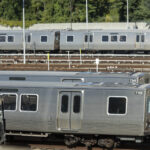
Metro service will be severely reduced Monday and it likely will stay that way for days and potentially weeks or months as the Metrorail Safety Commission ordered WMATA to pull the transit agency’s newest trains, the 7000-series.
The order comes days after a derailment on the Blue Line near Arlington Cemetery. None of the passengers were injured.
With those limitations, Metro will run about 40 trains on Monday, offering “a basic service pattern” with only six-car trains running every 30 minutes on all lines.
“As Metro continues to work closely with the Washington Metrorail Safety Commission and [National Transportation Safety Board] and more information develops, we will update the public about service for the remainder of this week,” Metro said in a brief statement. Metrorail ridership has been growing steadily in recent weeks and is hovering around 200,000 riders on average per weekday. That’s only about a third of pre-pandemic ridership.
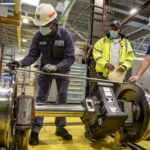
The independent safety commission and NTSB investigation found that the fourth axle on the derailed railcar was “out of compliance with the specifications for the wheel and axle assembly.” The safety commission says it found similar defects in other 7000-series trains that were not involved in the October 12 derailment.
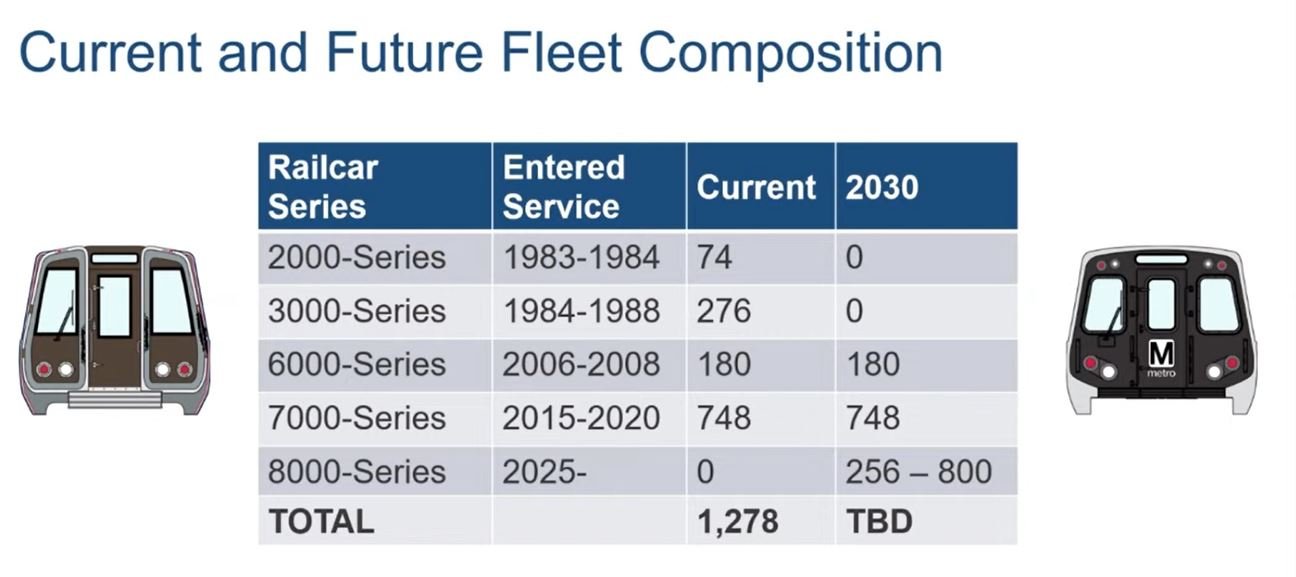
Those trains make up 60% of Metro’s fleet. Meanwhile, all but 16 of Metro’s 6000-series trains are also still out of service for issues with couplers. Between the 2000-series and 3000-series trains, Metro technically has enough to run about 58 trains, though several of those cars could be out of service for regular maintenance and other reasons.
The 7000-series trains accounted for 83% of the miles traveled on the system this year, according to the latest quarterly report Metro says the trains have been among their most reliable, traveling 55,000 miles between issues on average. Metro tracks the reliability of its railcars and says 2021 ended at a record high, “driven by strong performance in the 7000-series fleet.”
Since safety officials are unsure how widespread the issues may be, they ordered Metro to sideline the cars and develop a plan to assess the cause and “to provide for the detection and prevention of wheel gauge anomalies in 7000-series railcars.” The order came down at 8 p.m. on Sunday after a weekend of deliberations about how to proceed.
Wheel gauge is the distance between the wheels on an axle. Any discrepancy in that distance could cause problems like a derailment.
WMATA General Manager Paul Wiedefeld has often repeated that “safety trumps service” since taking over the job in 2015. In 2016, Wiedefeld closed the entire Metrorail system for a day on short notice to inspect power cables that had caused fires.
Paul Smedberg, chair of Metro’s Board of Directors, said Sunday night that he agrees with the call to remove the trains.
“This is a necessary safety precaution while the derailment investigation is ongoing,” Smedberg said. “Safety is our first priority.” He apologized to riders for the inconvenience.
Metro is encouraging riders to use bus routes as an alternative.
Consider taking @Metrobusinfo as an alternative to get around. Here's a map of our frequent Metrobus service routes between 7am-9pm. #wmata https://t.co/coMAARxFXI pic.twitter.com/eexq01c8IH
— Metrorail Info (@Metrorailinfo) October 18, 2021
D.C. Public Schools say to build in extra time to get to school tomorrow, but late student arrivals will be marked as excused.
The 7000-series trains came online starting in 2015 and the last one was delivered from the Kawasaki Rail plant in Lincoln, Nebraska, last February.