 Jordan Pascale
 Jacob Fenston
Update:
Metro says reduced train service will continue at least throughout the week as its newest 7000-series trains remained sidelined because of safety issues.
Starting tomorrow, trains will run every 30 minutes on all lines, except for the Red Line where they will run every 15 minutes. On the Silver Line they will run only between Wiehle-Reston and Federal Center Southwest. All trains will run with only six cars. No additional buses will be added.
Metro says the trains will remain out of service until the issue is resolved, but it’s unclear how long that may take. They said they will keep customers updated through its website and social media accounts.
“Safety remains Metro’s number one priority,” Metro General Manager Paul Wiedefeld said in a statement. “While we continue working hand-in-hand with the NTSB, FTA, and WMSC on the investigation, I want to assure our customers that their safety is driving every decision being made.
“We apologize for the reduced service, and ask for our customers’ continued patience and support as we work to get Metro back to normal operations.”
The transit agency has created a landing page for info about the Blue Line derailment, the subsequent investigation, and service impacts.
Original story:
Federal safety investigators said problems with wheels on 7000-series Metro trains could have led to a “catastrophic incident,” and said the problems were widespread and longstanding. Metro has known about the issues since 2017, according to National Transportation Safety Board investigators, who found problems with wheelsets on dozens of 7000-series Metro cars.
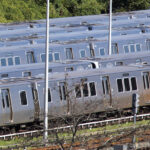
Late Sunday night, the Metrorail Safety Commission ordered WMATA to remove all 7000-series trains from service as the investigation continues. The trains account for roughly 60% of Metro’s fleet, and without them, riders saw significant delays during this morning’s commute.
Investigators laid out their initial findings at a press conference this morning, following last week’s Blue Line derailment near the Arlington Cemetery station. The train appears to have had multiple derailments and re-railments throughout that day, according to the NTSB. Investigators found pieces of brake discs, apparently from the derailed train, near the Largo and Rosslyn stations. The brake pieces apparently became dislodged when the train left the track, officials said.
As for the preliminary cause of the derailment, investigators say the wheels moved outward on the axle, causing problems at the rail switch near the Arlington Cemetery Station. During the derailment, the electrified third rail was damaged, which could have caused a fire. No one was injured during the incident. Russell Quimby, a former NTSB investigator told the Washington Post that wheels should “not ever move” and “something’s really wrong” when something so basic like that happens. He urged Metro not to return trains to service until they find a root cause and said they may have to replace wheelsets.
According to the NTSB, Metro has reported 31 wheel assembly failures on 7000-series trains since 2017. An additional 21 cars were found to have the issue. Metro says when wheelsets were found out of tolerance in past regular inspections, the trains were removed from service and the wheelsets replaced before being put back in passenger service. Investigators are still trying to determine if the issue is a manufacturer defect or if the problem is the result of regular use or some other reason.
Investigators have inspected 514 of the 748 railcars, so additional problems could be found, officials said.
“We are fortunate that no fatalities or serious injuries occurred as a result of any of these derailments,” said NTSB Chair Jennifer Homendy. “But the potential for fatalities and serious injuries was significant. This could have resulted in a catastrophic event.”
The train that derailed was last inspected for wheel alignment on July 27, 2021, according to safety officials. Metro says trains are inspected every 90 days. The train was due for its next inspection on October 27.
Homendy encouraged other transit agencies that use Kawasaki-made trains to check for the issue. The 7000-series trains were made in Lincoln, Nebraska. Kawasaki has also built trains for VRE and MARC locally and the MBTA in Boston, SEPTA in Philadelphia, MTA in New York City and the LIRR and PATH commuter trains in the NYC region. An MTA spokesperson said none of the Kawasaki trains in New York use the same axles as WMATA, but they will “closely monitor the results of the NTSB and D.C. Metro investigations to ensure full compliance with federal car equipment standards.” Kawasaki did not return a request for comment.
Metro hasn’t released much more information about the derailment investigation because NTSB rules prohibit parties involved from doing so.
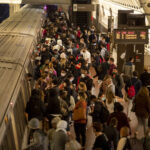
Riders across the region reported significant delays during Monday’s disrupted commute. Trains were supposed to arrive every 30 minutes on all lines Monday morning, but service levels reached 60-plus minutes on several lines, including the Red Line.
But with only 40 trainsets available to run service, platforms at Takoma, Fort Totten, and L’Enfant Plaza were unusually full of riders.
Metro tweeted an apology this morning, saying the move was made “out of an abundance of caution.”
“We understand the impact this decision has on transportation for the DMV area (National Capital Region),” Metro said in the tweet. “We apologize for this reduction in service and the inconvenience this is causing our customers.”
They also acknowledged crowded cars and said face masks continue to be required and Metrorail cars recycle the air approximately every three minutes.
It’s unclear how long the service impacts will last. It’s also unclear if trains could be returned one by one after they are inspected or if they will all be put back in service once the entire issue is resolved. The independent Metrorail Safety Commission is in charge of that decision but says it won’t know more on that until Metro submits its corrective action plan. That timeline is also unknown.
All of this comes at an interesting time for Metro. The District is touting that the region is back open for business, more white-collar workers are slowly returning to the offices and ridership has been growing steadily to about 200,000 rides each weekday, which is still about a ⅓ of pre-pandemic levels. Metro also has been running a sale on passes in hopes of getting riders to come back to the system. A potentially weeks or months-long service reduction could throw a major wrench into the region’s recovery and rider confidence.
Metro is not adding extra bus service, which some say is necessary to offset the spillover from Metrorail.
Meanwhile, elected officials in the region like Virginia Senator Mark Warner and Congressman Gerry Connolly and Majority Leader and Maryland Congressman Steny Hoyer say they support the move for safety, but also expressed frustration.
“According to the NTSB, WMATA did not take the necessary steps to address a potentially fatal mechanical failure of the 7000 series cars and let the problem languish and worsen over the course of four years,” Connolly said in a statement. “This is unacceptable and could have resulted in a catastrophic tragedy. I am demanding a plan of action from WMATA for how these issues will be addressed and rider confidence in system safety restored.”
Hoyer said in a statement that the investigation must be done thoroughly and accurately for “the safety of the WMATA ridership and its hardworking staff on the frontlines.”
“It is my hope that the investigation is conducted as swiftly as possible so that our commuters can get back to safe and reliable travel,” he said.