Martin Austermuhle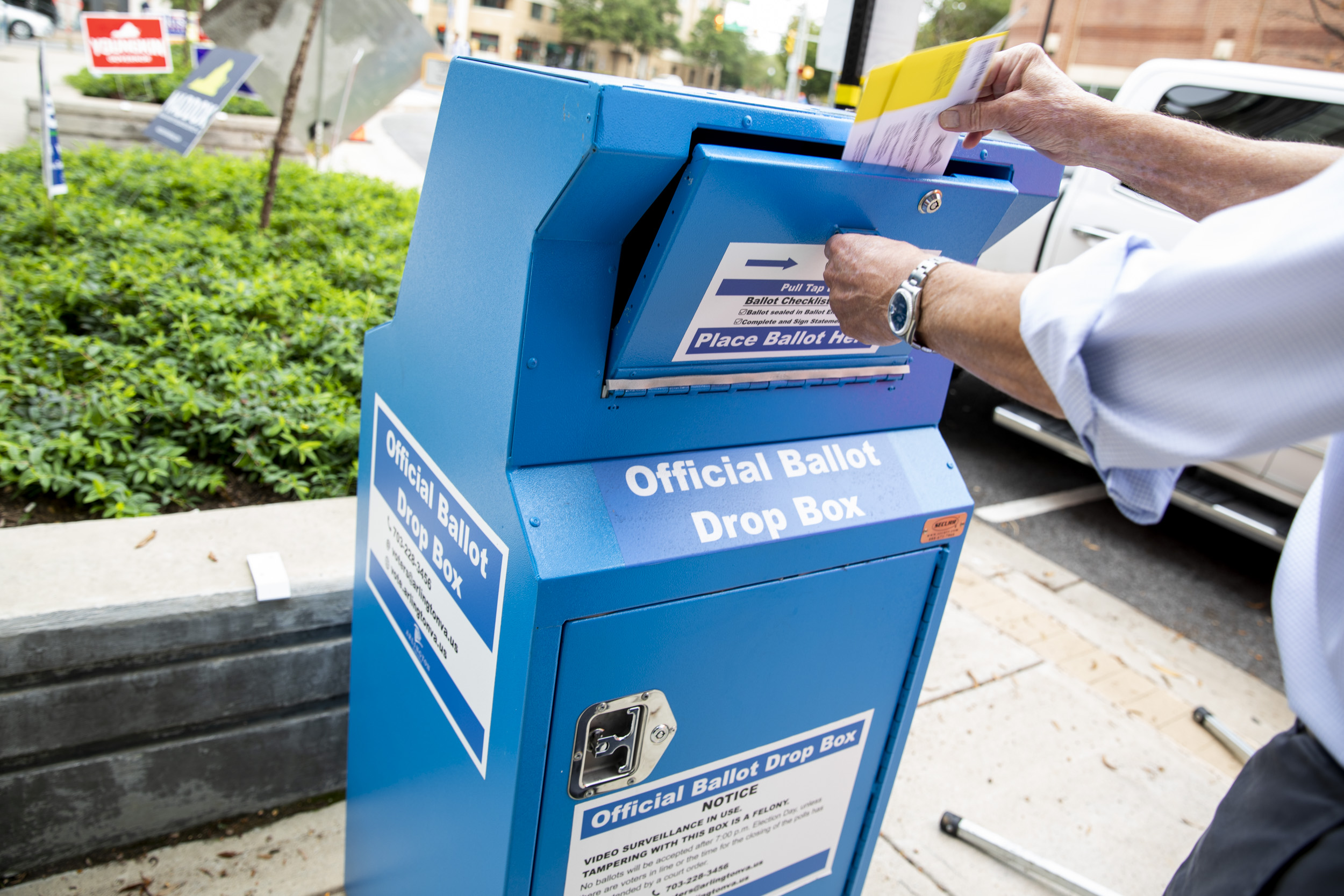
Scott Konopasek says he noticed it this summer: more people than usual were on hand to observe planned maintenance on voting machines and other equipment, a routine — and not exactly riveting — process that usually flew under the radar in years past.
“It’s good that people are interested in understanding the process,” says Konopacek, head of elections in Virginia’s Fairfax County. “What’s disconcerting is the unspoken motive for being there is that we can’t be trusted and there’s got to be a problem and they’re going to find it.”
But nowadays, such is the life of an election official, even more so as Virginia, where a hotly contested gubernatorial election comes to a head on Nov. 2 — the first high-profile electoral battle since the 2020 presidential election. The election comes amidst ongoing (and unsubstantiated) claims about fraud last year, and demands from many Republicans for “election integrity.”
That backdrop — along with the gubernatorial race between Democrat Terry McAuliffe and Republican Glenn Youngkin that has gotten much tighter as Election Day approaches — has led to a notable increase in the number of election observers and poll watchers becoming involved in the process. But unlike the usual Republican and Democrat observers of years past, election officials are noting a difference this time around. Konopasek says the people coming to observe the process this year appear to be more directly influenced by the claims of fraud from 2020 — and they are openly skeptical of the routine work that goes into running an election.
Election officials in Virginia have responded in part by trying to reassure voters the commonwealth’s voting system is secure through a publicity campaign. They are also implementing changes to how results will be reported on Nov. 2, largely to avoid confusion from years past when large counties posted results late into the night — often swinging the outcomes of key races.
Earlier this month, the Virginia Department of Elections launched “Democracy Defended,” a new website that state officials say is meant to highlight election security measures in use across the commonwealth. That includes reminding voters that voting and tabulating machines are not connected to the Internet, audits are already routine, and that paper ballots — which Konopasek calls “the final backstop” — are used across Virginia to ensure tallies are accurate and reviewable.
Virginia Department of Elections Commissioner Christopher Piper wants the public to know about the work his department is doing throughout the year. “While the voting process is something most Virginians pay attention to a few days every year, the system that ensures a trusted election outcome never stops,” he said. “That is the job of more than 133 certified registrars and their staff who follow 470 pages of election law. They work year-round to ensure free, fair, and transparent elections with the help of some 15,000 volunteers. They know how rigorous and meticulous our election process is.”
‘We are very much under intense scrutiny’
Konopasek has been working as an election official for 27 years (his Twitter name is ElectionYoda), overseeing voting in seven presidential elections in three states — Washington state, California, and Utah — before coming to Virginia earlier this year to lead the elections office in Fairfax County, the commonwealth’s largest jurisdiction.
His arrival in Virginia coincided with the commonwealth’s traditional off-year gubernatorial election, one of only two such statewide elections nationally that directly follow the presidential election (New Jersey is the other.) It also came as unproven claims of fraud stemming from former president Donald Trump’s loss have continued to percolate among Republicans, including Youngkin himself, who has delicately raised concerns about “election integrity” without fully embracing Trump’s claims that he won the 2020 election. President Joe Biden won Virginia by 10 points; in the second debate with McAuliffe, Youngkin agreed that “the election was certifiably fair.”
Trump has also alleged that Democrats will steal Virginia’s gubernatorial election, but Youngkin said at his first debate with McAuliffe that he believes “we’re gonna have a clean, fair election and I fully expect to win.”
Konopasek says he’s seen the impact of fraud allegations in the daily functions of Fairfax County’s elections office, largely in the increased number of observers during the routine testing of voting equipment that precedes every election. (Earlier this month Youngkin called for an “audit” of voting machines; local election offices test machines ahead of every election and the state runs a post-election risk-limiting audit of election results.)
“There’s a lot of misinformation and disinformation out there,” he says. “We are very much under intense scrutiny by voter integrity groups who are subscribed to some of these theories that are being circulated.”
Judy Brown has noticed the same uptick in interest this year in Loudoun County, where she runs the elections office. Brown says more observers have been present during the 45-day early voting period — and have been more skeptical of what she says is the usual process of running the election.
“The people do ask a lot of questions, which is okay because we want to be transparent and we do want to make sure that they are able to go back to the public and share what they’ve seen here,” she says. “We are just doing our job and running the election the way we always have. But it is a little stressful to have everything called into question when in fact we’re doing the same things today that we have always done.”
Gretchen Reinemeyer, the director of elections in Arlington County, says she has similarly noticed more engagement around election integrity issues, though she sees it as net positive.
“I definitely think after everything that has been published about elections over the last year we are getting a lot more questions, both from voters and observers,” she says. “So I wouldn’t say it’s necessarily scrutiny, but there’s a lot more interest in learning about the process.”
Changes to reporting results
Beyond election officials’ efforts to reassure voters and groups that the election will be secure, Virginia has made a number of changes to how results will be reported on Nov. 2.
Most significantly, early and absentee vote results will be reported first after polls close on Election Day. Election officials hope that will prevent confusion from years past, when those votes — now a significant proportion of total turnout — would be reported after day-of ballots, often swinging the outcome of certain races late in the night. That was especially the case in Northern Virginia, home to the commonwealth’s largest block of voters. (Fairfax County has the commonwealth’s largest number of registered voters, at 773,686 in September.)
“Hopefully this new way that we can report results in Virginia will allow for at least those results to come in sooner than 10 p.m., which is what we’ve had to do in the past,” says Reinemeyer.
“It’s a big chunk of votes,” says Konopasek. “In November, it was the majority of the votes and it’s kind of shocking to see them all just drop in all at once.”
In Fairfax County, Konopasek has also made another change to how votes are counted.
In years past, election officers at the county’s 229 polling places would start calling results into the central office as soon as polls closed. Those results would be manually entered into an Excel spreadsheet and uploaded to the county’s website. This year, though, removable USB drives from the ballot scanners will be physically transported to the central office and uploaded. (That’s currently the process in Loudoun County.)
Konopasek notes that transferring results directly from ballot scanners will prevent having to later correct errors in the manual entry process. “What I’ve learned of the past [was] there were always corrections and mistyping and typos and double data entry and all those things. And those are all human errors that when you have a manual process are likely to to occur. You can’t eliminate them, you can minimize them, but you can’t eliminate them. This process here does eliminate those human errors,” he says.
What won’t change is the usual public process that follows every election: the canvass. That’s when results are reviewed for any possible errors or miscounts, before being finalized and submitted to the Virginia Department of Elections for another layer of review and eventual certification.
Until then, Brown asks that voters let the process play out as it has in years past.
“I just want them to be confident in the process. Election officers are sworn in to uphold the election laws. They’ve been adequately trained to do that and we just remind people to just be patient. These are your friends, your neighbors, people you see when you go to church, to the store and they’re doing this as a civic duty,” she says. “We’re doing the best that we can. But the election process is secure.”