Debbie Truong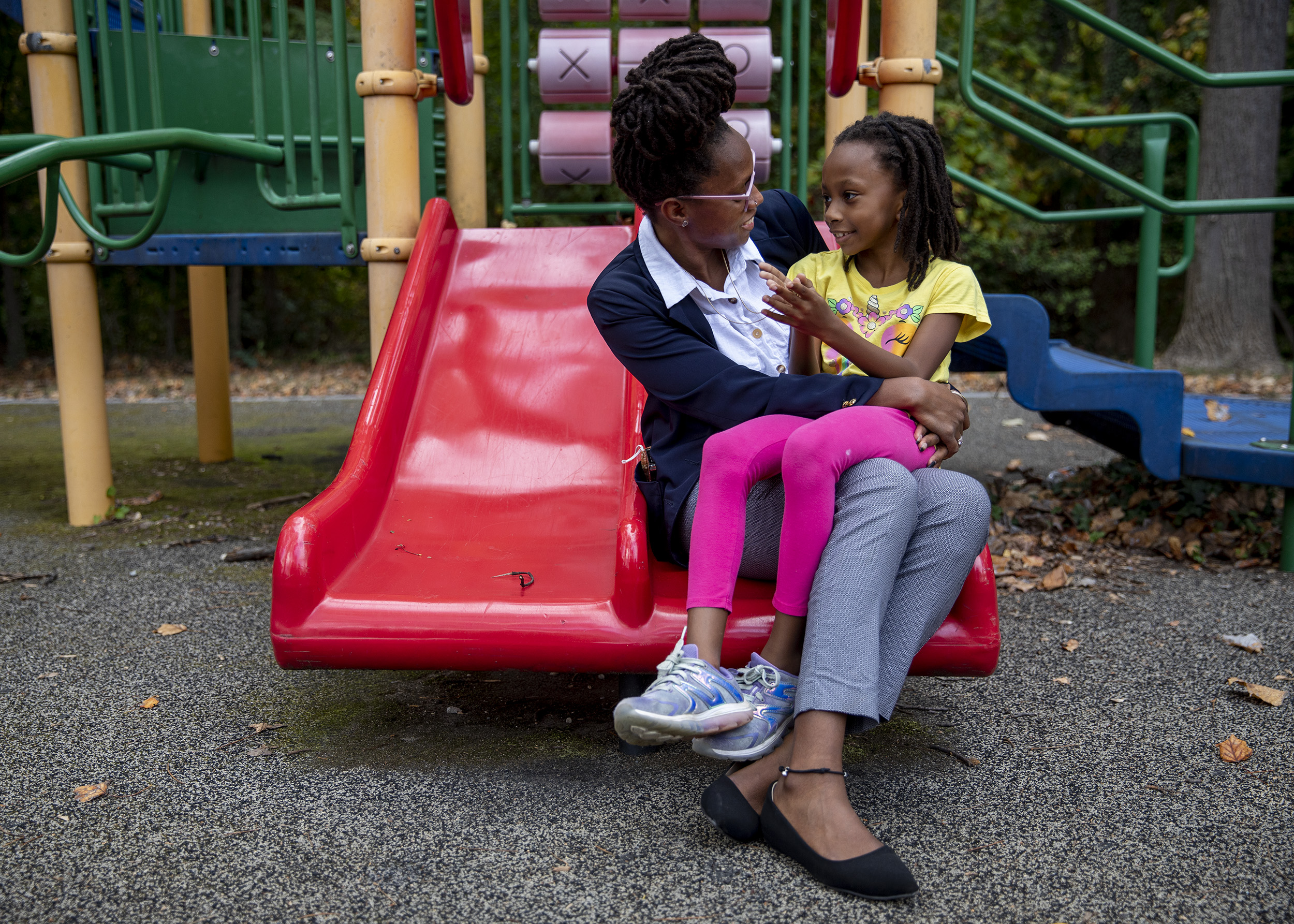
Learning all but stopped for Sharon Culver’s seven-year-old daughter when she was required to quarantine for seven days in September. The girl did not hear from staff at Anne Beers Elementary School in Southeast D.C. about instruction the entire time she was out of the classroom, Culver said.
Across the city at Oyster-Adams Bilingual School, Lisa Jordan said her daughter, India, transitioned quickly to virtual instruction when she had to quarantine for about a week. The fourth grader logged into virtual classrooms, following along as her teachers taught lessons in front of computer screens.
The difference in experiences highlights a tension that has developed since D.C. reopened for full in-person learning this academic year: how to educate students when they are required to stay home because they were exposed to a person with COVID-19.
In most cases, students are not sick themselves and are healthy enough to learn. D.C. education officials have left it up to schools to decide how and when they want to provide instruction synchronously, where teachers instruct classes live online, or asynchronously, where students learn independently.
That has led to inconsistent experiences across the city, drawing ire from parents and education advocates who worry time outside the classroom will disrupt learning and exacerbate achievement gaps that likely widened during the pandemic.
The Washington Lawyers’ Committee for Civil Rights and Urban Affairs sent a letter to city education leaders last month demanding schools develop and publish detailed plans for virtual education when students must quarantine.
Kaitlin Banner, the deputy legal director of the lawyers group, said many students are not provided live instruction when they are in quarantine. Others are given paperwork packets or online assignments they are expected to complete on their own.
“There’s not a comprehensive plan for students when they’re home,” she said. “When students miss days of school because they are out on quarantine, it means that they’re not getting the content from the teachers those days … it means that they’re likely to fall behind.”
Guidance from the U.S. Department of Education says students should have access to “high-quality and rigorous learning” when they are unable to attend school because of COVID-19 cases. That includes regular interactions with peers and teachers through live instruction, one-on-one sessions or small group interactions.
Some D.C. parents argue schools should transition students to synchronous instruction online if they must quarantine. Culver, who is a preschool teacher, said she would have welcomed any direction when her daughter was told to quarantine last month, even if it meant having her learn asynchronously.
“Some work should be provided,” she said. “We’re going to continue to have exposures. People are going to continue to test positive.”
D.C. Public Schools did not comment specifically about Culver’s situation. But the school system said in a statement that students in quarantine should receive live virtual instruction or self-guided work.
“We recognize that the necessity for students to quarantine presents difficulties for our families and that questions remain about the learning process during quarantines,” the statement said. “We will continue to provide information to families and support our schools as they work to ensure instructional continuity.”
Culver said she and her husband devised their own lesson plans for the second-grader, relying on virtual math and reading programs.
‘We want to make sure that they’re not denied their education’
Quarantines have already become a defining characteristic of the 2021-2022 academic year. On any given day, hundreds of D.C. students are required to stay home because they were exposed to someone who contracted the virus.
It happens with little notice, forcing families with young children to scramble to rearrange work schedules or find childcare.
D.C. Health rules say a student must quarantine if they are a close contact of a person who tests positive for COVID-19, according to D.C. Health.
A close contact is a person who comes within 6 feet of an infected person for more than 15 minutes. Students who are within 3 to 6 feet of someone who tests positive do not need to quarantine if both students are wearing masks and other precautions are in place.
Close contacts of someone who tests positive for COVID-19 must generally quarantine for 10 days.
For instance, in early September, all 129 students in the sixth grade at John Hayden Johnson Middle School in Douglass had to quarantine. About two weeks later, 95 students in middle school at Leckie Education Campus in Bellevue were required to quarantine.
How instruction is provided during quarantines can disproportionately affect the city’s most vulnerable children, Banner said. Schoolchildren may return to campuses after a week if they test negative for the virus on the fifth day of quarantine.
But some parents might not have time to bring their children to testing sites or have the money to pay for a rapid test.
And because vaccinated students can avoid quarantine, unvaccinated students stand to miss the most class time, Banner said. Large swaths of students still have not been vaccinated, including children under 12 who are not yet eligible for a vaccine.
Among youth eligible for the vaccine, disparities are stark: In Ward 2, a wealthy part of the city that is mostly white, 73 percent of 12 to 17-year-olds are fully vaccinated, according to city data. That’s compared to 21 percent of their peers in Ward 8, a predominately Black part of the city with large numbers of low-income families.
“Students in Wards 7 and 8, where the vaccination rates are lower, are more likely to be placed in quarantine more frequently,” Banner said. “We want to make sure that they’re not denied their education during those time periods.”
Banner also worries the lack of consistent instruction will harm students enrolled in special education, a group that has faced barriers to learning during the pandemic. Many students with disabilities have Individualized Education Plans, personalized legal documents that specify services students must receive.
Without a uniform plan for meeting those needs, Banner said students could lose out on critical services.
That was the case for Abria Law, according to her mother, LaJoy Johnson-Law.
The elementary school student has an Individualized Education Plan that says she needs occupational therapy and physical therapy, among other services. But she only received a paperwork packet that she was expected to complete on her own during quarantine, said Law, a parent support specialist with Advocates for Justice and Education, a group that serves students with disabilities.
“A work packet is not educational instruction,” Law said, adding that her daughter has already missed so much during the pandemic. “She’s already lost out on a year and a half of in-person instruction.”
Candice Bobo, executive director of charter operator Rocketship DC, where Abria is a student, said students in quarantine receive a mix of live virtual instruction and self-guided work for at least six hours each day. Rocketship, which has three campuses in the District, also provides online learning programs tailored to students’ needs when they must quarantine, she added.
But Bobo acknowledged that educating students in quarantine is not easy. So Rocketship has focused on minimizing the number of coronavirus cases in its schools. The charter mandated vaccines for all staff on September 1, going further than was required by Mayor Muriel Bowser at the time.
“Quarantines are disruptive to our school and our students’ learning experience, so we must do everything we can to end this pandemic,” Bobo said in a statement.
She added parents in Abria’s class received letters outlining a schedule for virtual learning, which included Zoom links to five hours of online class each day. The schedule also included time for gym and dance.
But Law said she never received a schedule for instruction during quarantine.
The mother said she does not fault her daughter’s school. Rather, she feels the city failed to adequately plan for this academic year and brought too many children back to classrooms too quickly, raising the likelihood students would have to quarantine in the first place.
Hurdles to remote instruction
Education leaders acknowledge quarantines can keep students out of classrooms for days at a time. During a news conference in August, D.C. Public Schools Chancellor Lewis Ferebee detailed what would happen to learning when children in the 50,000-student school system had to quarantine.
Students would receive live virtual instruction, a hybrid of virtual and in-person instruction or materials for self-guided learning, he explained.
The type of instruction depends on the number of students quarantining and teachers’ availability, Ferebee said. In other words, it makes sense to provide live online instruction to students if everyone in the same class must quarantine, less so if only a couple of students must stay home.
Guidance from the Office of the State Superintendent of Education says schools must provide “continuous education” for students in quarantine without sacrificing the quality of instruction for those who remain in person.
The city also faces another major hurdle in educating students remotely: staffing.
The Washington Teachers’ Union, which represents educators in D.C. Public Schools, has fought to limit simulcasting, where teachers must instruct students online and in person at the same time. Federal education officials also advise against the practice.
Jacqueline Pogue Lyons, the union’s president, said requiring teachers to do both would degrade the quality of instruction.
“We know that teachers cannot meet the needs of their students if they have to do both virtual and in-person learning,” Lyons said. “That would lead to a lot of challenges.”
One charter network in the District, KIPP DC, has opted to quarantine entire classes rather than have teachers instruct young students in person and remotely at the same time.
If a student in eighth grade or under tests positive for COVID-19, the entire class must quarantine for 10 days, according to Adam Rupe, a spokesperson for KIPP. Families told the charter network, which educates about 7,000 students, they wanted schools to take a “very conservative approach” to quarantines.
Some school systems elsewhere in the Washington region have devised other strategies.
In Maryland, students in Montgomery County Public Schools can access live virtual classes through a Zoom link, where they are taught by a “quarantine teacher” who is not their regular instructor, according to the school system’s website.
In Virginia, students who cannot attend in-person classes in Fairfax County Public Schools can watch live streams of class lessons, where they must have cameras and audio off. Teachers may also provide recordings instead of streaming lessons.
Out of school but not in quarantine
Alex Howard does not know what caused his eight-year-old daughter to develop a headache and gastrointestinal issues in September. The third-grader took three COVID-19 tests, all of which returned with the same result: negative.
“It didn’t quite line up with COVID symptoms but a lot of them crossed over,” Howard recalled.
Parents must fill out daily health screening forms confirming their child does not have symptoms consistent with the virus, a broad range of ailments that include chills, fever, congestion, sore throat, headache and fatigue.
Students must stay home if they have a “red flag” symptom such as loss of taste or smell or a combination of two other symptoms.
Howard said his daughter, who attends Brent Elementary School in Capitol Hill, missed four days of school because of the illness. The third grader felt well enough to complete assignments and was given the same work that was distributed to students who had to formally quarantine, according to her father.
She received a Word doc outlining math, reading and writing assignments she was expected to complete on her own. On one day, that included watching a YouTube video about place values, responding to a writing prompt based on a reading assignment and practicing typing skills.
Howard said his daughter finished assignments for each of the days within two hours. He felt the work was not enough and spent time developing activities for his daughter on his own.
“It’s basically a kid being on vacation, falling further behind,” he said. “Expecting kids of this age to manage their lives online through Word docs and websites is ludicrous.”
He said he feels D.C. Public Schools should have developed a more structured response to providing instruction for students in quarantine. Instead he said the burden has fallen to overworked teachers and administrators scrambling to cobble together assignments for children who cannot attend class.
“If you’ve got the expectation that hundreds or thousands of children are going to be quarantined, why wouldn’t you create a central body in your school system that scales to meet their needs,” he said.
About one month into the school year, Letisha Vinson’s two children felt congested and developed runny noses and coughs. They never showed other symptoms that could indicate COVID-19, such as loss of taste or fever.
Vinson kept her 10-year-old son, Isaiah, and 11-year-old daughter, Nahla, home from KIPP DC WILL Academy for five days. Neither received direct instruction the entire time.
Her children could sign on to Epic, a digital library, and iReady, an educational app with math learning games. But Vinson said the online offerings did not match the curriculum her kids were learning in class.
“It was just a week of no school. No learning, no nothing,” she said.
Both her kids eventually returned to school. Several weeks later, Nalah missed another five days because she had to quarantine after coming in close contact with someone who tested positive for COVID-19.
That time Vinson said her daughter received synchronous instruction, along with all her classmates. Instruction resembled last school year, when classes were taught fully online.
Still she worries about the possibility of having to keep her children from school more days if they experience slight symptoms of illness.
“I pray my kids never get sick again because I just don’t know what I’m going to do, unless they just keep missing school,” she said.