Colleen Grablick
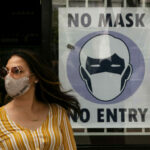
Starting next Monday, D.C. will no longer require mask-wearing in most business settings, like bars, restaurants, or gyms, D.C. Mayor Muriel Bowser and DC Health director LaQuandra Nesbitt announced Tuesday.
Masks will still be required in certain settings for all individuals, regardless of vaccination status, like schools and childcare facilities, libraries, public transportation, and congregate facilities. Private businesses will also maintain the authority to mandate mask-wearing. The decision to lift the mandate comes as a part of the city’s new “risk-based” response to handling COVID-19, Bowser said Tuesday, where risk levels correspond to an individual’s vaccination status.
“We continue to make progress on increasing our vaccination rates, and [we] emphasize again that vaccines remain our most effective tool in our toolkit for ending the pandemic,” Bowser said Tuesday. She didn’t rule out the possibility of reinstating a mask mandate, but said “hopefully that won’t happen.”
D.C. originally dropped its indoor mask mandate for fully vaccinated individuals in May, falling in line with Centers for Disease Control guidance at the time. Two months later, as COVID-19 cases climbed in the region and delta’s grip took hold nationwide, D.C. reinstated its indoor mask mandate for all individuals, following a CDC directive that anyone, regardless of vaccination status, wear a mask indoors if they live in a part of the country with “high” or “substantial” virus transmission.
As of Tuesday, D.C. is in the “substantial” spread zone, per the CDC’s tracking metrics. “Substantial” transmission occurs in any locality that reports 50-100 new cases per 100,000 residents over the past week, or is currently reporting a positivity rate between 8% and 10%. While the city’s positivity rate is just over 1%, D.C. reported 81 new cases per 100,000 residents in the past seven days, according to the CDC.
As Nesbitt outlined on Tuesday, D.C. will be transitioning away from some of its previous metrics used to track the pandemic, which aligned with reopening benchmarks, and instead align more closely with the CDC’s measurements.
For example, DC Health currently records the case rate per 100,000 residents on an average daily basis, while the CDC tracks that metric on a weekly basis. Both metrics are used to indicate “community spread,” or how present the virus is in the community. But DC Health and the CDC use different categories to measure severity. D.C. has three categories — minimal, moderate, and substantial — to measure spread, while the CDC uses high, substantial, moderate, and low. D.C.’s data currently reflect that the city is experiencing moderate community spread, with an average daily case rate per 100,000 residents of 13.83. Meanwhile, the CDC reports that D.C. has a case rate per 100,000 residents of 81.05 over the past week, and considers this substantial spread. Going forward, D.C. will publish both their own metric and the CDC’s, to alleviate confusion. The city will also be measuring and publishing the percentage of positive COVID-19 cases that result in hospitalization, and the percentage of D.C.’s population that is fully vaccinated.
The changes, according to Nesbitt, are designed to help residents assess their individual risk of contracting and falling seriously ill with the virus, as leaders begin to look at the virus as more of an “endemic” disease, meaning cases are constantly present at a baseline within certain regions. There isn’t currently a benchmark or metric that would trigger a mask mandate again, or further restrictions. Instead, Bowser said DC Health will continue to monitor transmission.
“We are learning to live with COVID…and the other part of that is, the world is not necessarily set up for the unvaccinated anymore,” Nesbitt said. “We want to make sure that our residents have all of the information that they need to be able to understand their individual risks for COVID-19, based on their own exposure, their health status, as well as our risk in the community.”
Infections in the city have dropped significantly since the delta-driven, late-summer surge. In September, the city’s case rate per 100,000 residents hit a peak at 37, the third-highest metric recorded since the pandemic began. (Previous peaks occurred in December 2020, and January 2021). Then case rates plunged as fall wore on. As of Tuesday, Nov. 16, the city reported a seven-day average of 82 new cases a day — down significantly from September, when that metric climbed past 250, but still above the lowest recorded averages during June and early July. Cases have also stagnated around that level this month, ending months of fairly sustained decline.
Neil Sehgal, a public health professor at the University of Maryland, tells DCist/WAMU that the city is definitely at a better position with the pandemic than this summer, but notes that infection rates have started to plateau ahead of a holiday season where increased travel and socializing indoors is likely to cause some sort of increase in cases locally. Still, he says, just because it’s not required anymore, doesn’t mean wearing a mask indoors is a bad decision.
“We’re trending in a flat direction right now,” Sehgal says. “Essentially, this is what it’s gonna be like for a while: We’re gonna have surges, they’re going to subside, we’re gonna have flare-ups in different parts of the country at different times. And our risk calculus is going to become much more individual.”
Since going back into effect in July, D.C.’s mask mandate has drawn particular pushback from local fitness studios, which have requested that officials drop the mask requirement if a gym requires proof of vaccination. (Repeatedly, DC Health officials have denied this request.) Other major cities (New York City being the first) have gone a similar route, foregoing an indoor mask mandate in lieu of a vaccine requirement. When asked if D.C. would consider implementing this type of “vaccine passport” system, Nesbitt said that creating the database would be difficult, given the large number of D.C. residents vaccinated out-of-state. She also added that there’s concern around equity issues, but that regional leaders are working together on potentially developing a digital vaccination card.
Meanwhile, Montgomery County’s indoor mask mandate, which lifted in October, is on track to be reinstated, as the case rate in the jurisdiction nears seven days of “substantial” spread. When asked about the neighboring jurisdictions moving in opposite directions on mask-wearing, Bowser was reluctant to answer.
“I don’t work for Montgomery County,” Bowser said. “I don’t actually know what they’re doing.”
As of Tuesday, Nov. 16, an estimated 63% of D.C.’s population is fully vaccinated.
This post has been updated with additional information.