Ally Schweitzer
Arlington County used to be known as a less expensive alternative to pricey D.C. With the average single-family home in Arlington now worth an estimated $968,000, those days are mostly over.
That’s one reason planners in the affluent suburb began a comprehensive study on how Arlington can spur the construction of additional, lower-cost housing options over time. Called the “Missing Middle” housing study, the effort is about to enter its second phase, after county staff presented their initial findings and recommendations to the county board Tuesday.
“This is really an opportunity to provide housing types that meet a broader range of housing needs for different groups of people in Arlington, ranging from empty nesters… first-time homebuyers, young families, and people who would like to live in our neighborhoods, but due to the limitations of our zoning, don’t have housing types that meet their needs,” says Richard Tucker, coordinator of the county’s Housing Arlington initiative.
The term “missing middle” refers to any type of housing development that is sized somewhere between a single-family home and a large apartment building. Arlington is already home to many “missing middle” neighborhoods lined with townhouses and small multifamily buildings, but more than three-quarters of its residential land is taken up by detached single-family homes, according to government data.
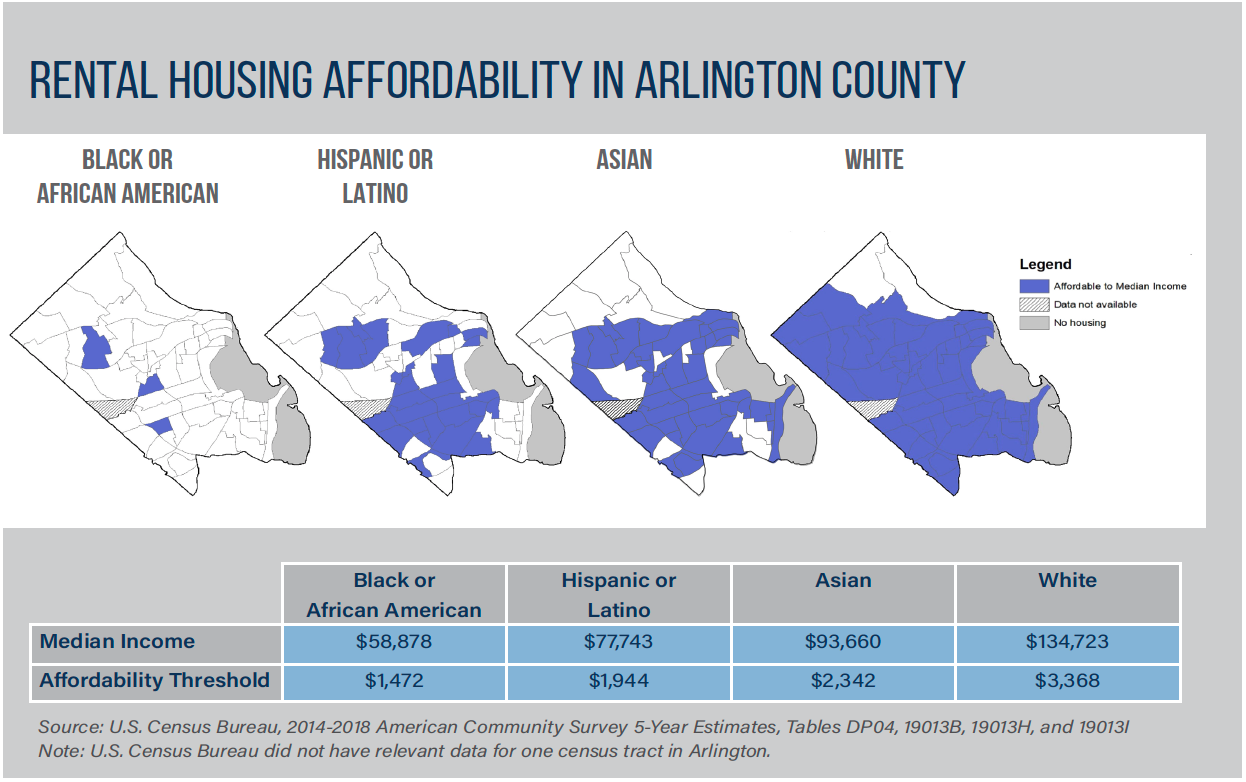
The county’s first “Missing Middle” report also shows that most of Arlington’s single-family neighborhoods are at least 70% white, though non-Hispanic whites make up 61% of the county’s total population.

The new 34-page report provides a glimpse into the kind of housing that could spring up in more Arlington neighborhoods if zoning rules are changed. It also documents the concerns of homeowners who have spoken out against “missing middle” housing, worried that an increase in homebuilding could have negative side effects, like environmental destruction or higher housing costs.
Public input — positive and negative — has been instrumental to the study since it began in 2020, Tucker says. But as planners embark on the second phase of their work, many residents don’t even know the study exists.
“Most of our engagement [during the pandemic] has been online, and that’s actually brought more people into the mix,” Tucker says, “but there are still challenges to reaching out to everyone.”
That’s why WAMU/DCist compiled the following primer on Arlington’s Missing Middle Housing Study. Read on for answers to the most basic questions about the effort, which could shape the future of Arlington’s residential neighborhoods.
Is “missing middle” housing the same thing as “affordable” housing?
No. “Missing middle” refers to housing size, not price. “Missing middle” homes like townhouses or duplexes have the potential to be less expensive than traditional single-family homes, but they’re not “affordable” by definition. (Government-subsidized affordable housing usually refers to homes attainable to a four-person household earning no more than 80% of an area’s median income. In the Washington region, that’s $103,200 per year.)
“The Missing Middle Housing Study will focus on increasing housing supply and housing choice as a land use tool to meet Arlington’s housing needs,” says the study’s Phase 1 report. “The County is working on many other fronts to reach [affordable housing] goals.”
What kind of “missing middle” housing is Arlington studying?
After analyzing a number of housing types and gathering public feedback on them, county staff decided to focus on four main types in Phase 2 of the study: single detached homes on small lots, duplexes, small multiplexes (including triplexes, fourplexes, and small buildings with five to eight units), and townhouses. The study’s authors say those housing types will be evaluated to “determine whether and how they could fit within the Arlington context.”
Does Arlington County plan to seize homes and replace them with “missing middle” housing?
No. But when the study is completed — slated for late 2022 — it is supposed to inform future decision-making by planners and the county board about where new housing types could be built. Any proposed zoning changes must go through a public process that is separate from the study. Also, zoning changes don’t affect the look and feel of current homes, just future development. A homeowner would have to sell their lot, or redevelop it themselves, in order to replace an existing single-family home with a denser structure.
What are the environmental implications of “missing middle” housing?
Since Arlington announced the study in 2019, residents have posed many questions about what a boom in new housing could do to the county’s tree canopy and stormwater management infrastructure, as trees are chopped down and new concrete surfaces are built to accommodate new housing.
The study’s first report doesn’t dispel those concerns, but it does provide context about how existing development is already causing environmental damage.
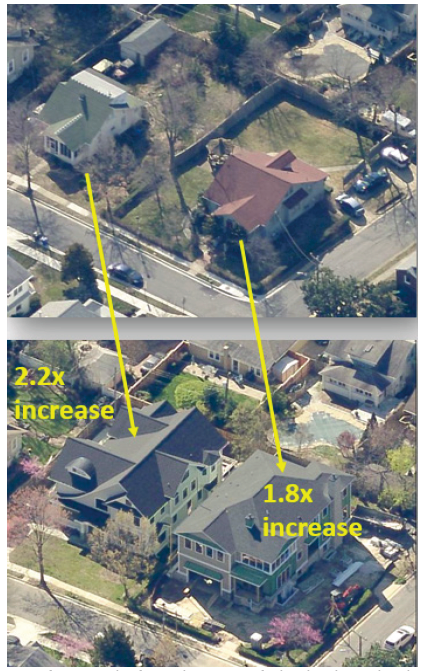
Under current zoning, smaller single-family homes in Arlington are being torn down and replaced with bigger single-family houses at a rate of 125 homes per year, the analysis says. That rebuilding trend adds the majority of impervious surfaces – like roads, sidewalks and buildings, ones that don’t allow water to soak into the ground – of all regulated development activity.
So while building “missing middle” housing is sure to have some environmental impact, it wouldn’t necessarily be worse than the status quo, planners say. Denser development could be taller instead of wider, for example, taking up less land and requiring fewer impervious surfaces than a new mansion does.
Can Arlington’s infrastructure handle more growth?
A leading criticism of proposed “missing middle” housing in Arlington is that the county simply cannot accommodate more people. Allowing denser housing to be built will lead to population spikes that strain schools, parks, community centers, and roadways to their breaking point, some say.
But the study’s authors note that population growth is happening now, and it will continue whether existing Arlington residents like it or not.
“If the County does nothing to allow other housing types, Arlington would continue to experience impacts on school enrollment, more households with more vehicles, loss of trees and other natural resources, and loss of pervious surfaces,” the report says. “These impacts would be realized without the benefits of offering other housing options and greater supply to sustain the community in the long-term.”
Planners have also stressed that any rezoning that happens in the wake of the analysis will take into account local infrastructure needs. Fine-grained planning about specific neighborhoods isn’t part of the study.
How could “missing middle” housing impact home prices?
There are two competing beliefs about how new, urban-style development affects existing housing prices. One is that it shoots up property values, raising taxes and market prices and deepening socioeconomic segregation. Another is that it lowers property values by bringing lower-priced homes into high-income areas. The county report addresses just the former idea. (The latter has been debunked in a series of studies.)
The county says, in a nutshell, that housing prices are already unsustainable in Arlington, and part of the solution is to add more supply.
“Gentrification is already a force in Arlington’s neighborhoods, including historically African American neighborhoods. These changes are due to increased demand for housing in these communities,” the report says. “Enabling [missing middle] housing in Arlington could produce more options that allow families to remain, such as options to support multi-generational families, opportunities to realize rental income, and smaller housing options that are less expensive than what is currently being produced in Arlington neighborhoods.”
But the report doesn’t claim that new housing will stop displacement of lower-income residents. That question is the subject of active debate and research. A working paper published in 2019 by the Upjohn Institute for Employment Research suggests that building new homes — including expensive housing — can drive down housing costs across metro areas, including in low-income neighborhoods. A 2020 study commissioned by the D.C. government showed that apartment development can keep rent prices more stable citywide than they would be without new construction. But other research has shown that new development can raise prices at lower-priced buildings nearby.
What happens next?
Arlington’s “Missing Middle” housing study now enters Phase 2, which will include a deep dive into specific “missing middle” housing types, where they could realistically be built, and how much the new housing could cost, among other focus areas.
County staff plans to make final recommendations for how to implement the study’s findings in the spring of 2022. Planners have said that public input will be incorporated into every step of the process, though that doesn’t mean every resident will be happy with the study’s recommendations.
“It is important to recognize that even if growth can be accommodated through careful planning and investment,” the report says, “changes may not be acceptable to all community members.”
The original version of this story included an incorrect link to a study about the relationship between new residential development and housing costs. The link has been corrected.