Jacob Fenston
 Tyrone Turner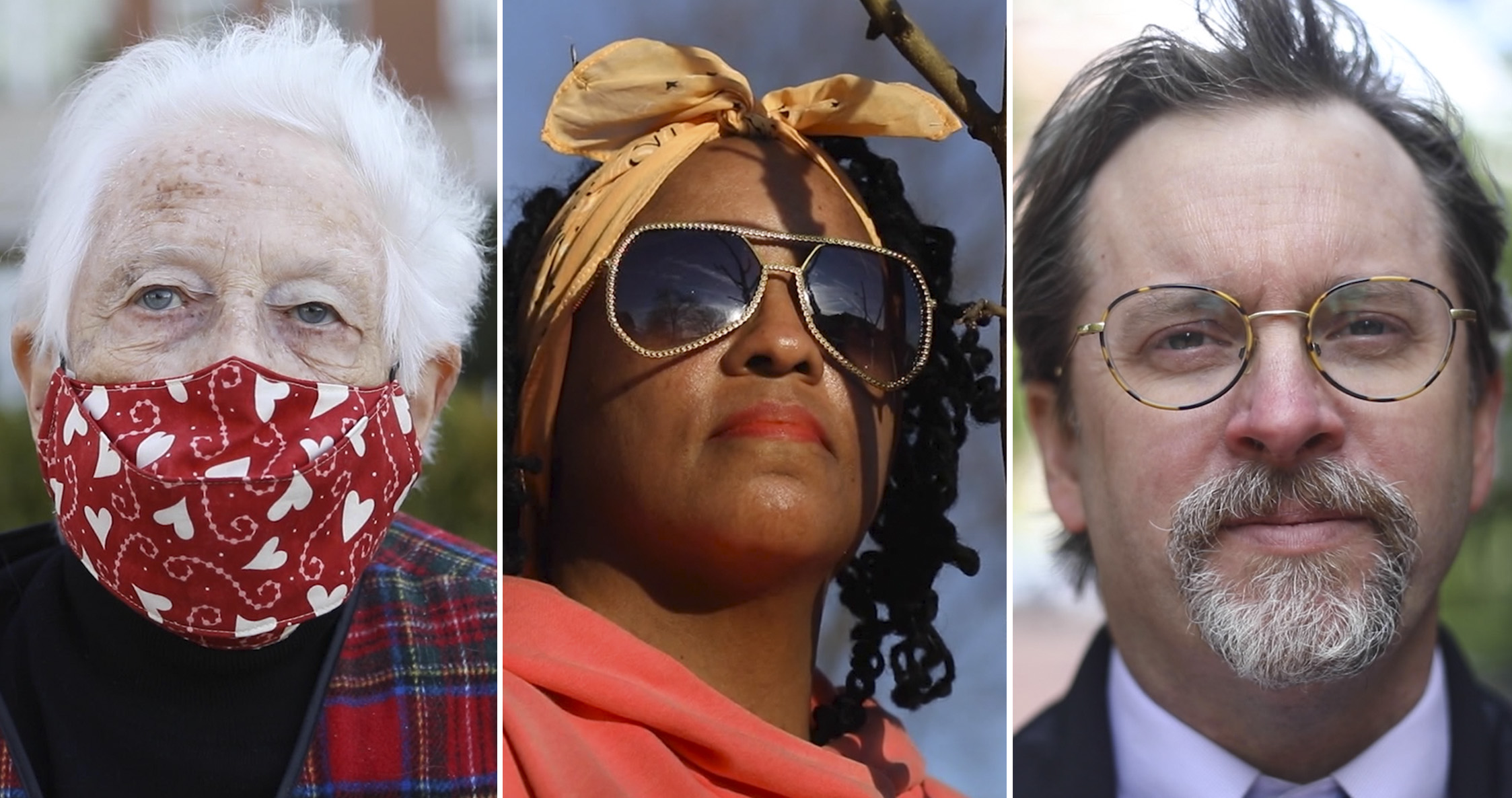
As D.C. and the rest of the world went into lockdown in the spring of 2020, DCist and WAMU began following the stories of several local residents living through the pandemic. Now, more than year and a half later, they reflect on life during the pandemic.
Margaret Sullivan
Margaret Sullivan is 87 and lives in a retirement home, Goodwin House, in Fairfax County. When I first talked to her, on April, 2, 2020, she described the early days of lockdown. Residents were confined to their own apartments mostly, with meals delivered. Visitors, even immediate family, were barred.
She also told me about her younger brother Ted, who had died of COVID-19 two weeks earlier — among the first 600 victims in the United States. “I’m the oldest and he’s the youngest,” Margaret said at the time. “That’s outside the order of things.”
Over the months, she confronted her own mortality — deciding she didn’t want to be put on a ventilator, if it came to that. And she cared for her husband Dan, who has Alzheimer’s disease, watching as the isolation and loss of normal routine increased his mental haze day by day.
Despite all the precautions at the facility, the virus found its way in, and Margaret saw friends and neighbors succumb to COVID-19. Some 50 residents have been infected with the virus, and a dozen have died. “When people start talking in abstract numbers, I just feel like, alright, I know the abstraction, I know the number, I know the names,” she says.
During the multiple peaks and valleys of COVID infection rates in the region, restrictions at Goodwin House were eased — Margaret got to see her kids and grandkids — then tightened up again. “I think it’s getting old,” she said, ten months into the pandemic.
“We mourn, and we mourn for all sorts of reasons. I think at this point, many of us here — without putting words to it — are mourning for a lost year. Now, for everybody, it’s been a lost year in some ways. But for those of us who live here — I’m in my now late 80s — we don’t have many years left. It’s less possible for us to have put off and think, ‘Well, alright, we’ll do that next year.’ The next years are not necessarily given.'”
Our original story about Margaret Sullivan published on April 23, 2020.
QueenAfi
QueenAfi Gaston is a lifelong D.C. resident, living in Ward 7. She’s survived domestic violence, and runs an organization counseling other survivors. In 2016, her 19-year-old daughter lost her life to domestic violence — shot to death by her boyfriend while holding their 2-month-old child.
“Just yesterday, I explained to my son, ‘Your mom has lived through so much trauma, and I’m still here.'”
“So I feel like in COVID, it’s nothing we can’t get through. We gonna get through this COVID thing, ’cause I’ve been through a lot of stuff that my community said I should have died at 15, and I’m still here.”
QueenAfi is now raising her granddaughter, Blake, who survived the shooting unharmed, as well as her own two sons.
“Nothing we’re doing is easy — who said it was going to be easy? I mean, if we can do it easy, we ain’t living life. Healing certainly ain’t about no microwave healing. Healing is not about the microwave, boo. You got to cook this in the cooker. You got to slow cook it.”
The three kids are now back in school, in person, after spending much of the pandemic at home. “So far so good,” says QueenAfi. “We’ve all been healthy, thank the Lord for that.”
Our original story about QueenAfi published on August 31, 2020.
Matt Norvell
When I first met Matt Norvell, on April 8, 2020, he was still trying to wrap his head around what it meant to be a hospital chaplain, in a time when a hug or a hand on the shoulder was no longer an option — his work counseling the sick and dying, as well as their relatives, had to be done over the phone or on Zoom, even through the glass door of a hospital room.
Over the course of the pandemic, he described waves of weariness among hospital staff. In November, 2020, in the midst of an infection spike, with vaccines still months away, Norvell said the hospital was permeated with an exhaustion “you can just about touch.”
“Everybody’s crankier, everybody’s sadder, everybody’s angrier,” he said at the time.
Norvell, an ordained Baptist minister, has been a hospital chaplain for more than a decade, working mostly in pediatrics — a job that even pre-COVID was emotionally challenging.
“We’re being present with people at some of the worst times of their lives — after they’ve been injured or they’ve got a new cancer diagnosis — that’s emotionally difficult by itself. I’ve learned over the years to have a pretty good rhythm about how to take care of myself.”
The pandemic, though, threw off that rhythm. “Like, the whole world was experiencing the same thing at the same time. There was nowhere that you could look and anybody was having a lighter day. Every story was really hard.”
“There have been times that I’ve caught myself just swirling in ‘What else is going to go wrong?’ Somewhere I stopped asking that question because it turns out there’s so many other things that could go wrong. So I stopped asking that question of what else is going to go wrong. For my own personal wellness, I had to start looking around to see what was going well.”
Our original story about Matt Norvell published on December 14, 2020.