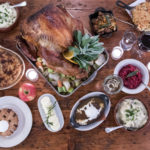
While most Washingtonians are dreaming of a beach day or a vacation away every July, Rasheed Abdurrahman is planning for Thanksgiving.
As the executive chef at local nonprofit Food & Friends, Abdurrahman knows far in advance how many meals he will need to make for the holiday. Since the 1980s, his nonprofit has served up thousands of meals throughout the year and for Thanksgiving for community members fighting life-threatening illnesses, their caregivers and dependents. This year, they’re set to make about 800 deliveries — totaling roughly 4,000 Thanksgiving meals in total.
But throughout this past summer, he watched prices soar for unfrozen, whole birds.
“By September, the pricing was close to $4.00 per pound,” said Abdurrahman. “On average, we want about a 10-pound bird, so that would be $40 just for the turkey alone and for all our clients it would have been … close to $30,000 just on turkeys.” That’s nearly half his Thanksgiving budget, he says. Before the COVID-19 pandemic, the nonprofit paid around $1.29 per pound, but even in 2020 he recalls that the price only rose to around $1.79 per pound.
Even those food items accompanying the centerpiece bird — cornbread, stuffing, green beans, buttered corn, rolls, butternut squash soup, fresh produce — cost more than they did last year, even with Abdurrahman ordering as far ahead as possible to “lock down” prices earlier in the year. He has noticed fresh produce, shelf-stable items and proteins other than turkey have spiked between 6% to 8%.
“If you have a pool of money, and you’re expected to do this much work with that money, then if you’re spending more, you can do less,” he explains. “The biggest thing for us is that we have to be very careful how much we’re spending.”
Americans across the country are seeing the impact of inflation throughout their lives this fall, from the gas pump to the grocery aisle. This year, serving a traditional Thanksgiving meal is expected to be 14% more expensive on average across the U.S. than it was in 2020, according to the American Farm Bureau Federation, an insurer and lobbying group for the agricultural sector. National media outlets like Bloomberg are reporting that heightened demand to gather for the holidays coupled with ongoing supply chain crunches have led to higher prices for Thanksgiving foods: Whole frozen turkey prices are up about 20% at the grocery store, with other baking goods facing multi-year highs. The problem has put a snag in the busy holiday giving season for nonprofits around the country, including for some in our region.
“We’re committed to this service remaining free to our clients, and we’re committed to high quality service,” explains Carrie Stolzfus, Food & Friends’ executive director, pointing out that food price increases not only impact nonprofits themselves, but also the average resident donating to social causes. “If it gets more expensive, that affects our ‘ask’ to the community to help us do this work.”
At Feed the Fridge, another local nonprofit addressing food insecurity, the cost of ingredients are double what they were last year, according to Mark Bucher, the nonprofit’s founder and a co-owner of local steakhouse chain Medium Rare. Specifically, wholesale turkey that once cost him under $1.00 per pound now costs $3.99. And wholesale dairy products — milk, butter, cheese — are 40% higher than the year-prior.
“If I need $1,000 more, I write a check for $1,000. If I need $500 more, I write a check for $500, or I’ll find a donor to give it to me” he says, noting that right now the nonprofit “is in pretty good shape.”
But relying on personal donations from Washingtonians is difficult now that many are resuming their pre-pandemic routines.
“During COVID [in 2020], we were raising a fair amount of money: People were home, they had extra time on their hands, they had some extra money; they weren’t going into the office, they weren’t paying for dry cleaning, they weren’t going out for office lunches,” explains Bucher. “Now that people are kind of back … personal giving, that $5, $10, $15, $20 has really dried up, not just for us, but for all nonprofits. And that’s a really big problem.”
But, he adds, “We will never let someone go hungry for budgetary reasons.”
Food & Friends was forced to find ways to save money amid rising turkey prices. Abdurrahman could have opted for frozen birds, which are slightly lower in price, but logistically, those birds are more difficult for Food & Friends to process. (To remain frozen, “that means that’s a whole walk-in refrigerator that we can’t use for anything else because it’s now full of raw meat.”) So instead he pivoted to buy bone-in turkey breasts instead of whole birds to save money.
There are some advantages to using breasts instead of whole birds, said Abdurraman, who is marking his third Thanksgiving with the nonprofit this month. More breasts can fit in the ovens at once, meaning Food & Friends can more quickly prepare the birds for dinner. But for a holiday wrapped up in so much tradition and expectation, “obviously, [the nonprofit] wanted to give clients the full Thanksgiving experience,” he said, noting that they’re still providing “all the same sides and pies.”
Food prices aren’t the only way that local nonprofits are experiencing the impact of national price hikes on goods across the supply chain. According to Stoltzfus, Food & Friends uses a combination of volunteers and staff members to deliver meals, meaning the nonprofit doesn’t have to budget for all of its actual transportation costs.
But in October, Stoltzfus says the nonprofit “spent over 40% more than budgeted on gasoline in October, with $3,330 spent [compared to] $2,333 budgeted.” She adds that the organization will have to fundraise for all the expenditures in excess of budget.
Not every area nonprofit helping Washingtonians facing food insecurity reports feeling the pinch.
“Calvary Women’s Services has not had too many issues, and our holiday meals are provided by volunteers,” explains Heather Laing, the organization’s chief development officer, over email. “We have had some of our clients who live in their own apartments who are running into challenges with the increased food costs, but we anticipate being able to meet that need for the holiday with donated boxes of food and gift cards.”
What might these price hikes mean for area nonprofits later in the holiday season? Stoltzfus said she can’t predict that (unless she became “some kind of wizard,” she jokes) because of active fluctuations.
“All we can do is roll with the punches and the changes, and keep our commitments,” she says.