 Jenny Gathright
 Héctor Alejandro Arzate
 Martin Austermuhle
Ward 1 Councilmember Brianne Nadeau unveiled emergency legislation on Thursday that would prevent the city from clearing existing homeless encampments and require that it instead provide a number of services — including lavatories and trash disposal — at encampments the city has said it wants to remove.
The legislation — which could get its first vote on Dec. 7 — came in the middle of an ongoing encampment clearing in Truxton Circle, where about 40 residents experiencing homelessness have been living in tents since late 2019.
The planned clearing is part of a pilot program by D.C. Mayor Muriel Bowser’s administration that is working to clear four homeless encampments — two in NoMa and two in Foggy Bottom, in addition to the Truxton Circle encampment. The city’s plan involves first offering residents housing and services, and then clearing the sites and not letting anyone come back.
D.C. officials have said the program is a means to address the growing number of encampments that have popped up across the city since the pandemic started, as well as the health and safety concerns associated with some of the encampments. But homeless advocates — and a growing number of lawmakers — have expressed discomfort with the formal clearings, pushing Bowser instead to merely continue working to get unhoused residents into apartments without removing them from encampments during the process.
She has largely ignored those requests, and on Thursday morning crews proceeded with a planned clearing of the Truxton Circle encampment at New Jersey Avenue and O Street NW. A bulldozer and dump trucks lined the street, and police blocked off public access to the Allen Park as it prepared to evict residents. Dozens of people also arrived to protest the encampment clearing, and about a dozen police officers were also present at the scene.
Reporting today at NJ & O Street. Encampment clearing about to start. Lots of police, machinery, and observers. @wamu885 @DCist pic.twitter.com/0eDnRdJnwz
— Héctor Alejandro Arzate (@hectoraarzate) December 2, 2021
D.C. officials formally counted 32 residents at the encampment. According to D.C. data, as of earlier this week 12 had signed leases and another 16 were in the housing-search process. Homeless advocates say the city undercounted the number of residents there.
Darlene Torres and Ezekiel Hernandez, a married couple who had been living in a tent in the park along New Jersey Ave. since late October, got in a van right before the bulldozers started to drive in to the park. They said they would be staying in a hotel for the night but did not know what would come next.
Torres said they had signed up for housing provided through the city, but it was “going to take a little bit, hopefully before the new year.”
“We’ve built a kind of community, kind of family, kind of thing. It hurts to see people hurting,” said Hernandez, who added that he had been waiting for his birth certificate to arrive from New Mexico and a Social Security card to arrive from out of state in order to secure housing.
“It’s not my lack of effort or I was just bullshitting around,” he said. “I really couldn’t obtain the services that everyone else could.”
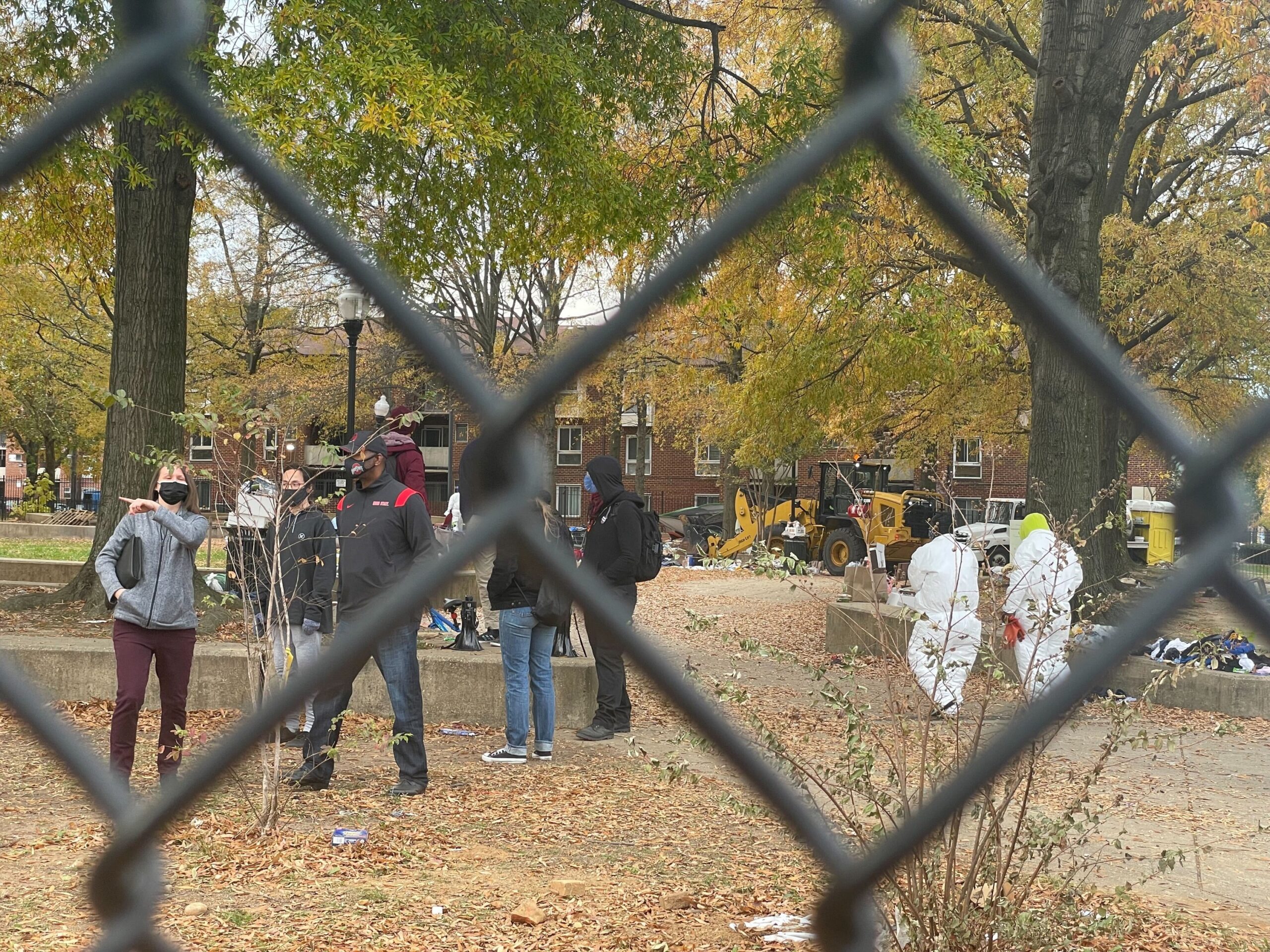
At-Large Councilmember and mayoral candidate Robert White was at the clearing and criticized the approach the Bowser administration has taken in recent weeks to clear encampments.
“The problem is not everyone is placed into housing yet and when they’re moved out of here, they don’t know where they’re gonna go. So we still have a homeless crisis in our city. We’re just pushing people out, in what I think is a cruel and tragic way,” said White. “This is a huge issue because what we’re saying is, ‘you can be homeless but you can’t be homeless here.’”
City officials have defended the program, saying that it is designed to protect residents from the elements and get them into housing quickly.
“There was a recognition… that the number of tented encampments were growing across the city and the persons living in those encampments were at extreme risk not only from potentially contacting COVID but also the elements associated with living outside,” Deputy Mayor for Health and Human Services Wayne Turnage has said about the pilot. “We decided to take a modification of the Housing First model to see what would happen if we deployed that strategy.”
The city decided to clear the NoMa encampments first, in October. But the operation was suspended after a city worker operating a small bulldozer lifted a tent on L Street that still had a person inside of it. The resident was uninjured but was taken to a local hospital as a precaution.
In the wake of that incident, D.C. councilmembers have been pushing for the city to change how it clears encampments — or pause the encampment clearings altogether.
“If the resident had not been able to communicate their presence, they could have died,” Nadeau wrote on social media at the time. “We are literally talking about life and death when working with encampments.”
A number of homeless advocacy groups and coalitions — including The Way Home Campaign, Jews United for Justice, the Washington Legal Clinic for the Homeless, and the Greater Washington Community Foundation — have said they support the effort to provide people with housing but strongly disagree that it should be paired with the prohibition on camping. They’ve raised concerns about what happens to residents who opt out of the city’s offers for housing and services but are still forced to leave encampments.
“We support providing housing to all people experiencing homelessness,” wrote the Washington Legal Clinic for the Homeless after the NoMa encampment clearing. “However, we reject the Bowser administration’s attempt to frame forced displacement from large visible encampments as new or necessary to the provision of housing.”
Jesse Rabinowitz, a senior manager for policy and advocacy at Miriam’s Kitchen, said Thursday’s encampment clearing at Truxton Circle was illustrative of the problems with the city’s approach.
“They’ve blocked down the entire neighborhood with police in an incredible escalation, which is proof that this pilot program was intended to invisibilize and criminalize homelessness,” he said.
“What we want the council to do is focus on housing. Housing ends homelessness. D.C. has a historic amount of housing vouchers that could end homelessness for about 2,400 individuals,” Rabinowitz added. “If we focus on housing, homelessness will look markedly different in D.C. in the next year. I think we’ll see fewer tents, fewer encampments, and fewer people sleeping outside. But in order to do that, we have to focus on housing and stop harming people by evicting their homes and their encampments.”
If approved by the council, Nadeau’s bill would achieve at least part of that. It would both prohibit the city from clearing encampments and from creating no-tent zones. The measure would also require that the city provide bathrooms, garbage disposal, and other services at the encampments D.C. has identified for clearing as part of the pilot program, and also mandate that the city remove concrete barriers or fencing that has been used to block off certain former encampments — like the ones in NoMa.
The bill’s fate remains unclear, though. It will need nine of the council’s 13 members to approve it, and as an emergency measure cannot require that the city spend any money.
As city workers prepared to clear the Truxton Circle encampment, Darlene Torres said she was grateful for those who gathered to protest, but stressed out by the entire situation.
“It’s starting to get sad now. I’ve seen people cry. This is not cool,” she said. “They’re straight up going to crush and crumble and throw people’s things.”