Martin Austermuhle
You can pay bills, swipe into a Metro station, order a car, and do countless other things on your phone. And now venture capitalist and former political operative Bradley Tusk wants D.C. residents to be able to use their phones to vote.
Tusk Philanthropies is bringing its mobile voting project to D.C., hoping to make the nation’s capital the first place in the country where residents can use phones and computers to cast ballots. Tusk, a former campaign advisor to New York City Mayor Michael Bloomberg and one-time Uber official, has in recent years funded mobile-voting pilot programs across seven states — including Washington, West Virginia, and Oregon — largely to support overseas and military voters. But his effort in D.C. would represent the first push to make mobile voting a permanent part of elections for all voters.
“D.C. will be a pioneer for opening this up for all eligible voters. It would be the first in the nation to do that for D.C. elections,” says Jocelyn Bucaro, a former elections administrator in Denver who now leads Tusk’s Mobile Voting Project. “D.C. is really proving to be a place for progressive election reform and making voting easier and more convenient for voters. And I know the D.C. Council is committed to that. So we wanted to join their efforts and be supportive if we can.”
Tusk recently announced a $10 million investment to build a secure mobile voting platform, which Bucaro says would let voters use a phone, tablet, or computer to fill out a digital version of their paper ballot and then securely transmit to a digital ballot drop box, where election officials would print it out and count it.
“Voters have to go through some form of authentication in order to access their ballot, so the back end system will need to identify who the voter is, make sure they’re eligible, make sure they haven’t already voted,” she explains. “Some applications might use biometric information to verify the voter, and then the voter will mark their ballot on their device and they can sign their signature affidavit, provide any other identifying information that might be required. If they have to provide a photo of an ID or something, they can simply do that with the device.”
Bucaro says the benefits of mobile voting are clear: it’s easier and more convenient, and would lead to higher turnout in elections. A Tusk-funded study of West Virginia’s 2018 mobile voting pilot showed that turnout did go up by between three and five percentage points. According to a Tusk-commissioned poll of 500 likely D.C. voters conducted in early November, 58% of respondents said they support mobile voting.
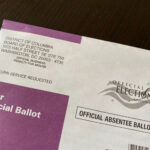
Last year Arlington County Democrats offered mobile voting for a school board caucus. And the D.C. Board of Elections allowed hundreds of voters who had not received their absentee ballots to vote by email, using a system traditionally reserved for overseas and military voters.
Still, skeptics of mobile voting abound. They say that just like hackers can steal someone’s bank information or take over their social media accounts, they could wreak havoc on the civic exercise that makes democracy tick.
“Study after study has found that internet voting has fundamental security vulnerabilities that simply haven’t been resolved at this point. And a lot of them are almost impossible to overcome given the current implementation of the internet, because the internet was never really designed with security in mind,” says Mark Lindeman, an expert on voting security and audits with Verified Voting, a nonpartisan group that focuses on elections and technology.
Four federal agencies concluded as much in a May 2020 assessment, saying that “securing the return of voted ballots via the internet while ensuring ballot integrity and maintaining voter privacy is difficult, if not impossible, at this time.”
D.C. is something of a pioneer in proving the vulnerabilities of online voting platforms. In 2010, election officials invited security researchers to try and hack into an internet voting portal for overseas voters before it was fully deployed for use; hackers made quick work of the site, while election officials took two days to discover anything was amiss. Even Tusk’s poll shows security is top of mind for D.C. voters when asked about mobile voting; when respondents were asked to list their concerns, fully half of them cited hacking, security, or fraud.
Lindeman says most people assume there’s a degree of insecurity to most online transactions, like banking. But that same degree couldn’t exist for mobile voting, he adds.
“Some tolerance for fraud is built into our current digital banking systems. But with voting, there’s really very little tolerance for fraud and there needs to be very little tolerance for fraud. And again, the fact that our votes, unlike our financial transactions, have to be separable from our individual identities makes the problem even harder,” he says.
Bucaro says she’s well aware that ballot security is a concern for many voters, but adds that Tusk’s new mobile voting push is working with former skeptics of the idea to ensure ballots can be transmitted safely.
“There has been a rapid advancement just in the last five or six years in terms of cryptography, the ability to verify from end to end that everything is working correctly and to ensure that that the ballot is is recorded in a digital ballot box in such a way that it can’t be changed or altered or tampered with once it’s recorded,” she says. “There is risk, but there are also ways to mitigate that risk, and there are ways to ensure that any potential threat is detectable so that voters have the opportunity to catch a problem if there’s a problem.”
Whether or not D.C. lawmakers agree remains to be seen. The council is already considering a number of elections-related bills, including one to introduce ranked-choice voting and another to make permanent the use of mail ballots. (Tusk did hire local lobbyist Max Brown for his mobile-voting push; Brown is the board chair of Events D.C. and is close to Mayor Muriel Bowser.)
Earlier this year, Councilmember Trayon White (D-Ward 8) introduced a bill to allow voters to cast ballots using their phone. Bucaro says that bill was coincidental, but she wants to work with White to refine it and use it to move the idea forward. Councilmember Brooke Pinto (D-Ward 2) says she is “enthusiastic” about championing mobile voting in the city.
“Providing a myriad of options to vote is especially important in our city to enfranchise all residents and ensure older adults, persons with disabilities, and others for whom voting in person may be difficult,” she said in an email.