Boston, Massachusetts was one of the first of the many older cities along the east coast and around the Great Lakes that received a federal court order to comply with the Clean Water Act. According to the Environmental Protection Agency, the Clean Water Act (CWA) establishes the basic structure for regulating discharges of pollutants into the waters of the United States and regulating quality standards for surface waters. The CWA made it unlawful to discharge pollutants from a point source into navigable waters without a permit. Boston was required by the court order to stop the decades-old pollution of Boston Harbor.
When cities like the District, Boston, New York, Indianapolis, Richmond, and more than 700 other municipalities were planned long ago, the state of the art for handling wastewater was to combine both the sanitary flow and the stormwater flows into one sewer pipe. The systems provided outfalls to the surrounding receiving waters that allowed these pipes to overflow when it rained heavily to prevent upstream flooding. Population growth and consequent paving of the green spaces in these older cities have exacerbated water quality challenges due to combined sewer overflow (CSO) systems.
While Boston’s consent decree was signed in 1997 and the District’s in 2005, the two cities followed remarkably similar paths in control of CSOs. Both Boston and the District built two of the country’s largest and most innovative wastewater treatment plants.
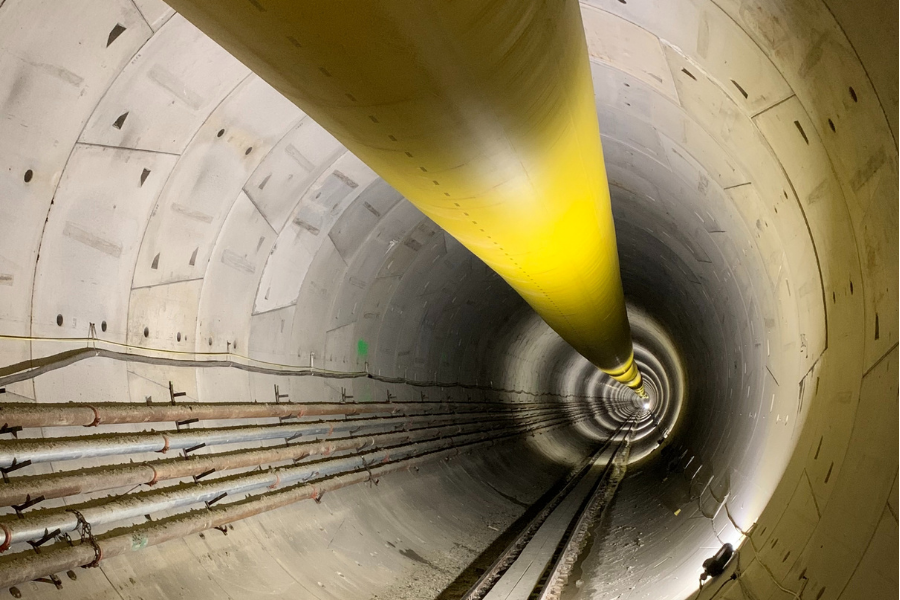
Interestingly, the 35 CSO projects in the Boston Harbor Project and the 21 in the DC Clean Rivers Project are what tunnel engineers consider triumphant achievements due to the large benefits they provide despite the challenge of their large size and the complexity of their construction in an urban environment. For Boston, the “jewel in the crown” was the $270 million South Boston CSO Storage Tunnel; for D.C., it’s the $580 million Northeast Boundary Tunnel (NEBT), currently under construction. The South Boston Tunnel was 2 miles long and 17 feet in diameter, while NEBT is over 5 miles long and 23 feet in diameter. Both were mined by tunnel boring machines. The South Boston Tunnel had eight associated surface construction sites for CSO connections and tunnel shafts, and the NEBT has 11. The South Boston Tunnel was built to eliminate CSO and stormwater discharges to the swimming beaches in South Boston after all but the heaviest of storms. When the NEBT is placed in operation in 2023, it will complete the Anacostia River Tunnel system and reduce polluting the river with CSOs by 98%. It will also improve the resilience in the area the tunnel serves by significantly reducing the frequency, magnitude, and duration of sewer flooding and basement backups in the Northeast Boundary drainage area. While both projects required temporary impacts on traffic, residents, businesses, bikers, and pedestrians, during construction, both projects will have long-lasting benefits to the communities they serve for decades to come.
To learn more about the NEBT, please visit dcwater.com/nebt.