Ally Schweitzer
Before the pandemic, an estimated 200,000 federal employees commuted to D.C. offices every day. They bought coffee. They ordered lunch. Sometimes, they downed half-price beers at happy hour.
Today, many of those workers only commute as far as the kitchen table each morning. Their coffee, lunch, and beer all come from the same place: the refrigerator.
The COVID-19 crisis transformed federal telework from novel to normal in just a matter of months. Around 3% of federal employees teleworked daily before the pandemic. That percentage swelled to 59% last year, according to a recent survey.
Now, it looks like federal telework is here to stay. The Office of Personnel Management, the federal government’s chief human resources agency, released new guidance last month meant to help more agencies embrace flexible work arrangements. The first update in a decade to the guidance on remote work, the document acknowledged the policy’s success during the health emergency.
“Agencies prior to the pandemic considered a lot of jobs ineligible for telework,” says Jacque Simon, policy director for the American Federation of Government Employees, a labor union that represents 700,000 federal workers around the world. “Their minds were changed during the pandemic.”
But the feds’ new stance on remote work could spell trouble for D.C.’s economy.
“It would be difficult, just psychologically, to have to go [back to work] now,” says Ron, a federal employee.
John Falcicchio, D.C.’s deputy mayor for planning and economic development, has been wrestling with that possibility for months. Concerned about the long-term health of downtown businesses and real estate, he and other members of Mayor Muriel Bowser’s administration have been lobbying the federal government to call most of their workers back, at least part-time, as soon as possible.
“We don’t need them to come back five days a week,” Falcicchio says, “but we do need them to come back in some form or fashion.”
The U.S. government employs more than 2 million civilians globally. It’s also the single largest employer in D.C., and one of its biggest landlords. The General Services Administration, which manages the federal government’s real estate portfolio, owns or leases nearly one-quarter of office space in the city, according to 2018 data provided by the Downtown D.C. Business Improvement District. The federal government is exempt from D.C. property taxes, but spending by federal workers contributes millions in sales and restaurant tax revenue each year, Falcicchio says.
If every federal worker spends an average of $20 a day downtown, the deputy mayor says, “somewhere between $60 and $100 million of tax revenue has vanished if those workers don’t come back.”
The drop in foot traffic has walloped business districts south of K Street. As of this fall, downtown D.C.’s economy was operating at a third of pre-pandemic levels, when just a quarter of workers were reporting to the office in person, according to the Downtown D.C. BID. Hundreds of businesses downtown have shuttered, and restaurant owners continue to report low sales at eateries that once thrummed with office employees.
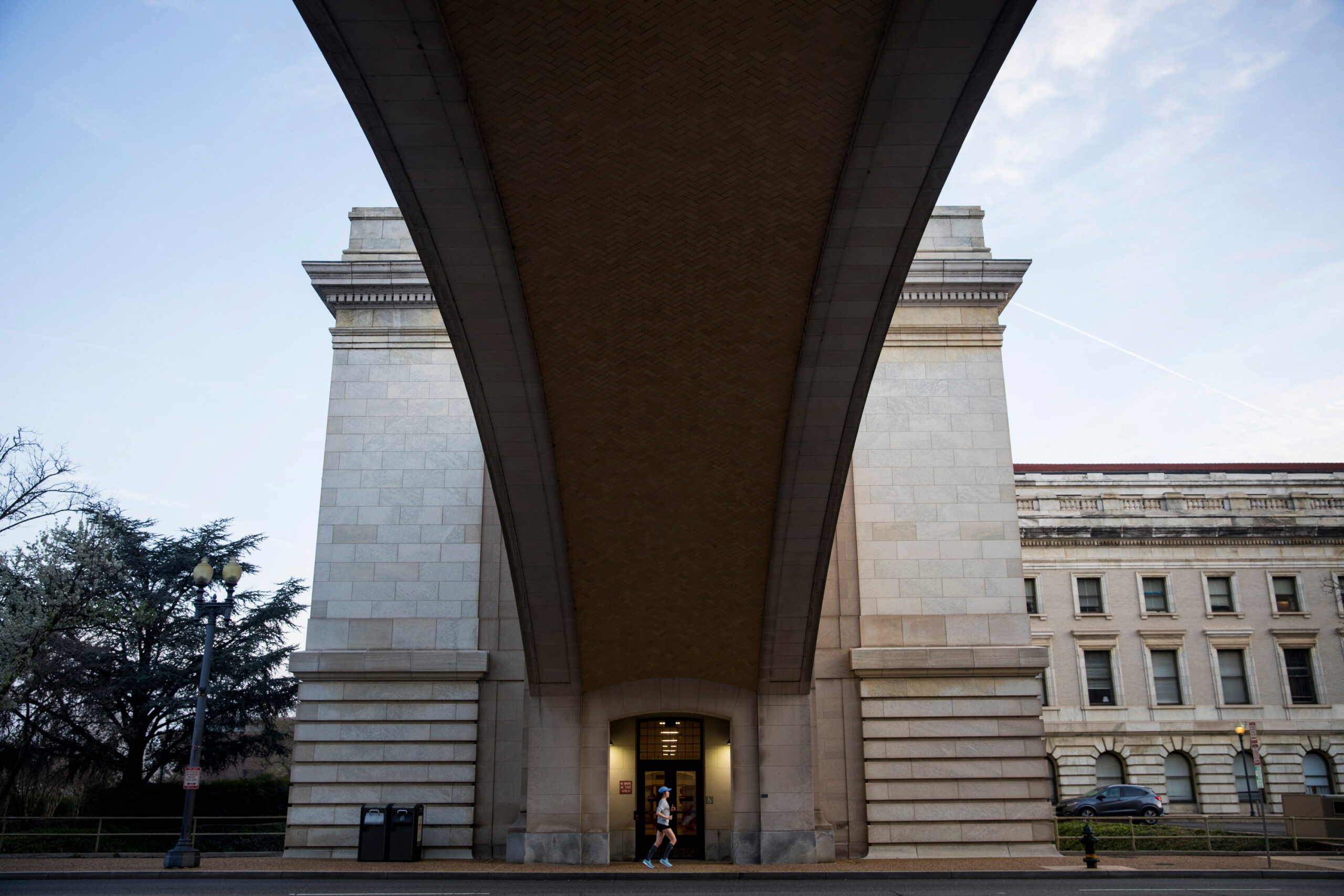
But pleas from business owners and the D.C. government haven’t produced an about-face by the numerous federal agencies that continue to allow maximum telework for most of their D.C.-area employees. Many agencies are still finalizing official return-to-work plans with union leaders, says Jacque Simon with AFGE, and their plans are all over the map, even among offices within a single agency.
“It really would be nice to have just one answer here, but they really vary tremendously,” Simon says.
As departments continue to finalize return-to-work plans, many federal employees have now settled into their new telework routines — and they aren’t eager to go back.
Stuart, a lawyer for a small federal agency who withheld his last name because his employer has not authorized him to speak with the media, didn’t celebrate when the pandemic closed his office in L’Enfant Plaza last year. He had friends who strongly preferred working from home, but he was skeptical.
“I didn’t think I was ever going to fall in that camp,” the attorney says. “I thought it would be awful.”
Nearly two years later, Stuart has grown to appreciate not having to commute from his home in Cleveland Park. But he admits the shift has changed his spending habits. Before the pandemic, he and his wife dined out regularly after work. Now, they usually eat at home, just out of habit.
“Once you’re in the house, it’s kind of hard to get moving,” he says.
Ron is a federal worker who lives in Silver Spring, and also requested his identity be withheld because his employer has not authorized him to speak with the media. He says he used to spend as much as $50 a day when he reported part-time to his office in Federal Triangle.
“I spent twelve bucks on parking, $10 for coffee and whatever, and lunch was probably, like, $20 at Sweetgreen,” he says. “I was much looser with my discretionary spending.”
Ron misses lunching downtown, but he doesn’t necessarily want his employer to call him back, either.
“It would be difficult, just psychologically, to have to go in now,” he says.
The General Services Administration began planning to shrink the federal government’s office presence in D.C. and across the country years before the pandemic hit, but COVID-19 hastened the transition. Agency leaders have told GSA they plan to downsize their office space between 20% and 50% post-pandemic. The government is starting to invest in coworking, with GSA inking a contract in September with WeWork and four other shared office providers, and it’s exploring ways to concentrate employees from multiple agencies into fewer buildings.
“Common sense suggests that using and consolidating into federally owned facilities is better for taxpayers than signing new leases,” GSA administrator Robin Carnahan said during an event hosted by Government Executive in October.
Carnahan told House lawmakers last month that 40% of GSA’s leases are set to expire over the next four years, granting the agency an opportunity to slim down its real estate footprint for good, saving taxpayers an estimated $2 billion a year.
But the pandemic forced a transition to telework that took place much faster than it would have otherwise, says Yesim Sayin Taylor, executive director of the D.C. Policy Center, a business-backed think tank.
“We knew telecommuting was coming, but going through it over 10 years, with idiosyncratic changes like one firm at a time reducing their footprint … is very different from going through this all at once,” the economist says.
The appearance of half-empty federal offices downtown could have ripple effects across industries, Taylor says. Businesses that revolve around the physical presence of government workers — everything from lobbying firms to caterers — may be less interested in occupying space downtown if most workers stay home.
“It’s sending a signal to other people who want to be in close proximity, ‘Maybe you don’t need to be on K Street. Maybe you don’t need to be in the downtown area,’” Taylor says.
The Bowser administration has tried to spur more foot traffic downtown by summoning its own workforce back to the office. While thousands of federal workers remained at home, city government workers began to return to in-person work in May, with more called back in June and July, says Deputy Mayor John Falcicchio. Now, most of the city’s executive branch workforce is required to work in the office at least three days a week.
“The mayor has made sure D.C. government is back in person,” Falcicchio says. “What we need now is the federal government to show leadership once again, as they’ve done throughout the pandemic, and come back.”
But some leaders and business groups are already preparing for the possibility that downtown will never return to the old normal.
The D.C. BID Council, an association of D.C.’s 11 business improvement districts, has hired an advertising firm to help revive interest in downtown. The forthcoming “return to city life” campaign is expected to focus on culture and entertainment options downtown.
After the D.C. Council rejected a proposal from Councilmember Brooke Pinto (D-Ward 2) to create a 35-year, $140 million tax break for developers who convert office buildings into housing, the lawmaker introduced a bill that would provide tax breaks to property owners who refashion office space into homes, retail, or other uses.
Increasingly, it looks like office owners downtown need to start considering a range of possibilities for their buildings, according to the D.C. Policy Center. Office vacancies were already rising before the pandemic, says a recent report from the think tank, and neighborhoods with a combination of commercial and residential space proved to be more resilient during the crisis.
Redeveloping office buildings — including federally owned properties — could lead to exciting changes in what’s now an office-heavy part of the city, says Yesim Sayin Taylor. But that’s taking a long view.
“A lot of people talk about, ‘Oh, cities will always survive.’ I don’t disagree with that, but there’s a real cost to the transition,” Taylor says. “It’s sort of like when you think about the pandemic. In the long run, we’re going to survive, but there’s a generation that’s being hit pretty hard by it.”
The original version of this story inaccurately said the Bowser administration introduced a 35-year tax break to support downtown office conversions. The proposal was brought by Councilmember Brooke Pinto (D-Ward 2). The story has been corrected.