Amanda Michelle Gomez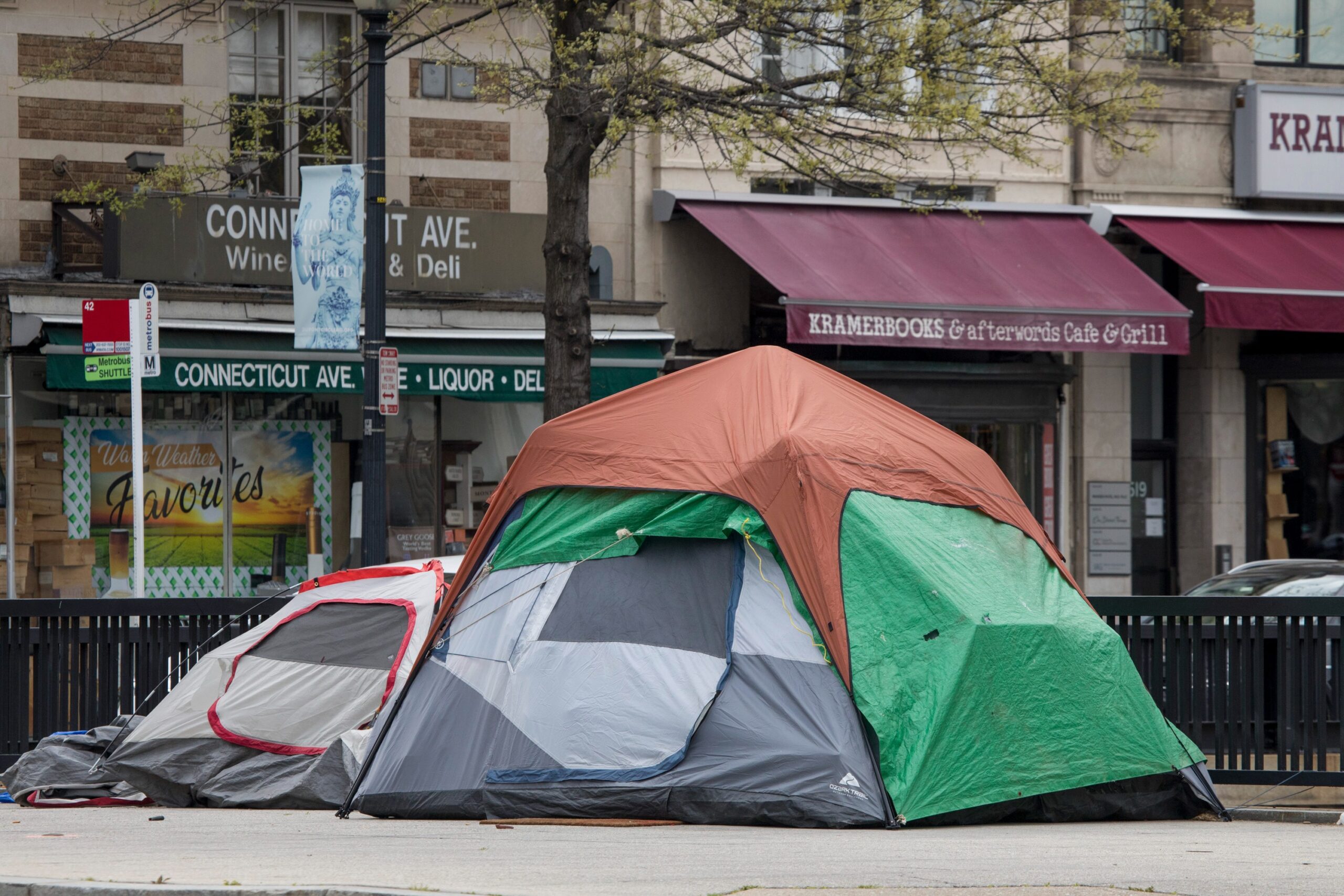
D.C. Mayor Muriel Bowser stood before a crowd outside the Chevy Chase Community Center last Thursday to present her new plan to build more affordable housing west of Rock Creek Park. Just a day before, an official from the Department of General Services apparently ordered the site cleared of a homeless encampment.
An email thread, provided to DCist/WAMU, starts by declaring a “sweep” of the recreation center in preparation of the mayor’s scheduled event. The emails between government officials across several agencies begin Tuesday, Dec. 14. Employees were preparing for an event about how the Bowser administration intends to meet its larger goal of building 36,000 units by 2025. The goal is an important piece of the mayor’s re-election platform.
“I need your help again,” wrote Cameron Washington with the Department of General Services in an email to a Department of Human Services colleague. “MMB will be at Chevy Chase Community tomorrow and we need assistance with cleaning belongings of a resident who lives in the bushes in the front of the property.”
Melvyn Smith, with homeless services outreach at DHS, then flagged the “urgent” request for the department. The person experiencing homelessness had “a large amount of belongings and property that is very visible and obstructing to the facility,” Smith said in an email.
“The Mayor is scheduled to speak on this coming Thursday,” Smith continued, “and help is needed with preparing the location for this event by engaging the consumer to collect and gather his things in support of the event and the public who use this facility as well as those in attendance.”
Attached photos of the scene in the email thread show several items, including a suitcase and blankets tucked into some bushes. Smith’s email prompted the Office of the Deputy Mayor for Health and Human Services to determine the encampment should be cleared because it “blocks a major entry/exit point for the facility.” Jamal Weldon with DMHHS, which oversees the city’s response to encampments, then ordered the “disposition and removal of these items” on Thursday, Dec. 15 — a few hours before the mayor’s prepared remarks.
The photos included do not make clear where the apparent encampment was located in relation to the recreation center’s entrance or its proximity to the exact site of Bowser’s press conference.
DCist/WAMU reached out to named officials, but none have yet responded. Washington did forward the request to a DGS spokesperson, who did not immediately provide comment.
A spokesperson for the Office of the Deputy Mayor for Health and Human Services said the department determined Thursday’s intervention met the threshold because items blocked “a major entry/exit point for the facility.” “Residents have not been observed at this location recently, though several outreach attempts have been conducted,” the spokesperson said via email. “[The Department of Public Works] was able to remove the large number of undisturbed/abandoned items and trim the foliage that also presented a blockage to that entry/exit point.”
The front desk at Chevy Chase Community Center, a facility of the Department of Parks and Recreation, also declined to comment on the encampment. Randy Speck, who chairs the Advisory Neighborhood Commission where the center is located, says he’d never seen an encampment there. Nor had he received any complaints about one blocking an entrance, he told DCist/WAMU via email.
The emails underscore the lack of a clear policy around encampment clearings. City officials often say encampments are cleared for health and safety reasons, while some homeless advocates argue the reasons are oftentimes nebulous. They say residents are sometimes evicted from their tents for reasons that are not so clear cut, such as neighborhood complaints.
On its website, the Office of the Deputy Mayor for Health and Human Services says it will provide “ample notice and outreach before city officials clear an encampment.” But the agency also says it will make exceptions when an encampment poses an “immediate threat to public health or safety.” It’s unclear what the case was last Thursday; the encampment is not on the city’s public list of encampment “engagements.”
How and when the city clears encampments has been in the spotlight in recent months. Bowser’s administration launched a new program over the summer in which officials offer housing to residents at select encampments, before clearing them and not allowing anyone to return. During one clearing under the program in NoMa this fall, a bulldozer driver struck and lifted an encampment resident who was still inside a tent. (The person wasn’t injured, according to officials). The program has been criticized by some advocates and councilmembers for criminalizing homelessness for being too visible, as well as not guaranteeing permanent housing; not every encamped resident gets housed.
Ward 1 Councilmember Brianne Nadeau introduced a measure earlier this month that would temporarily halt encampment clearings, and offer residents living outdoors access to services like lavatories and trash disposal. The Council had postponed the vote on the bill to Tuesday, but it ultimately failed to pass by a 7 to 5 vote.
The council’s Office of Racial Equity has rated the bill favorably, writing that it will “protect the health and wellbeing of Black residents, Indigenous residents, and other residents of color living in encampments as long as the pause is in place.”
Amber Harding, a housing attorney with the Washington Legal Clinic for the Homeless, says the encampment clearing at Chevy Chase Community Center demonstrates the need for lawmakers to set clear boundaries for when and how city officials can engage with encampment residents, and to ensure officials are held accountable to those standards.
She said that if city officials cleared the encampment just to prepare for the mayor’s press conference, that would be extremely concerning.
“It’s an abuse of power to clear encampments not for any justifiable, rational health and safety need, not with any notice to the person or opportunity for the person to say like, “Hey, I can clean that up if that’s a problem,” Harding tells DCist/WAMU. “And just to reduce the presence of people who are homeless because there is a concern that it looks bad to the mayor when she’s talking about housing — to have such a visible reminder that she hasn’t created enough affordable housing to meet the need.”
Harding notes that had Nadeau’s bill passed earlier this month, it may have prevented the Chevy Chase clearing.
On Dec. 8, the council had opted to delay the vote on Nadeau’s bill in the hopes of reaching a compromise. Several councilmembers voiced concerns that the bill bluntly restricted city officials from clearing any encampments. “There are areas where encampments are not ideal,” said At-Large Councilmember Christina Henderson during the council’s debate earlier this month, naming one outside of Seaton Elementary in the spring.
The Council voted on a revised version of the bill on Tuesday, one that wouldn’t stop clearings in certain spots like school or recreation center grounds. Still, councilmembers who had voiced concerns — like Henderson and Ward 6 Councilmember Charles Allen — voted “no.”
Various homeless advocates called the vote shameful. It’s unclear whether another bill will be introduced in the session next year.