Margaret Barthel
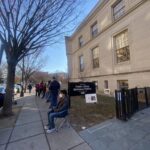
Just before Christmas, Kenneth Llewellyn, who lives on Columbia Pike in Arlington, started experiencing COVID-like symptoms. On December 23, he went to the county’s Highlands Park. testing location to try to get a PCR test, after he couldn’t find a rapid test for sale at any area pharmacies. He was met with an hours-long line. A friend brought him coffee and he settled in to wait.
“And then about two hours later, I had no more hot coffee, it felt a lot colder, and the line wasn’t moving,” Llewellyn, 32, tells DCist/WAMU. “I could tell from where I was and where the tent was [that] I was going to be there for another hour at minimum. So I just said, ‘Screw this, I’ll just operate [assuming] that I’m positive.’”
Llewellyn finally resorted to calling around to area pharmacies for rapid tests he could purchase. He found one and confirmed that he had COVID-19 on Christmas Eve, though he has since recovered and tested negative.
Llewellyn works from home, and was able to go to try to get tested because his job is flexible. But he points out that waiting in long lines — and ultimately paying out of pocket to buy a rapid test — isn’t something everyone can do.
“People can’t be expected to stand out in lines for hours when their job doesn’t allow that,” he says. “I’m a lucky person, but other people, they’re either not getting paid or using time off to stand in that line.”
Shortages in COVID-19 testing availability have become acute lately, as the highly contagious omicron variant surges and area residents scramble to get tested before and after holiday gatherings. In Northern Virginia, where free public testing availability has frequently lagged behind the options in D.C., capacity is particularly strained.
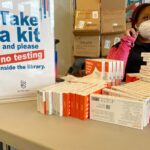
In Arlington County, Fairfax County, and Alexandria, the public libraries are out of free rapid tests supplied by a Virginia Department of Health program, and have been since last week. Residents report long lines and a lack of appointments at Arlington’s public testing locations, which perform PCR tests. Other localities have no public testing option for people who don’t have symptoms.
All that is having an impact on residents’ ability to test when they have symptoms or in order to stay safe while socializing during the holidays. Plenty of people have horror stories — long lines, cancelled appointments, endless calls to area pharmacies — from their quest to try to find a test.
Couldn’t find any appointments, many places weren’t even allowing registration for the walk-ins, and one place even cancelled my appointment because they suddenly changed the ages they were testing. Ended up getting a rapid test from a friend who received them for free in the UK.
— basit (@TheBasitHound) December 27, 2021
Carolyn Lamer, who runs the Virginia Department of Health’s library test kit program, says all three systems should be receiving a shipment of new tests this week, including 10,000 kits in Fairfax and just over 2,000 kits each in Arlington and Alexandria.
“We’ve really seen demand shoot up for this program, which I’m imagining is why these libraries are stocking out so quickly, and also why we’ve been a little bit slower in resupplying them,” Lamer says. “One other factor is that many libraries closed for the Christmas holiday, so that impacted our shipping schedule.”
The Virginia Department of Health has been distributing free rapid antigen testing through public library systems across the commonwealth since November, but in Northern Virginia, the program hasn’t kept pace with skyrocketing demand. Throughout December, residents have been reporting library branches running out of tests on the same day they receive a new supply.
So far, the VDH program has distributed 38,000 test kits to the three Northern Virginia localities, including 3,800 kits in Alexandria, 32,000 kits in Fairfax, and 1,800 in Arlington. (Alexandria joined the program first, in mid-November, followed by Fairfax in late November and Arlington in early December.) Lamer says libraries are responsible for placing requests for numbers of tests, which VDH then attempts to fill — a process that has been going more slowly than expected.
“We are getting the kits we’ve ordered, but there is a little bit of a delay,” she says.
For Virginians looking for a test, Lamer recommends visiting the VDH website, which has a locator tool with testing options.
“We’re just asking people to be patient and try and try and use all of the testing and resources that are available within the community,” she says, noting that the public library testing is not meant to be the sole option for testing (though in some communities, other public testing options are limited to people experiencing symptoms, not those seeking to test preventatively).
“One thing that we’re also really excited about is the fact that D.C. did start their antigen distribution program from their local libraries as well, and we’re aware that Maryland also does have rapid kit distribution as well,” Lamer says. “So we’re hoping that this will really boost supply throughout the DMV area and take the pressure off of any one resource.”
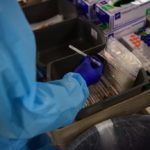
Lines for PCR tests — the lab-performed diagnostic considered the gold standard in picking up even small traces of COVID-19 in samples — have stretched for multiple hours and around blocks in Arlington, even for people who previously booked appointments.
Jamie Lockhart, a South Arlington resident, waited an hour and forty minutes for a PCR test last week at the Pentagon City Curative kiosk. (The county has a handful of Curative-run kiosks that perform the tests for appointment holders and walk-up patients alike.) She needed the results to safely attend a friend’s Christmas dinner, after she and her husband decided not to travel to see family this year.
“When I texted my husband about how long I’d been waiting, he said, ‘Don’t catch COVID waiting in the COVID line,’” Lockhart, 35, says.
Lockhart is heartened to see that people are getting tested in the first place, given the holiday surge and the presence of the omicron variant. And she hopes that public officials will seek to expand testing, particularly with an eye to serving frontline workers who may have difficulty accessing tests. She herself considered trying to find a rapid test at an Arlington public library branch, but ultimately decided she should leave those for people who can’t purchase one at a retail pharmacy or don’t have the time to spend standing in line.
“As the county and others are thinking about how to get more testing out there, making sure that it’s targeted towards those that may not have access through their employers or may not be able to take time off as easily to go to a doctor’s appointment,” she says.
Arlington’s public testing sites will test anyone, but in other local Northern Virginia jurisdictions like Fairfax, public COVID testing is still reserved for people with symptoms, not residents who simply want to know their COVID status before or after gathering with other people. On the Fairfax County COVID testing website, the first suggestion for people seeking a test is to call their primary care provider.
For Erin Coogan, 23, who lives in Fairfax County, that meant searching for an urgent care provider that could test her after her boyfriend tested positive — and ideally before the holidays, when she hoped to spend time with family. But the Fairfax urgent care clinic she chose was struggling to keep up with the demand. It took a full day — from just before 8 a.m. until after 3 p.m. — for Coogan to see a doctor to confirm that she needed a test, to get results from a rapid antigen test and for a staff member to perform a PCR test on her. Those results didn’t come back to confirm that she was COVID-negative for another several days, and she had to quarantine herself on Christmas.
And Coogan recognizes that not everyone would be as conscientious, or be as willing or able to miss work to get tested. Some of her friends gave up on getting tests.
“You [had] to go through so much pain and heartache to be able to get tested during the last week,” Coogan says. “You really had to be committed. So if you were anything but committed — you think of all the people that went to gatherings and how many people ended up testing positive and will test positive in the coming days.”
Even with the delays, wait times, and difficulty finding testing availability, a record number of people in Northern Virginia are being tested — in some cases, at higher rates than the rest of Virginia. Alexandria, home to 2% of the state’s population, represented 9% of the total number of tests conducted on Christmas Eve. Close to 9% of Alexandria’s entire population has been tested in the last 9 days, according to the city’s mayor. Fairfax County has broken its previous single-day testing record multiple times in December. On Christmas Eve the county tested 6,090 people.

The strain on the testing system is coming as Northern Virginia shatters its previous case records from earlier in the pandemic. But Virginia officials have offered few concrete strategies to contain the surge, beyond encouragement for people to get vaccinated and to take their own steps to social distance. (D.C., for instance, has reinstated indoor mask mandates and has put in place a vaccine requirement for public places starting in January.)
While D.C.’s distribution of free at-home rapid tests got off to a somewhat chaotic start, the city doesn’t seem to be encountering the same supply issues as neighboring jurisdictions – although before the holidays, lines at public walk-up PCR sites painted a picture reminiscent of Dec. 2020.
As cases surged last week and residents scrambled to get their hands on tests before holiday travel, Mayor Muriel Bowser announced a program to bring rapid at-home tests to eight different libraries in D.C., augmenting the already existing at-home PCR testing offered at the city’s public libraries. Launched on Wednesday, Dec. 23, the program allocates 1,000 rapid test kits a day to eight different libraries – one in each ward. Residents must show proof of D.C. residency, and are limited to two kits per person. (Residents are required to report the results of their at-home rapid tests to the city.)
During a press conference last week, Bowser said the city currently has 260,000 kits on hand, with an additional 6 million ordered. Locations offering the test kits may expand as supply increases, per the mayor’s office, but as of Monday, the city had kits available for pick-up at all eight libraries.