Ally Schweitzer
A Congress Heights apartment complex once owned by a notorious landlord is getting a new life after the conclusion of a years-long legal battle with tenants and the District government.
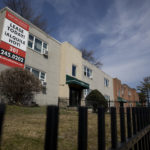
For more than a decade, a decaying 47-unit complex adjacent to the Congress Heights Metro station has embodied an untenable situation faced by many low-income residents in D.C. Tormented by vermin, mold, and crime in the apartments, tenants simultaneously faced losing their homes as the buildings’ owner worked quietly to sell and redevelop the rent-controlled property into a high-end town center development.
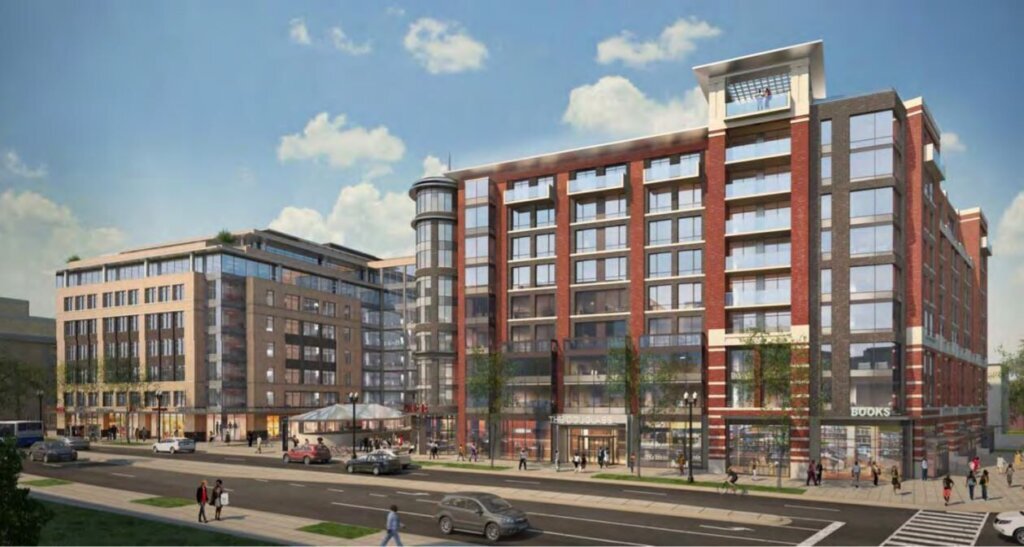
Now, the saga appears to have concluded with the settlement of a protracted lawsuit and a new development team on board that plans to transform the property into a mixed-use project with 179 affordable apartments, a third of them family-sized. The deal, announced officially this week, has the approval of tenants, who fought in court to exercise their rights under D.C.’s Tenant Opportunity to Purchase Act — and won.
Ruth Barnwell, president of the Congress Heights SE Tenants Association, says she looks forward to residents having access to affordable housing as the neighborhood faces mounting growth pressure. The apartments occupy highly desirable real estate near the rapidly developing St. Elizabeths campus.
“For decades in the future, our tenants — along with many other members of our community, including families and seniors — will be able to enjoy living in safe, healthy and affordable housing in Congress Heights,” Barnwell said in a statement.
D.C. Attorney General Karl Racine says the deal represents a positive outcome for the property owned previously by Sanford Capital, a Bethesda-based real estate investment firm that a judge booted out of the city temporarily in 2018 for failing to address a string of severe housing code violations.
“The resolution in this case is fair and just,” Racine said in an interview with WAMU/DCist. “This end result was successful for the tenants, and for individuals in our city who desperately need affordable housing.”
For Racine, the announcement marks the end of his first battle with a neglectful landlord — something that has become a hallmark of his since he became the District’s first elected attorney general in 2014. During his second year in office, OAG sued Sanford Capital over poor conditions and got the complex placed into receivership in 2017. A judge later ordered the company to begin negotiating the sale of the building exclusively with tenants. Instead, Sanford Capital transferred three of the buildings to developer CityPartners via a deed in lieu of foreclosure, violating the court order.

Racine calls the move a blatant attempt to circumvent TOPA law, which grants current tenants the right to make an offer on their building before it’s sold to someone else. But the plan backfired, he says. Instead of allowing CityPartners to take over the complex, OAG added the firm to its receivership case against Sanford Capital. Soon afterward, tenants at Congress Heights Apartments filed a TOPA lawsuit against both companies. After months of intense litigation, CityPartners washed its hands of the matter by agreeing in 2020 to sell the complex to a development team selected by the tenants.
Today, CityPartners founder Geoffrey Griffis offers faint praise for the newly finalized project.
“I’m disappointed that CityPartners isn’t moving ahead with our development and our vision, but I’m pleased that it’s staying somewhat intact,” the businessman said in an interview with WAMU/DCist. He denies that his firm intended to deprive Congress Heights residents of their TOPA rights, and says CityPartners’ acquisition of the buildings — despite defying a court order — was meant to take Sanford Capital out of the picture and put an end to the litigation.
“I naively thought Karl Racine would be happy,” says Griffis, a former zoning official whom Mayor Muriel Bowser appointed to the National Capital Planning Commission in 2015. “I never saw any reason that [he] should have continued any sort of litigation against me.”
Aubrey Carter Nowell, Sanford Capital’s principal, did not return a request for comment.
Will Merrifield, an attorney with the Washington Legal Clinic for the Homeless who first began working with Congress Heights tenants in 2013, agrees with Racine that the new affordable housing plan is a win for low-income residents. But he says the drawn-out battle — a “blood fight,” he calls it — signifies how tough it can be for renters to triumph over development plans they consider not in their best interest.
“Congress Heights shows why there is an affordable housing crisis,” Merrifield says. “It took a almost a decade for people just to be able to act on their TOPA rights. It’s illustrative of how this process works and why it’s broken.”
Merrifield ran unsuccessfully for an at-large Council seat in 2020, vowing to tilt the balance of power in the development process toward tenants, and promote more affordable housing citywide. The seat was ultimately won by Christina Henderson.
Plans for the new Congress Heights development call for 240,000 square feet of commercial space and 179 units of affordable housing. Three-quarters of its housing will be targeted to residents earning less than 50% of the area’s median income, or $64,500 for a four-person household. The apartments are slated to open in 2025.
Attorney General Racine, who is not seeking reelection when his term expires at the end of this year, says the situation in Congress Heights popped up on his radar early during his first campaign.
“As soon as we heard about Congress Heights, we went to work,” Racine says.
Today, the Congress Heights complex is vacant, with nine remaining households occupying temporary housing nearby. The buildings were nearly full when Sanford Capital began acquiring the properties roughly a decade ago, the attorney general says. But residents fled as conditions steadily declined. Racine maintains that forcing tenants out by neglecting upkeep — an illegal practice known as constructive eviction — was the company’s goal from the beginning.
“[It’s] the name of the game in the District of Columbia, at least in regards to certain slumlords and developers,” Racine says. “It’s about time that they finally get called out on it.”
But even as Racine celebrates the victory, he says some D.C. landlords will continue to wage similar campaigns against low-income tenants, gradually chipping away at what affordable housing remains in the city.
“Ask the question: What would have happened had advocates, great lawyers, and the Office of Attorney General not stepped in?” he says. “We know what would have happened, because the business model goes on.”