Jacob Fenston
At home, you may have changed your light bulbs from incandescent to highly efficient LEDs — it’s easy, and increasingly affordable. But for a city with more than 1,110 miles of roadways, and some 75,000 streetlights, changing the bulbs takes more than a trip to the local hardware store and a stepladder.
D.C. transportation officials announced, after a years-long process, that they’ve selected a contractor to conduct the city-wide lighting upgrade, at a cost of $309 million. The work is scheduled to begin this spring and be completed within two years.
Replacing the fixtures will cut streetlight energy use in half, according to the District Department of Transportation, preventing 38,000 tons of greenhouse gas emissions each year — equivalent to not driving about 87 million miles. The new lights will feature remote monitoring and control functionality: lights that are out can be identified in real time; poles will have tilt sensors, so the city can be alerted to any that are tipping over; and lights will be dimmable from afar.
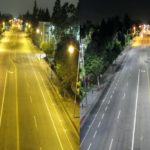
The new LED lights will also be more directional than the current high-pressure sodium lights, so more light can be cast where it is needed — on sidewalks and streets — and less light will shine into residents’ windows and into the night sky.
The project will also include installing 239 Wi-Fi access points, greatly expanding the District’s public wireless broadband network.
The District’s earlier attempts to convert to LED streetlights were stymied when residents complained of overly bright, harsh light. “What I noticed immediately was just how incredibly blinding and glaring they were,” says Delores Bushong, a Ward 5 resident whose street was converted to LEDs in 2016.
The problem with those early LEDs had to do with Kelvin (color temperature) and lumens (brightness). The new LEDs on Bushong’s street were 4,000 Kelvin — closer to daylight than the golden glow people are accustomed to from traditional light bulbs. And they emitted too many lumens, says Bushong — DDOT replaced old 100-watt high-pressure sodium bulbs with 110 watt LEDs, more than doubling the actual brightness (because efficient LEDs create more light with the same amount of energy).
“It was more like a soccer field,” says Bushong.
Since then, she joined a citizens’ advisory panel to help guide the District’s new streetlight replacement program. It met ten times over the past two years. Bushong says she’s pleased with the results: the LED lights in residential areas will be 2,700 Kelvin (equivalent to an incandescent bulb), and not substantially brighter than the old lights. Commercial areas will have brighter and slightly bluer lights, at 3,000 Kelvin.
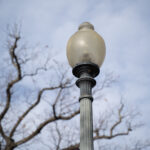
No changes will be made to streetlight placement, or the style of the poles and luminaries, many of which are of historic design, dating to the 1920s.
The project is being undertaken as a public-private partnership, or P3 — a first in the District. Under the arrangement, the selected contractor, Plenary Infrastructure DC, will finance the project and install the lights according to the District’s specifications, and maintain them for 15 years. Over that time period, the District will compensate the contractor based on meeting performance criteria, including timely completion of the project.
DDOT Director Everett Lott said in a statement that the arrangement “increases cost savings and performance accountability, both of which we know are incredibly important to every District resident.”
Under the contract, the contractor will have to adhere to a strict timeline for repairs, or incur a financial penalty. Lights that are out, but still have power, must be repaired in 72 hours; lights that are out but don’t have power must be repaired within 15 days.
Some public spaces in the District will not be included in the lighting conversion. These excluded areas include federal land, such as around the U.S Capitol and on National Park Service land, as well as some D.C. property, such as city parks.