Amanda Michelle Gomez
 Rachel Kurzius
Employees at three Union Kitchen stores in D.C. filed union petitions with the National Labor Relations Board Thursday, becoming the latest local chain to organize for better working conditions.
Union Kitchen started as a D.C.- based food accelerator, supporting food startups like Ice Cream Jubilee and Whisked bakery by offering business and technical assistance. The company has expanded to brick-and-mortar retail locations that sell packaged local products and made-to-order food and drinks at six stores in D.C. and Virginia.
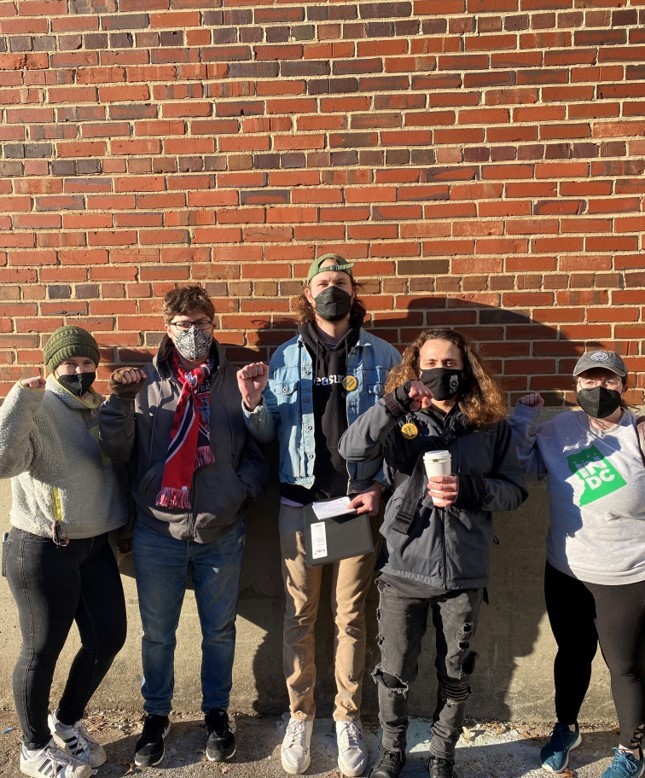
Four current and former store employees involved in the effort to unionize tell DCist/WAMU that they appreciate the company’s unique approach to food and believe in Union Kitchen’s mission of supporting local entrepreneurs. So instead of quitting when wage and personnel issues arose, three of them, along with 17 co-workers, decided to form a union to improve their working conditions.
“The idea for the company is so good and there’s a really great foundation and structure for it to be this really amazing company,” says Emily Davis, a Union Kitchen employee since August 2020. “There’s just a lot of flaws, and we feel like, by unionizing, we can help to make it something really great.”
Through collective bargaining, Union Kitchen employees want a say in wage policies, COVID-19 protocols, and scheduling. They also want to create a formal grievance process, motivated in part by what some workers say was a discrepancy in how tips were paid out. Some workers say although management attempted to resolve the issue, they don’t believe it’s been fully addressed. Union Kitchen leadership maintains they have followed all applicable laws.
Cullen Gilchrist, the CEO of Union Kitchen, confirmed that he received the union petitions on Thursday afternoon. Speaking with DCist/WAMU about a half hour later, he says he is still determining whether Union Kitchen will voluntarily recognize the union, or whether the NLRB will hold an election.
“We’re trying to build a great team and that’s what we’ve got to focus on,” says Gilchrist. “Ultimately, we just want to work on having an awesome culture that reflects all of Union Kitchen.”
However, worker Rob Ballock says that Gilchrist has visited his store, which is organizing, and spoke to employees in a way that casted doubt on whether unionizing was necessary. Worker Gabe Wittes confirms, saying Gilchrist is deploying “standard union-busting tactics” across the three organizing stores.
“I certainly continue to talk and listen to people,” says Gilchrist when asked about these claims.
The United Food and Commercial Workers Union Local 400 would be the collective bargaining agent for about 25 employees across all three stores. The regional labor union recently helped Politics and Prose employees organize, and represents thousands of workers employed at chain grocery stores across the region, like Safeway and Giant. Organized labor has flexed its muscles during the pandemic after years of a decline in membership, particularly in the private sector.
Fresh on the minds of some Union Kitchen workers is a forthcoming policy that would no longer give customers an option to tip on their payments. This is on the heels of them voicing concerns over the summer about whether Union Kitchen paid its employees all of the tips the stores received.
Gilchrist says that the plan to eradicate tips has been in the works since early 2020, but was postponed because of the pandemic.
At the moment, hourly workers earn a base pay, plus the promise of at least $3 per hour in tips. The starting salary is $15.20 plus the additional $3, meaning at least $18.20 per hour. Some workers say they often saw significantly more than $3 per hour in tips.
On January 17, Gilchrist sent employees an email that announced the company would remove the option for customers to tip, starting in mid-February.
Gilchrist tells DCist/WAMU that the decision to get rid of tips was “made based off of both our team and what they wanted, and what our community wanted. The vast majority of customers don’t tip, and many of those who did felt pressure to do so,” he says. “We’re trying to make our customers comfortable.”
The eradication of tips will be paired with an hourly wage increase, with Union Kitchen increasing its compensation across all jobs by an average of almost 20 percent, according to Gilchrist.
The average doesn’t tell the whole story, though. The pay increases are far more significant for workers on the higher end of the scale because “with more responsibility comes more pay,” the email says. A starting hourly wage at Union Kitchen would change to $18 with no potential for tips — that’s 20 cents less than the starting wage prior to the switch.
“It’s important to us that we pay our staff a great wage,” says Gilchrist. “Our minimum wage is $18 an hour. Our average in-store wage is going to be $27 an hour. On a national level and even on a local level, it’s very, very, very strong pay for what we do in our stores.”
Currently, D.C.’s minimum wage is $15.50 an hour, and Virginia’s is $11.
He added that Union Kitchen offers benefits far beyond the hospitality industry standard, including paid sick leave, and health care plans that cover vision and dental care.
The employees who spoke to DCist/WAMU say that they’re worried that the forthcoming raises aren’t enough to counteract the money they would lose through the eradication of tipping. Gilchrist contests this claim.
A nearly identical policy went into effect at homegrown chain Compass Coffee in March 2020. While it was messaged by management as a boon to workers, employees said that it ultimately led to a reduction in their take-home pay.
The role of tips in organizing the Union Kitchen union goes back further than this month’s announcement. Last summer, some employees who had been keeping records of tipping data believed they had found a discrepancy.
“Solely in credit card tips, we were missing between 40 and 150 dollars a week,” says Wittes, who worked at various stores since starting in December 2019.
They brought their concerns to management. According to multiple workers, Gilchrist told them he had hired a law firm to audit the finances and figure out what was happening.
For months, they waited to hear back. In October, two things occurred: The first was that Union Kitchen revised its official tip pooling policy in the employee handbook and Gilchrist said in an email that the policy would be retroactively applied to any tips collected on or after the start of 2020.
Then, many employees got what management called a “bonus.”
“My bonus barely covers just the nine weeks that I was at the K Street store, let alone the year plus that I’ve been employed at Union Kitchen,” says Wittes. “The bonuses were not enough. And from the workers that we’ve talked to, we believe that to be true pretty universally.”
Gilchrist says that Union Kitchen follows “all applicable laws regarding employment, and certainly that extends to how tipping works.”
Workers no longer have access to the system that had previously let them see how much customers had tipped daily. Gilchrist says that this is a matter of limiting confidential information, like financial data, to a small group.
Workers started discussing the possibility of unionizing during the summer, when investigating the tip discrepancy along with other issues.
“Unionization offers us protection as we investigate this,” says Wittes. “If Cullen were to retaliate against one of us for asking questions about our pay, we would have Local 400’s lawyers.”
Employees say they’ve been told to bring up any concerns about their workplace with Union Kitchen’s “people team,” later renamed “Support At Union Kitchen,” but it’s unclear to them who staffs this new department. Gilchrist says that the process for raising concerns is laid out in the employee handbook, and that the company has an “open door policy” for workers to discuss any issues.
However, some workers say the current system of resolving grievances falls short, after several employees reported a store manager’s alleged racist and sexist acts. According to multiple employees, the manager long declined to hire female employees despite a diverse pool of applications, and would racially profile Black shoppers. The manager also allegedly tried to call the police on Black children who frequented the store for free ice and occasionally stole candy bars.
“Our manager was telling us to call the police on Black children and communicated that we felt unsafe by their presence. It was just really horrible and I refused to do that,” says Wittes. “That was a big source of tension. There were a few weeks where I was, like, not sure if he was going to fire me.”
According to multiple workers, they were told that management would look into the situation. The store manager’s questionable conduct became an open secret for over a year, they say, and the company just recently let go of the manager.
Gilchrist says that Union Kitchen does not discuss former employees, adding that “we have a robust anti-discrimination policy and trainings at Union Kitchen. And no, we did not have that problem. And if we did have that problem, that would have been dealt with … We have zero tolerance for that sort of thing … I find it disturbing that someone would make that allegation.”
Union Kitchen employees filed separate union petitions, similar to Starbucks workers in Buffalo. That means each store — ones at Eckington, 9th, and 3rd streets — would have its own bargaining unit. Majorities in each store had signed union-authorization cards, according to UFCW Local 400.
Gilchrist says that the number of people who signed union-authorization cards represents a “pretty small percentage” of the overall company, which has between 75 and 90 employees, depending on the season. It’s not clear how many of those employees would be eligible for the union. “Speaking with those people will certainly be a goal.”
Ballock, who’s worked at Union Kitchen since August 2020, says he’s doubtful that Gilchrist will voluntarily recognize the union.
“Everyone at my store is frankly pretty fed up with his response,” says Ballock. “We are extremely excited about the fight to come because we know we are on the moral side.”
This story has been updated to reflect Virginia’s current minimum wage.